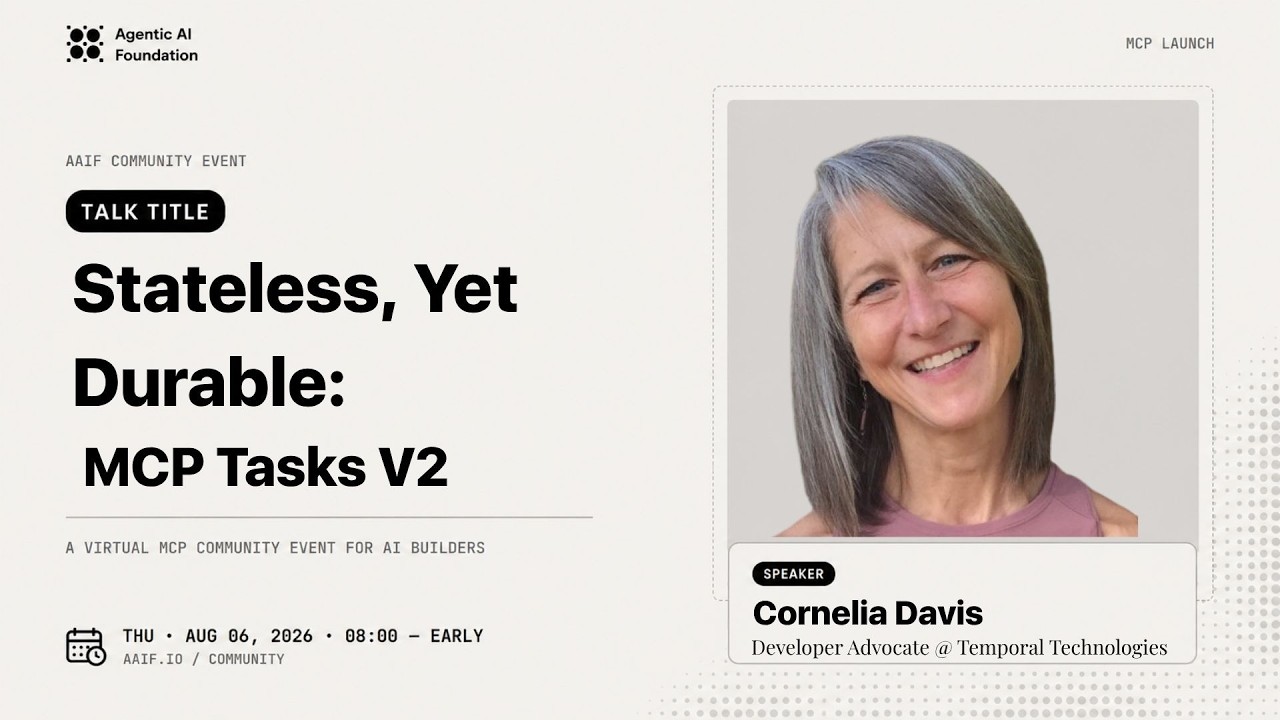
Stateless, Yet Durable: MCP Tasks v2
Summary
The session details MCP Tasks v2, an architectural evolution designed to enable durable, long-running workflows while maintaining a fundamentally stateless protocol design. Using Purchase Order processing as a concrete example, the talk contrasts the complexity and scalability issues of V1 (which relied on stateful server tracking and polling) with the simplified V2 approach. The key shift involves moving client responsibility for task ID persistence to durable storage and introducing a future notification mechanism to replace inefficient constant polling.
Key takeaways
-
MCP Tasks v2 Simplification
17:53
V2 eliminated the complex `task list` functionality (due to scalability concerns) and significantly changed how elicitation flows, simplifying the client-server protocol into basic polling and an explicit `update` API.
-
Durability vs. Statelessness
4:28
While the MCP protocol is stateless, the tasks themselves are designed as durable state machines (e.g., invoice processing), requiring robust mechanisms to track their lifecycle states (Working, Input Required, Terminal).
-
Scaling Beyond Polling
23:50
For massive scale (millions of tasks), constant polling is inefficient. The future direction involves implementing a notifications mechanism within the MCP Tasks protocol to allow idle tasks to consume zero resources until an event occurs.
Technical details
-
MCP Protocol Evolution
930s
V2 eliminated `task list` and changed `task result`, simplifying the client-server communication for long-running processes. The server is no longer responsible for holding all in-flight tasks; clients must persist task IDs to durable storage.
-
Workflow Implementation
1200s
The speaker demonstrated using Temporal (an open-source distributed system platform) to implement both the client and server sides of a Purchase Order processor, showcasing how state transitions (e.g., from 'Working' to 'Input Required') are managed via polling and task updates.
-
Task Lifecycle States
345s
A task progresses through defined states: Working (in process), Input Required (waiting for external input/approval), or Terminal (Completed, Failed, Canceled). The protocol must manage these transitions reliably.
Mentioned resources
- Agentic AI Foundation (AAIF)
- Temporal Open Source Project
Channel & topics
Watch on YouTube · Back to latest
This independent, AI-assisted summary is provided for commentary and informational purposes. It may contain errors or omit important context. Please watch the original video for the creator's complete presentation. Video, thumbnail, and related copyrights belong to their respective owners.