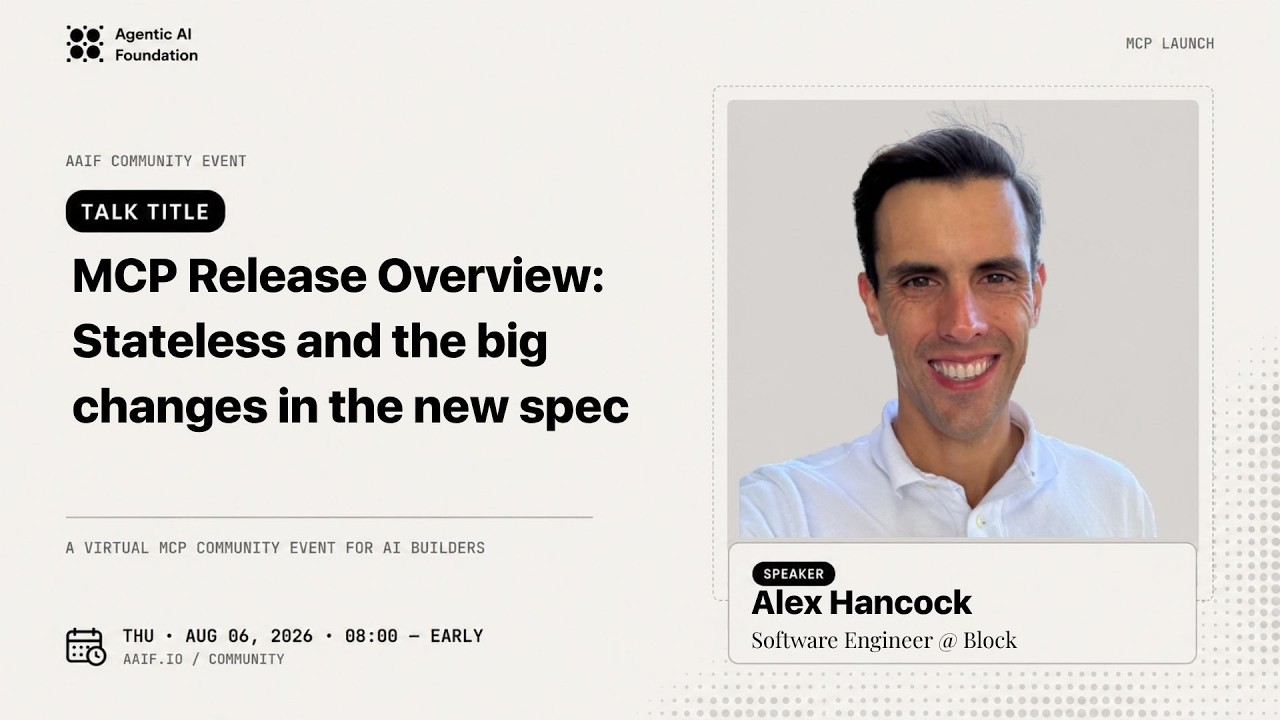
The Universal Remote Control for AI — Alex Hancock, Block
The talk addresses the lack of a standardized client-to-harness interface in the agentic AI stack. While the Model Context Protocol (MCP) provides a strong standard for agents performing actions (the agent going out), a standard for client software to issue tasks and receive updates is missing, leading to bespoke, non-interoperable systems. The speaker proposes the Agent Client Protocol (ACP), developed by the Zed and JetBrains teams, which standardizes communication using JSON RPC. ACP allows multiple, independent client applications (e.g., editors, terminal clients) to drive the same agent harness, significantly increasing interoperability and enabling the modular placement of the four core components: client, harness, tools, and model, especially when remote transports are implemented.
Key takeaways
-
The Need for Client Standardization
2:03
Currently, many agent harnesses expose custom or bespoke interfaces, often requiring a single, dedicated client application. This lack of a universal standard hinders interoperability, comparing it to needing a different browser for every website.
-
ACP as the Universal Remote Control
5:02
The Agent Client Protocol (ACP) was developed to allow a single, high-quality client implementation (like an editor) to control any harness, regardless of the underlying system. It is designed to be neutral and extensible.
-
Modular Agentic Stack Architecture
By implementing remote transports for ACP, MCP, and model endpoints, the entire agentic stack becomes modular. The client, harness, tools, and model can all be independently placed (e.g., client on a desktop, harness in a container, model in the cloud).