Topic

AI Updates Newsletter

All digests tagged AI Updates Newsletter

Understanding AI Agent Hallucination in AI Systems thumbnail

· 10:51

Understanding AI Agent Hallucination in AI Systems

AI hallucination occurs when an AI system confidently provides information that is factually incorrect. As systems evolve from basic LLMs to autonomous agents (which plan, reason, and take action), the risk landscape changes significantly. While advanced agents can increase error opportunities, grounding them with tools (like search or APIs) dramatically reduces hallucination by allowing verification. Mitigation requires implementing robust design choices: connecting agents to verified 'sources of truth,' enforcing tool-based reasoning, strictly controlling operational scope boundaries, and maintaining a human in the loop for critical decisions.

Key takeaways

  1. Hallucination Definition 0:13

    Hallucination is when an AI system confidently provides information that is totally incorrect (1:25). This risk increases as systems move from simple chatbots to autonomous agents.

  2. Agentic Risk Profile 0:02

    Agents do hallucinate less when grounded with tools (e.g., search tools, data connectors, RAG) because they can verify information instead of guessing (2:08). However, they introduce more danger because a wrong action (like updating a field or scheduling a meeting) can be taken with complete confidence (3:15).

  3. Mitigation Strategy: Grounding and Tools 0:07

    The fastest way to reduce hallucination is to connect the agent to reliable 'sources of truth' (e.g., SharePoint, CRM systems) and enforce tool-based reasoning rather than pure text prediction (7:30).

Watch on YouTube Full article

Why AI Makes the Humanities More Important Than Ever thumbnail

· 14:32

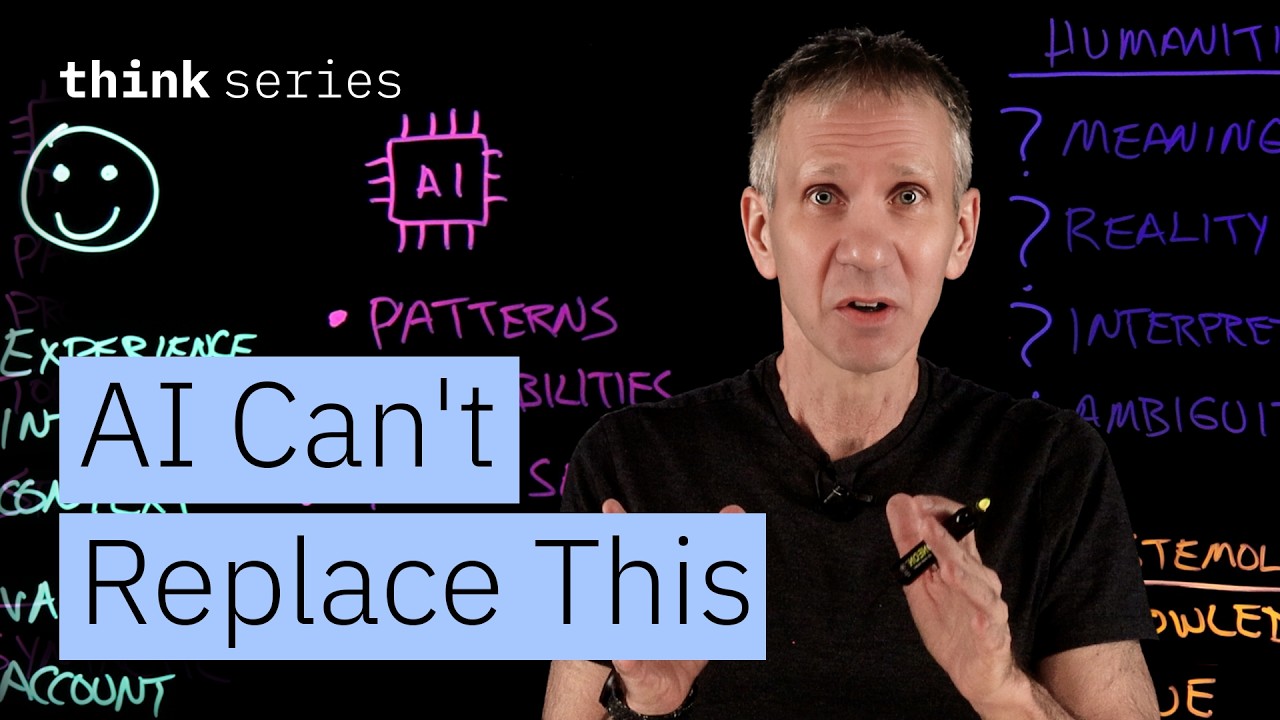
Why AI Makes the Humanities More Important Than Ever

While advanced AI systems excel at generating fluent language by predicting statistical patterns (syntactic), they lack inherent understanding of human intent, ethics, or context (semantic). The video argues that fundamental humanistic disciplines—such as philosophy, history, and rhetoric—are crucial for providing the necessary judgment, ethical grounding, and critical interpretation required to use AI responsibly. In an AI-driven world, technical fluency is insufficient; the most valuable skill becomes critical thinking and interpretive judgment.

Key takeaways

  1. AI operates on patterns, not understanding 7:40

    Large Language Models (LLMs) function by predicting token sequences based on statistical correlations, meaning they are fundamentally syntactic. They do not inherently possess lived experience or semantic understanding of truth or value.

  2. The user is the critical interpreter 11:55

    AI systems shift the need for interpretation rather than eliminating it. The human must act as the active participant who interprets the AI's output, making decisions and taking action based on that interpretation.

  3. Prompting is a form of system control 13:40

    The quality of an AI output is highly dependent on the prompt (input). Structuring prompts, defining constraints, and clearly expressing intent are practical applications of rhetoric and discourse analysis, making this skill an operational competence in AI systems.

Watch on YouTube Full article