Topic

RAG

All digests tagged RAG

Understanding AI Agent Hallucination in AI Systems thumbnail

· 10:51

Understanding AI Agent Hallucination in AI Systems

AI hallucination occurs when an AI system confidently provides information that is factually incorrect. As systems evolve from basic LLMs to autonomous agents (which plan, reason, and take action), the risk landscape changes significantly. While advanced agents can increase error opportunities, grounding them with tools (like search or APIs) dramatically reduces hallucination by allowing verification. Mitigation requires implementing robust design choices: connecting agents to verified 'sources of truth,' enforcing tool-based reasoning, strictly controlling operational scope boundaries, and maintaining a human in the loop for critical decisions.

Key takeaways

  1. Hallucination Definition 0:13

    Hallucination is when an AI system confidently provides information that is totally incorrect (1:25). This risk increases as systems move from simple chatbots to autonomous agents.

  2. Agentic Risk Profile 0:02

    Agents do hallucinate less when grounded with tools (e.g., search tools, data connectors, RAG) because they can verify information instead of guessing (2:08). However, they introduce more danger because a wrong action (like updating a field or scheduling a meeting) can be taken with complete confidence (3:15).

  3. Mitigation Strategy: Grounding and Tools 0:07

    The fastest way to reduce hallucination is to connect the agent to reliable 'sources of truth' (e.g., SharePoint, CRM systems) and enforce tool-based reasoning rather than pure text prediction (7:30).

Watch on YouTube Full article

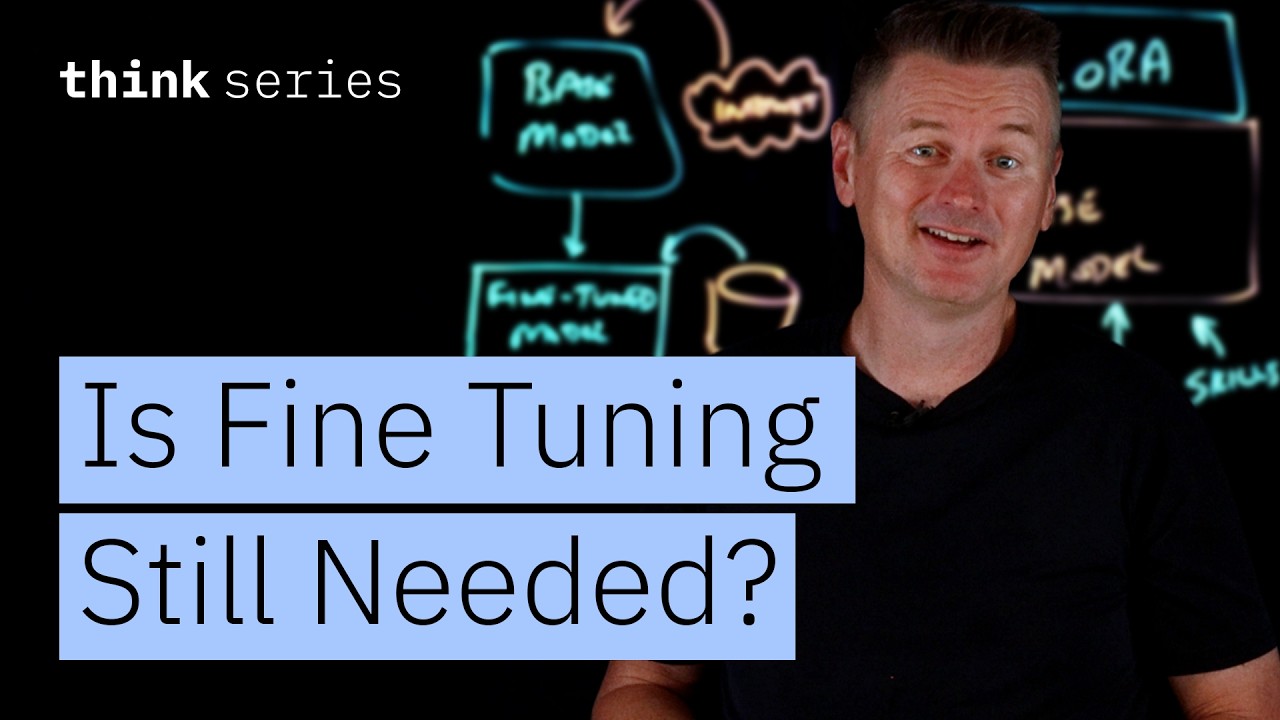
Is Fine-Tuning Still Needed? LLMs, RAG, & LoRA thumbnail

· 10:52

Is Fine-Tuning Still Needed? LLMs, RAG, & LoRA

While early successes demonstrated that fine-tuning custom LLMs could outperform general models (e.g., legal AI in 2023), the landscape has shifted significantly. Modern frontier models are rapidly closing the gap due to massive context windows and improved reasoning capabilities. The current architectural best practice suggests prioritizing non-weight modification techniques like Retrieval Augmented Generation (RAG), Context Engineering, and Agent Skills before resorting to fine-tuning. Fine-tuning remains valuable for specific bottlenecks, such as achieving low latency or when using parameter-efficient methods like LoRA.

Key takeaways

  1. Fine-Tuning vs. General Models

    Historically, custom fine-tuned models outperformed off-the-shelf leaders (e.g., legal AI over GPT-4 in 2023). However, general models are catching up due to massive context windows and improved inference reasoning.

  2. Modern Customization Stack 6:20

    The preferred order for customization is: Base Model $\rightarrow$ Prompt/Context Engineering $\rightarrow$ RAG (for proprietary knowledge) $\rightarrow$ Agent Skills (for procedural know-how). Fine-tuning should be the last resort.

  3. Cost and Complexity of Customization 7:45

    Fine-tuning is costly, involving not only training runs but also data collection, evaluation, regression avoidance, and continuous maintenance as frontier models advance.

Watch on YouTube Full article

How to Go From Data Scientist to AI Engineer (I Did This) thumbnail

· 30:13

How to Go From Data Scientist to AI Engineer (I Did This)

This roadmap guides individuals transitioning from Data Science or Machine Learning into AI Engineering. The core message is that the role shifts focus from statistical modeling in notebooks to becoming a full-stack software engineer capable of building reliable, production-grade AI systems. Key areas covered include closing the software engineering gap (OOP, structured Python projects), mastering LLM backends (FastAPI, Pydantic, Docker), and implementing advanced techniques like Retrieval Augmented Generation (RAG), evaluation (Evals), and guardrails.

Key takeaways

  1. The AI Engineer Shift 0:59

    AI Engineering requires moving beyond Jupyter notebooks to structured Python projects using OOP principles, Git, testing, debugging, logging, and environment management. The focus shifts from pure research to building reliable systems around pre-trained models.

  2. Data Science Advantage 2:00

    Individuals with a DS/ML background have an advantage because they are trained in statistical thinking (distributions, error analysis) which is critical for making non-deterministic LLM outputs reliable in production.

  3. The Importance of Production Backends 5:29

    To build deployable systems, learn to use FastAPI and Pydantic for API creation. Containerization using Docker and persistent data storage with PostgreSQL are essential steps.

  4. Advanced AI Techniques 7:30

    Mastering RAG (Retrieval Augmented Generation) requires understanding vector databases (e.g., using the PGvector extension in PostgreSQL). Furthermore, implementing Evals and Guardrails is crucial for quantifying performance and preventing issues like prompt injection.

Watch on YouTube Full article