Topic

Claude Code

All digests tagged Claude Code

Datadog Deleted All Its AI Context. It Worked. thumbnail

· 1:01:23

Datadog Deleted All Its AI Context. It Worked.

Datadog detailed its journey scaling AI coding agents across 4,000 engineers, highlighting that performance improvements were achieved by deleting years of accumulated context files (context rot). The discussion emphasizes the critical role of building dedicated evaluation (evals) platforms to make data-driven decisions about model selection and agent capabilities. Key findings include using evals to replay historical PRs for code review guardrails and adapting hiring practices away from traditional LeetCode interviews toward real-world, large codebase tasks.

Key takeaways

  1. Context Rot: Deleting Context Improved Performance 2:49

    The team found that deleting old, accumulated AI context files (written prior to models like Sonnet 3.5) led to better evaluation scores, demonstrating 'context rot'—where historical information becomes irrelevant or harmful to the agent's performance.

  2. Evals for Code Review and Regression Testing 5:49

    The first concrete application of evals was building a platform that replays historical PRs known to have caused incidents, allowing agents to act as a last guardrail before production deployment.

  3. Shift from Productivity to Ambition 59:02

    The core lesson learned is that the goal of AI adoption should not solely be increasing productivity, but rather 'increasing ambition'—enabling teams to attempt and validate more complex ideas.

  4. AI-Driven Interviewing 53:25

    The process of hiring is evolving away from low-signal LeetCode interviews toward real-world scenarios that require AI to navigate and understand large, complex codebases.

Watch on YouTube Full article

From Signal to PR: Anatomy of a Self-Improving Agent — Jason Lopatecki, Arize thumbnail

· 20:36

From Signal to PR: Anatomy of a Self-Improving Agent — Jason Lopatecki, Arize

The future of observability is shifting from human-driven dashboards to machine-readable telemetry that powers autonomous AI agents. Arize's Signal automates the debugging process by pulling deep production traces and logs (sometimes ten megabytes) directly into the repository as files. This allows coding harnesses, like Claude Code, to understand the exact code path taken during an error, enabling agents to propose fixes and creating a continuous loop where systems can autonomously improve themselves. The human role is evolving from responder to reviewer.

Key takeaways

  1. Observability Shift (2.0) 2:16

    Observability is moving beyond UI clicks and graphs; it's becoming a 'smoke'—telemetry data that agents can read to debug software, allowing for continuous automated fixing.

  2. The Key Unlock: Traces on Filesystem 6:08

    The critical breakthrough is pulling relevant production traces and logs down as files into the repo. Coding agents are highly effective with file formats, giving them the exact code path rather than guessing among millions of branches.

  3. Autonomous Fixing Loop 6:54

    The goal is to build systems that autonomously fix themselves. The process involves an agent investigating first, gathering deep evidence (traces/logs), and proposing a fix before human intervention.

  4. Security and Deployment

    To ensure compliance for large enterprises (e.g., Uber, Booking), agents must run within the customer's Virtual Private Cloud (VPC) using sandboxes, preventing production systems from connecting directly to external models.

Watch on YouTube Full article

Harness Engineering is not Enough: Why Software Factories Fail — Dex Horthy, HumanLayer thumbnail

· 19:18

Harness Engineering is not Enough: Why Software Factories Fail — Dex Horthy, HumanLayer

The video argues that current efforts in 'harness engineering' and increasing tokens are insufficient for building reliable AI software factories because they fail to address fundamental model training shortcomings. The core problem is maintaining codebase quality over time (maintainability), which current reward functions do not penalize. To move forward safely, the speaker advocates returning to rigorous human-led upfront planning: Product Review $\rightarrow$ System Architecture $\rightarrow$ Program Design (down to types and call graphs) $\rightarrow$ Vertical Slices.

Key takeaways

  1. The Failure of 'Lights Off' Factories 12:10

    Attempting to run a software factory with no human code review ('lights off') leads to failures, even for advanced agents. The issue is not scale or prompting, but a fundamental model training limitation.

  2. Model Training Flaw (The Maintainability Gap) 17:12

    Current coding models are primarily trained on passing tests and solving one-off problems. Their reward signal does not penalize poor program design or the erosion of codebase maintainability, meaning they get better at passing tests but worse at keeping large systems stable.

  3. The Path Forward: Structured Planning

    To move faster safely, engineers must re-emphasize upfront planning steps: Product Review (desired behavior/mockups), System Architecture (component contracts/data models), Program Design (types and call graphs), and Vertical Slices (implementation order).

Watch on YouTube Full article

Why We Killed Our Multi-Agent Pipeline — Subbiah Sethuraman and Abhilash Asokan, ZS Associates thumbnail

· 15:00

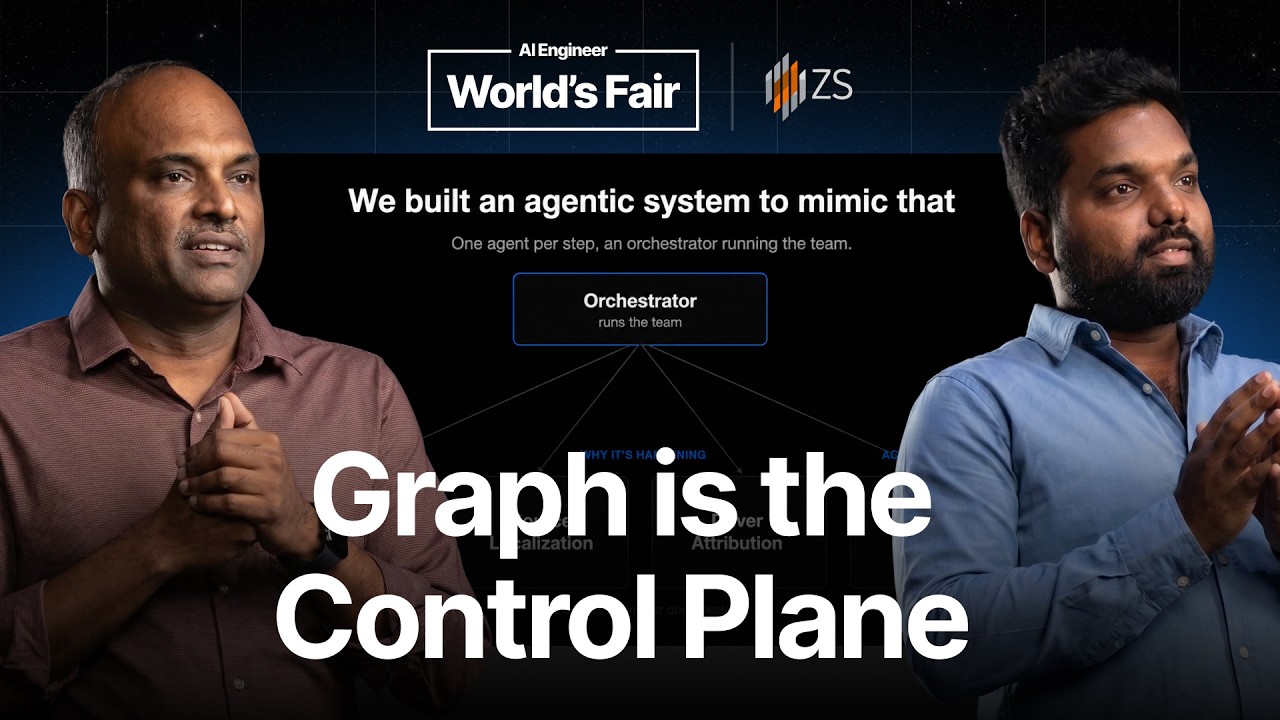
Why We Killed Our Multi-Agent Pipeline — Subbiah Sethuraman and Abhilash Asokan, ZS Associates

The video details the architectural overhaul of a multi-agent pipeline designed for complex pharma commercial analytics. The initial system failed because it attempted to mimic human analyst behavior by assigning separate agents to every step (signal detection, localization, attribution, synthesis), leading to context loss and incoherent reasoning. The rebuild focused on three key principles: 1) Separating deterministic signal detection into a pre-agent automated pipeline; 2) Consolidating core reasoning into a single agent that owns the end-to-end picture; and 3) Utilizing a Knowledge Graph (KG) not as a data lookup table, but as a 'control plane' to bound hypotheses and guide the investigation process. This resulted in a system capable of producing complex analyses in minutes, matching months of human effort.

Key takeaways

  1. Deterministic vs. Agentic Workflow 11:41

    Complex workflows must separate deterministic parts (like signal detection) into automated pipelines that run before the agent is activated. Agents should be reserved for investigation and reasoning, not initial data fetching or filtering.

  2. Single Point of Reasoning Ownership 13:25

    Instead of distributing judgment across multiple agents, consolidate the entire end-to-end reasoning process into a single main agent. This agent can use tools to spawn sub-agents only for focused lookups, ensuring coherence and maintaining ownership of the overall conclusion.

  3. Knowledge Graph as Control Plane

    A Knowledge Graph must be treated as a control plane—a mechanism that dictates what hypotheses an agent can test and what path it can take—rather than merely being a lookup table for data. This bounds the search space and ensures domain relevance.

Watch on YouTube Full article