Topic

GLM 5.2

All digests tagged GLM 5.2

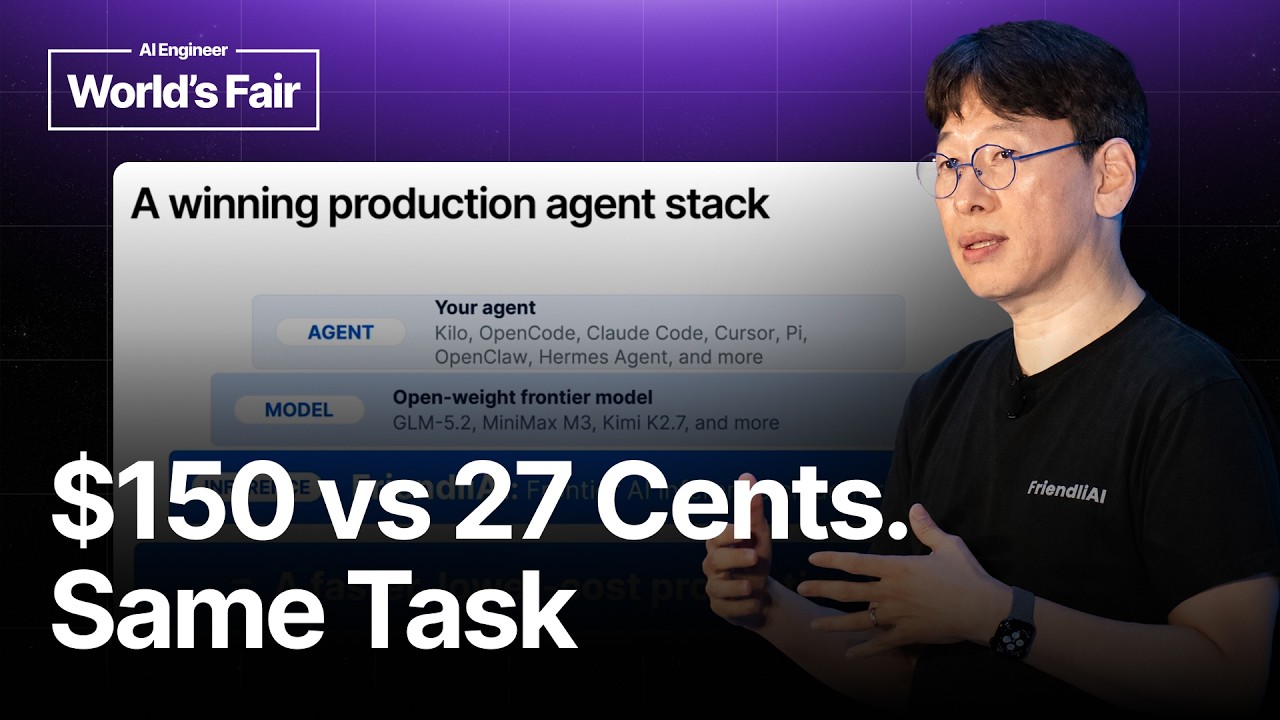
The Frontier AI Inference Cloud for Agents — Byung-Gon (Gon) Chun, FriendliAI thumbnail

· 14:59

The Frontier AI Inference Cloud for Agents — Byung-Gon (Gon) Chun, FriendliAI

The talk outlines the shift from traditional request-based LLM inference (chat) to complex, task-based agentic inference. Because agents run in long loops (plan, act, observe, repeat) and generate massive context prefixes, standard inference stacks fail. FriendliAI addresses this by presenting an 'inference cloud for agents' built on four pillars: Prefix Caching, hierarchical KV Cache Management, Cache Aware Routing, and Agent Aware Scheduling. This architecture enables open-weight models (like GLM 5.2) to achieve frontier quality at a fraction of the cost of closed models, making complex, multi-step agents economically viable for production.

Key takeaways

  1. The Unit of Work Shifts from Request to Task 5:18

    In chat, the unit is the request (optimizing for low latency). In agents, the unit is the task, which runs autonomously for minutes or hours. Optimization must therefore focus on end-to-end task latency, not single-call latency. (3:18)

  2. Open Weights Achieve Frontier Quality at Lower Cost 2:06

    Open-weight models are now capable of completing complex agentic tasks (e.g., building a tower defense game) at a usable level, rivaling closed models. For the same task, GLM 5.2 (open-weight) was approximately 5.6 times cheaper than Anthropic's Opus 4.8. (2:06)

  3. The Four Pillars of Agentic Inference Cloud 11:42

    To optimize for task latency, the stack relies on: 1) Prefix Caching (computing shared prefixes once); 2) Hierarchical KV Cache Management (across GPU, host, and disk); 3) Cache Aware Routing (sending requests to replicas holding the prefix); and 4) Agent Aware Scheduling (understanding the long-term program context). (7:02)

Watch on YouTube Full article

The Missing Layer: Design Taste in AI Agents — Hassan El Mghari, Together AI thumbnail

· 14:10

The Missing Layer: Design Taste in AI Agents — Hassan El Mghari, Together AI

The talk addresses the critical role of design and User Experience (UX) in making AI applications successful, arguing that polished aesthetics are a major competitive advantage. The speaker details methods to avoid generic 'AI slop' by codifying anti-patterns using tools like Hallmark, leveraging specific themes, and adopting structured development practices such as providing visual references, writing detailed prompts, and iterating with smaller open-source models.

Key takeaways

  1. Use Visual References (Inspiration Vault)

    Always provide AI models with a large collection of screenshots or inspiration images to guide the design output. This significantly improves the final product quality.

  2. Structure Prompts and Features

    Instead of sending one massive prompt for all features, break down development into smaller steps (one or two features per prompt) and use longer, more specific prompts (e.g., voice notes) to guide the agent.

  3. Iterate with Smaller Models 10:53

    Start base builds using larger models (like Codex/Claude Code), but use smaller, faster open-source models (such as GLM 5.2) for iterative refinement and polishing to achieve better results.

Watch on YouTube Full article

Datadog Deleted All Its AI Context. It Worked. thumbnail

· 1:01:23

Datadog Deleted All Its AI Context. It Worked.

Datadog detailed its journey scaling AI coding agents across 4,000 engineers, highlighting that performance improvements were achieved by deleting years of accumulated context files (context rot). The discussion emphasizes the critical role of building dedicated evaluation (evals) platforms to make data-driven decisions about model selection and agent capabilities. Key findings include using evals to replay historical PRs for code review guardrails and adapting hiring practices away from traditional LeetCode interviews toward real-world, large codebase tasks.

Key takeaways

  1. Context Rot: Deleting Context Improved Performance 2:49

    The team found that deleting old, accumulated AI context files (written prior to models like Sonnet 3.5) led to better evaluation scores, demonstrating 'context rot'—where historical information becomes irrelevant or harmful to the agent's performance.

  2. Evals for Code Review and Regression Testing 5:49

    The first concrete application of evals was building a platform that replays historical PRs known to have caused incidents, allowing agents to act as a last guardrail before production deployment.

  3. Shift from Productivity to Ambition 59:02

    The core lesson learned is that the goal of AI adoption should not solely be increasing productivity, but rather 'increasing ambition'—enabling teams to attempt and validate more complex ideas.

  4. AI-Driven Interviewing 53:25

    The process of hiring is evolving away from low-signal LeetCode interviews toward real-world scenarios that require AI to navigate and understand large, complex codebases.

Watch on YouTube Full article