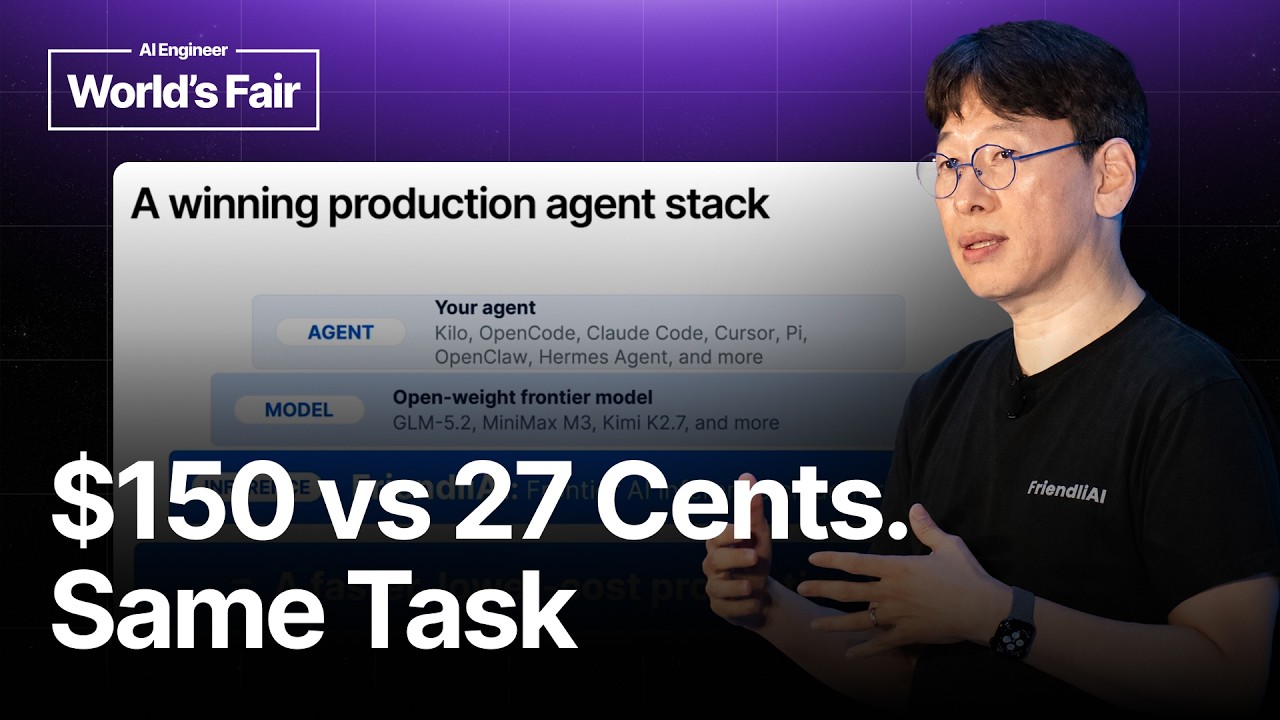
The Frontier AI Inference Cloud for Agents — Byung-Gon (Gon) Chun, FriendliAI
The talk outlines the shift from traditional request-based LLM inference (chat) to complex, task-based agentic inference. Because agents run in long loops (plan, act, observe, repeat) and generate massive context prefixes, standard inference stacks fail. FriendliAI addresses this by presenting an 'inference cloud for agents' built on four pillars: Prefix Caching, hierarchical KV Cache Management, Cache Aware Routing, and Agent Aware Scheduling. This architecture enables open-weight models (like GLM 5.2) to achieve frontier quality at a fraction of the cost of closed models, making complex, multi-step agents economically viable for production.
Key takeaways
-
The Unit of Work Shifts from Request to Task
5:18
In chat, the unit is the request (optimizing for low latency). In agents, the unit is the task, which runs autonomously for minutes or hours. Optimization must therefore focus on end-to-end task latency, not single-call latency. (3:18)
-
Open Weights Achieve Frontier Quality at Lower Cost
2:06
Open-weight models are now capable of completing complex agentic tasks (e.g., building a tower defense game) at a usable level, rivaling closed models. For the same task, GLM 5.2 (open-weight) was approximately 5.6 times cheaper than Anthropic's Opus 4.8. (2:06)
-
The Four Pillars of Agentic Inference Cloud
11:42
To optimize for task latency, the stack relies on: 1) Prefix Caching (computing shared prefixes once); 2) Hierarchical KV Cache Management (across GPU, host, and disk); 3) Cache Aware Routing (sending requests to replicas holding the prefix); and 4) Agent Aware Scheduling (understanding the long-term program context). (7:02)