Topic

Developer Experience

All digests tagged Developer Experience

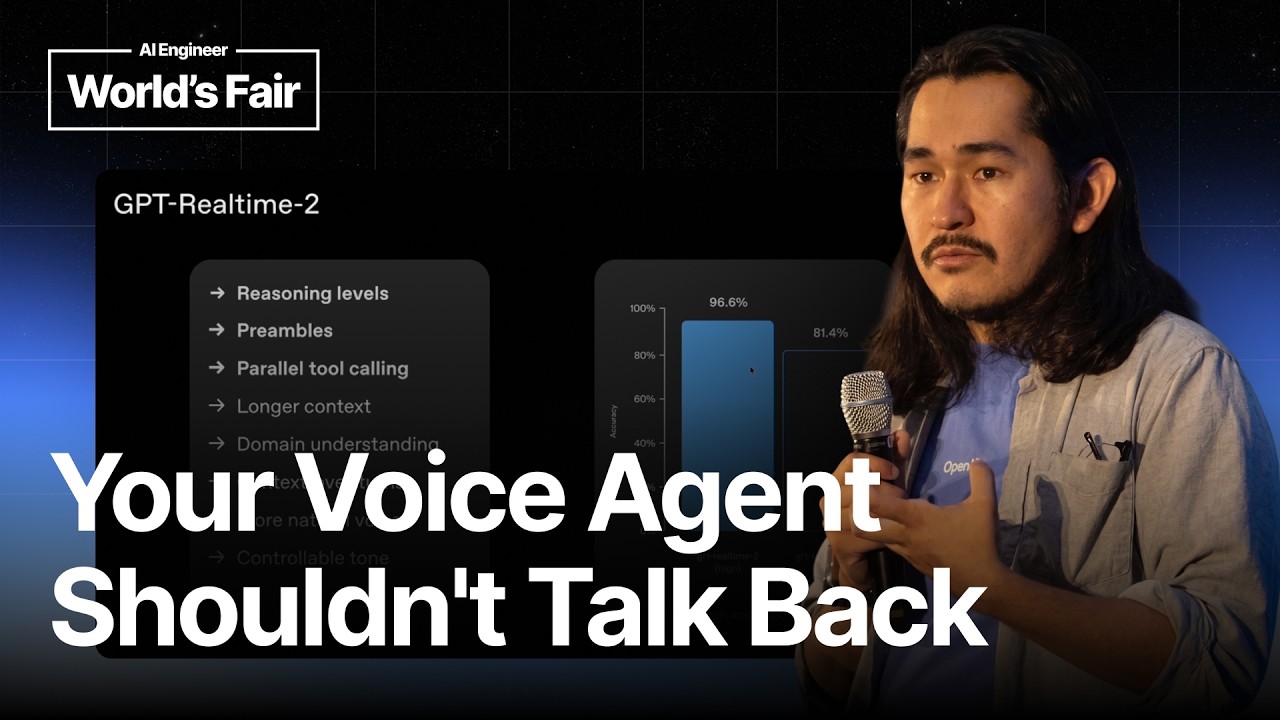
Voice Agents Can Just Do Things — Charlie Guo, OpenAI thumbnail

· 15:50

Voice Agents Can Just Do Things — Charlie Guo, OpenAI

The presentation challenges the common misconception that voice agents must respond using speech. Instead, the speaker argues that voice models can utilize three distinct, non-mutually exclusive modes: Speech-to-Speech, Speech-to-Action, and Event-to-Speech. For developers, the key takeaway is that building voice agents is simplified by recognizing that existing application verbs (API endpoints, React hooks) can be directly exposed as tools for the model to call. Furthermore, the talk details the technical shift toward native audio processing (audio in, audio out) and introduces advanced models like GPT-realtime 2, which adds reasoning and structured tool calling capabilities.

Key takeaways

  1. The Three Modes of Voice Interaction 0:12

    Voice interaction is categorized into three modes: Speech-to-Speech (e.g., coaching, translation), Speech-to-Action (user talks, model uses tools, e.g., form filling), and Event-to-Speech (model reacts to an event, e.g., proactive alerts).

  2. Developer Focus: Exposing Verbs as Tools 10:58

    Developers can integrate voice by treating existing application verbs (API endpoints, React hooks) as callable tools, allowing the model to drive the existing software rather than just generating text.

  3. The Shift to Native Audio Processing

    Modern voice models are moving away from the chained approach (transcribe speech -> LLM -> text -> audio) to native audio tokens, which preserves critical context like tone, cadence, and emotional impact.

  4. GPT-realtime 2 Capabilities

    The latest model in the real-time family offers reasoning capabilities, parallel tool calling, and 'preambles' to manage user expectations while actions are performed in the background.

Watch on YouTube Full article

From Tokenmaxxing to Trusted Throughput — Mingsheng Hong, Ironclad thumbnail

· 23:04

From Tokenmaxxing to Trusted Throughput — Mingsheng Hong, Ironclad

The talk argues that optimizing AI token usage should not focus solely on cost reduction (austerity). Instead, the goal is to maximize 'Trusted Throughput'—the value derived from code validated by internal engineering and external customers. The speaker emphasizes that as AI makes code generation abundant, the bottleneck shifts downstream to Code Review and Continuous Integration (CI/CD). Key strategies include defining advanced metrics (e.g., weighted merged PRs) and improving developer experience by eliminating flaky tests and measuring wait times.

Key takeaways

  1. AI Usage Dashboards as Smoke Detectors 1:34

    Usage dashboards should track token usage across teams/individuals but must not be positioned as leaderboards or incentives for maximization. Instead, they serve as 'smoke detectors' to identify pockets of low adoption or sudden usage anomalies (1:34).

  2. Focus on Trusted Throughput, Not Cost Reduction 13:11

    The metric for ROI should be 'Trusted Throughput'—high-quality output validated by internal engineering and external customers. Attempting to cut cost before measuring value is premature (8:33).

  3. Metrics Evolution Beyond Lines of Code (LOC) 22:25

    The process for measuring value has evolved from LOC, to open PRs, to merged PRs, and finally to weighted merged PRs that incorporate a complexity score. This moves the focus from volume to quality (11:20).

Watch on YouTube Full article

How to avoid disaster when vibe-coding a billing engine — Andrew Garvin, Stripe thumbnail

· 17:49

How to avoid disaster when vibe-coding a billing engine — Andrew Garvin, Stripe

Andrew Garvin discusses the complexities of building a billing engine, particularly when integrating advanced AI agents. He emphasizes that because billing involves deep business logic and real money, full autonomy is risky. The solution presented is using agentic tools (like Stripe Projects) to accelerate development into controlled test environments (sandboxes), rather than deploying directly to production. Key architectural components include portable 'skills files' for context and verbose error messaging for self-correction.

Key takeaways

  1. Agent Guardrails are Essential for Billing 11:53

    Billing carries deep business logic; therefore, the recommendation is to use coding agents only to accelerate development into a test environment (sandbox), not to ship directly to production. This minimizes risk when dealing with financial data.

  2. Skills Files Provide Contextual Guardrails 10:02

    To manage complexity, Metronome uses an extensible set of portable 'skills files' that provide necessary context and API knowledge to the agent, removing friction during setup and evolution.

  3. Shift from Seats to Credits (Usage-Based Pricing) 17:18

    The rise of agents operating entire systems necessitates a shift away from seat-based pricing models toward usage-based credit systems. This is crucial because the value may accrue to a single agent/user, not a fixed number of logins.

Watch on YouTube Full article

The Missing Layer: Design Taste in AI Agents — Hassan El Mghari, Together AI thumbnail

· 14:10

The Missing Layer: Design Taste in AI Agents — Hassan El Mghari, Together AI

The talk addresses the critical role of design and User Experience (UX) in making AI applications successful, arguing that polished aesthetics are a major competitive advantage. The speaker details methods to avoid generic 'AI slop' by codifying anti-patterns using tools like Hallmark, leveraging specific themes, and adopting structured development practices such as providing visual references, writing detailed prompts, and iterating with smaller open-source models.

Key takeaways

  1. Use Visual References (Inspiration Vault)

    Always provide AI models with a large collection of screenshots or inspiration images to guide the design output. This significantly improves the final product quality.

  2. Structure Prompts and Features

    Instead of sending one massive prompt for all features, break down development into smaller steps (one or two features per prompt) and use longer, more specific prompts (e.g., voice notes) to guide the agent.

  3. Iterate with Smaller Models 10:53

    Start base builds using larger models (like Codex/Claude Code), but use smaller, faster open-source models (such as GLM 5.2) for iterative refinement and polishing to achieve better results.

Watch on YouTube Full article