Topic

OpenAI

All digests tagged OpenAI

Gemini 4 Argon Is #1 On A Leaderboard. Here's Why You Still Can't Use It. thumbnail

· 15:57

Gemini 4 Argon Is #1 On A Leaderboard. Here's Why You Still Can't Use It.

The video argues that AI leaderboards and benchmarks are obsolete metrics for determining real-world usefulness. The new, critical benchmark is 'customer obsession'—the ability to build products that solve specific, deeply felt user pain points. The speaker posits that the bottleneck in AI development is no longer the underlying models (like Gemini 4 Argon or Fable 5.5), but the product experience itself. Successful AI products must integrate complex agentic workflows (using tools like Dots and Muse) into existing user workflows, moving beyond the limitations of the simple chatbot interface.

Key takeaways

  1. Benchmarks are Dead

    The model with the highest benchmark score does not guarantee real-world usefulness. The true measure of AI success is how deeply it is integrated into a customer's workflow and how well it solves specific, complex problems.

  2. Customer Obsession is the New Benchmark

    The most valuable AI is built by people who obsessively use it, notice where it fails, and make those failures matter. This discipline is as much a business practice as an engineering one.

  3. The Product Experience is the Bottleneck 3:20

    The speaker asserts that the models are no longer the bottleneck; the product experience and the ability to deliver useful, integrated solutions are the current limiting factors in AI adoption.

  4. Agentic Workflows are Key 5:52

    Advanced AI agents (like Dots and Muse) are useful for connecting disparate data sources (e.g., financial accounts, emails, bookmarks) to build comprehensive models or automate complex tasks like cancellations, which is superior to manual clicking.

Watch on YouTube Full article

Every AI Company Is Accidentally Building a Bank — Dor Sasson, Stigg thumbnail

· 20:08

Every AI Company Is Accidentally Building a Bank — Dor Sasson, Stigg

The talk argues that modern AI product scaling requires treating AI consumption not merely as a usage metric, but as a complex financial system. Current architectures often fail because they check entitlements and usage *after* the inference (post-invoice), leading to massive overspends and operational crises (e.g., Anthropic, OpenAI pricing changes). The solution involves implementing financial infrastructure that performs synchronous checks *before* consumption, similar to an ATM withdrawal, and settling asynchronously.

Key takeaways

  1. AI Pricing Emergencies are Infrastructure Failures 2:00

    Recent pricing scrambles (Anthropic, OpenAI, GitHub) are not just commercial issues; they expose fundamental architectural flaws where usage checks happen after the invoice, making scaling impossible.

  2. Synchronous Check, Asynchronous Settle 10:27

    The core architectural shift needed is to enforce entitlements and check balances synchronously at the request level (the 'hot path'), while reconciling and settling the costs asynchronously.

  3. Adopting Banking Principles 17:11

    Scaling AI requires implementing financial concepts like double-entry bookkeeping, concurrency control, hold-and-settle mechanisms, and managing multiple, distinct credit pools (e.g., debit, cash, savings).

  4. Visibility is Table Stakes

    Enterprise clients now demand fine-grained visibility into AI workload consumption across different models, teams, and agents, making this capability a non-negotiable requirement for doing business.

Watch on YouTube Full article

Voice Agents Can Just Do Things — Charlie Guo, OpenAI thumbnail

· 15:50

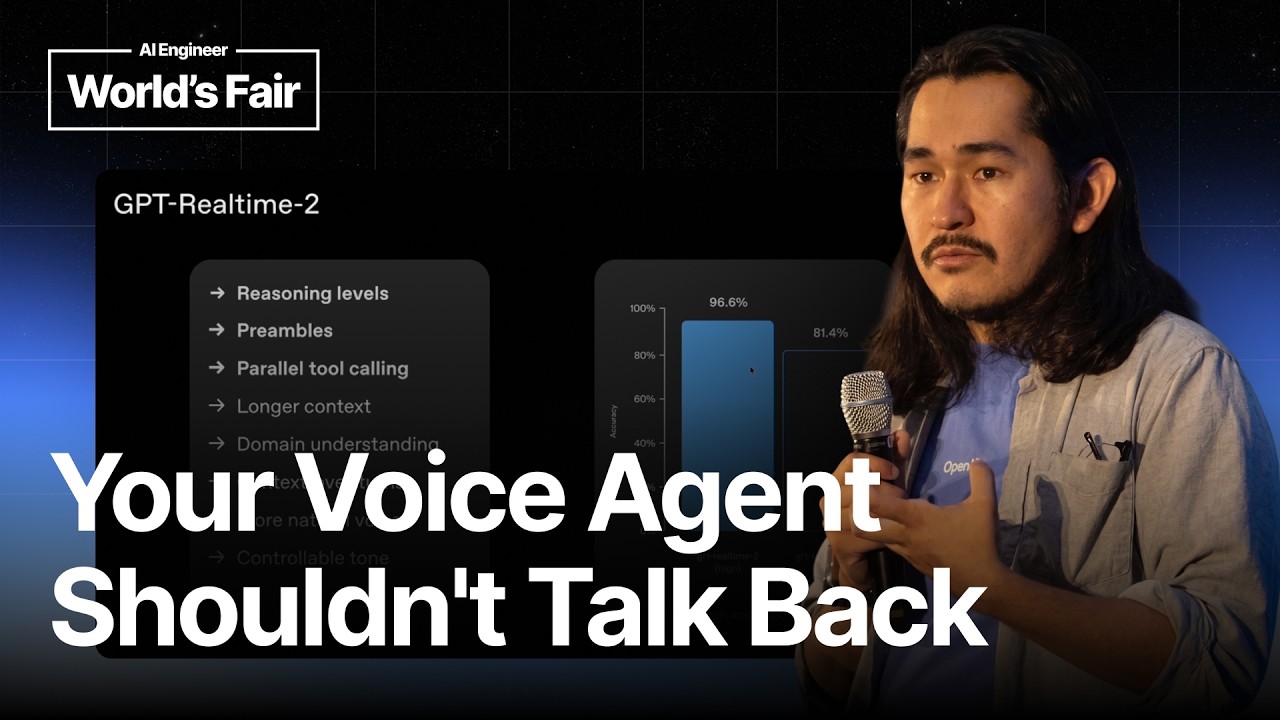
Voice Agents Can Just Do Things — Charlie Guo, OpenAI

The presentation challenges the common misconception that voice agents must respond using speech. Instead, the speaker argues that voice models can utilize three distinct, non-mutually exclusive modes: Speech-to-Speech, Speech-to-Action, and Event-to-Speech. For developers, the key takeaway is that building voice agents is simplified by recognizing that existing application verbs (API endpoints, React hooks) can be directly exposed as tools for the model to call. Furthermore, the talk details the technical shift toward native audio processing (audio in, audio out) and introduces advanced models like GPT-realtime 2, which adds reasoning and structured tool calling capabilities.

Key takeaways

  1. The Three Modes of Voice Interaction 0:12

    Voice interaction is categorized into three modes: Speech-to-Speech (e.g., coaching, translation), Speech-to-Action (user talks, model uses tools, e.g., form filling), and Event-to-Speech (model reacts to an event, e.g., proactive alerts).

  2. Developer Focus: Exposing Verbs as Tools 10:58

    Developers can integrate voice by treating existing application verbs (API endpoints, React hooks) as callable tools, allowing the model to drive the existing software rather than just generating text.

  3. The Shift to Native Audio Processing

    Modern voice models are moving away from the chained approach (transcribe speech -> LLM -> text -> audio) to native audio tokens, which preserves critical context like tone, cadence, and emotional impact.

  4. GPT-realtime 2 Capabilities

    The latest model in the real-time family offers reasoning capabilities, parallel tool calling, and 'preambles' to manage user expectations while actions are performed in the background.

Watch on YouTube Full article

AI ROI, Why the Agent Isn't the Answer thumbnail

· 1:32:03

AI ROI, Why the Agent Isn't the Answer

Achieving Return on Investment (ROI) with AI agents requires moving beyond simply implementing agents and instead focusing on the surrounding system architecture. Key constraints include the quality of the data context (what the agent can see) and the ability to measure performance (how to prove it's working). Speakers emphasized that the most valuable investments are in creating robust feedback loops, formal verification, and building federated, comprehensive data layers that preserve optionality and scope.

Key takeaways

  1. Focus on the Feedback Loop, Not Just the Agent 20:00

    The greatest ROI comes from investing in the feedback loop—the ability to automatically ingest failure modes and allow the system to improve itself. This is more critical than optimizing the agent itself.

  2. Measure Full System Cost, Not Just Token Cost 26:40

    To accurately measure ROI, the cost model must include all factors: retries, human attention, review cycles, and infrastructure, not just the token expenditure. Analyzing the full system cost allows for better optimization decisions.

  3. Data Context is the Primary Constraint 38:20

    Agents are limited by the data they receive. The solution is to build a federated, logical view of data that stitches together multiple sources (e.g., real-time Kafka data and long-term Iceberg data) to preserve optionality and scope.

  4. Formal Verification for Stability 21:40

    For mission-critical components, formal modeling (e.g., using TLA) is necessary to verify system behavior and prevent bugs, even when agents are constantly modifying the code base.

Watch on YouTube Full article

Anthropic, OpenAI & Thoughtworks on Context Engineering thumbnail

· 10:08

Anthropic, OpenAI & Thoughtworks on Context Engineering

The core challenge in deploying AI agents is shifting from model intelligence to context engineering. Speakers from Anthropic, OpenAI, Thoughtworks, and Tessl argue that the surrounding context—including organizational knowledge, structured guides, and robust feedback loops—is the primary multiplier for agent capability. Key technical concepts include defining new constraints (human time, attention, context window), building specialized harnesses using computational tools like codemods and static analysis, and establishing a Context Development Lifecycle (CDLC) that runs parallel to the traditional Software Development Lifecycle (SDLC).

Key takeaways

  1. Context Engineering Multiplies Intelligence 0:24

    Model intelligence alone is insufficient for durable, scalable products. Context engineering provides the necessary domain-specific knowledge required for agents to succeed within an organization.

  2. Remaining Software Constraints 5:02

    Most traditional software engineering constraints are obsolete. The three remaining foundational limits when using human-agent teams are: human time (the most scarce resource), human/model attention, and the context window size.

  3. Agent Harness Architecture 8:41

    A coding agent harness requires two components: 'guides' that proactively point the agent forward, and 'sensors' that provide immediate feedback for self-correction (e.g., static analysis, logs).

  4. The Context Development Lifecycle (CDLC)

    Humans must own the CDLC while agents handle the SDLC. This involves generating context, evaluating agent performance via runtime observability, and optimizing skills in a continuous loop.

Watch on YouTube Full article