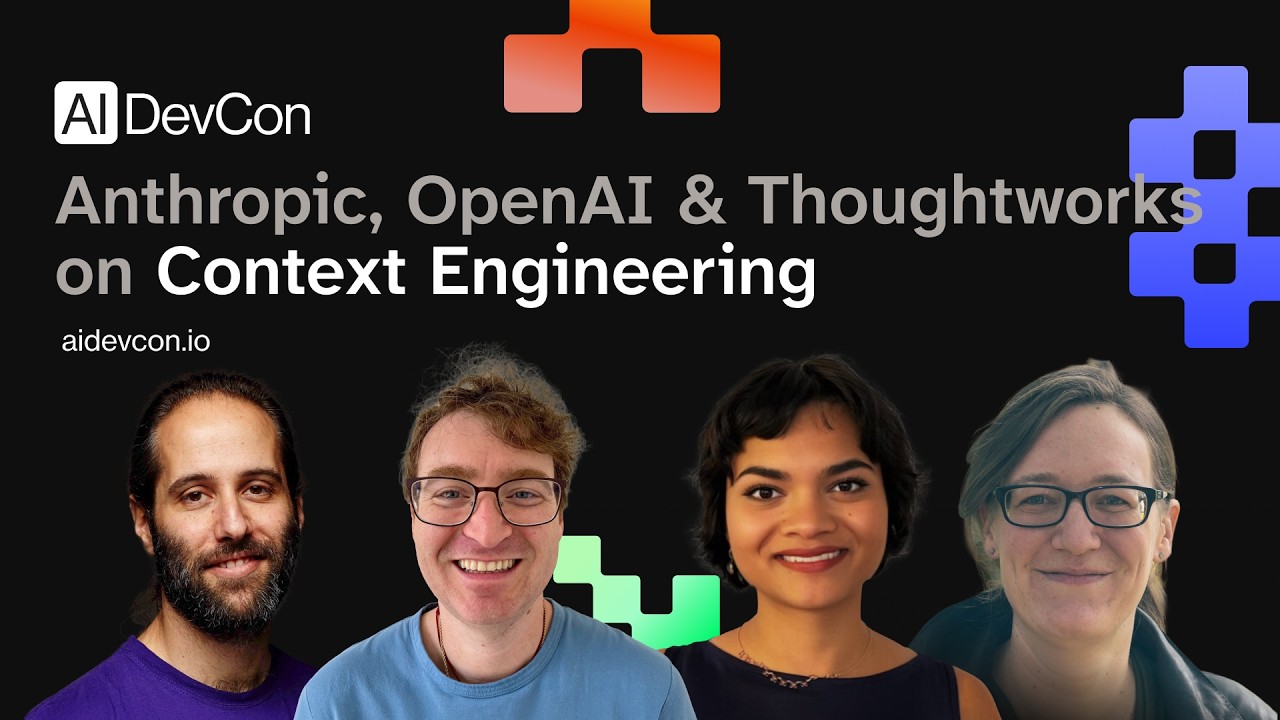
Anthropic, OpenAI & Thoughtworks on Context Engineering
Summary
The core challenge in deploying AI agents is shifting from model intelligence to context engineering. Speakers from Anthropic, OpenAI, Thoughtworks, and Tessl argue that the surrounding context—including organizational knowledge, structured guides, and robust feedback loops—is the primary multiplier for agent capability. Key technical concepts include defining new constraints (human time, attention, context window), building specialized harnesses using computational tools like codemods and static analysis, and establishing a Context Development Lifecycle (CDLC) that runs parallel to the traditional Software Development Lifecycle (SDLC).
Key takeaways
-
Context Engineering Multiplies Intelligence
0:24
Model intelligence alone is insufficient for durable, scalable products. Context engineering provides the necessary domain-specific knowledge required for agents to succeed within an organization.
-
Remaining Software Constraints
5:02
Most traditional software engineering constraints are obsolete. The three remaining foundational limits when using human-agent teams are: human time (the most scarce resource), human/model attention, and the context window size.
-
Agent Harness Architecture
8:41
A coding agent harness requires two components: 'guides' that proactively point the agent forward, and 'sensors' that provide immediate feedback for self-correction (e.g., static analysis, logs).
-
The Context Development Lifecycle (CDLC)
Humans must own the CDLC while agents handle the SDLC. This involves generating context, evaluating agent performance via runtime observability, and optimizing skills in a continuous loop.
Technical details
-
Context Engineering
24s
Context engineering is identified as the main lever for translating raw model intelligence into durable, scalable products. It involves distilling useful primitives and managing memory to support continual learning paradigms like 'dreaming'.
-
LLM Constraints & Attention
302s
The foundational limits on agent performance include human time (a scarce resource), attention capacity (both human and model, as attention must sum to one), and the context window. Overcoming these requires retooling workflows for parallel task execution.
-
Agent Harness Components
Harnesses are built using computational guides (e.g., codemods like OpenRewrite, effective code search) and sensors (e.g., static analysis, log access). Codemods are highlighted as powerful tools for version upgrades and framework migrations.
-
Observability & Evaluation
Runtime observability is crucial for monitoring coding agents to extract real-world evaluation scenarios and identify gaps. This data can then be used to update and optimize agent skills, driving the CDLC.
Mentioned resources
- AI DevCon NYC 2026
- Anthropic
- OpenAI
- Thoughtworks
Channel & topics
Watch on YouTube · Back to latest
This independent, AI-assisted summary is provided for commentary and informational purposes. It may contain errors or omit important context. Please watch the original video for the creator's complete presentation. Video, thumbnail, and related copyrights belong to their respective owners.