Topic

Product Management

All digests tagged Product Management

Velocity Sickness: What Happens When Your Whole Team Gets 10x Faster — Matt Dailey, Ref. thumbnail

· 20:37

Velocity Sickness: What Happens When Your Whole Team Gets 10x Faster — Matt Dailey, Ref.

The video addresses 'velocity sickness'—the stress of sudden, unimpactful increases in AI-driven output that do not translate into meaningful product progress. The speaker argues that current engineering workflows are flawed because they treat all work as implementation (code) and fail to properly manage the critical decision layer. To solve this, engineers must separate the durable state/decisions from the ephemeral actions/implementations. This is achieved by shifting focus from using chat interfaces for planning to utilizing dedicated, shared document structures that capture system state.

Key takeaways

  1. Understanding Velocity Sickness 2:00

    Velocity sickness is defined as the stress caused by sudden output increases due to AI, resulting in high output without corresponding impact. This manifests as too many PRs to merge, working across too many directions simultaneously, or 'declaring agent bankruptcy' (doing work that isn't retained).

  2. The Critical Failure Point: Decision Ownership 5:45

    The most critical risk is allowing agents to make key decisions. If an engineer delegates decision-making, they lose ownership of the code and, by extension, the product.

  3. Shifting Focus from Code Velocity to Idea Velocity 10:30

    To combat velocity sickness, teams must shift focus from merely shipping code (code velocity) to prioritizing and exploring ideas (idea velocity). This means focusing on planning and understanding the system's contours before implementation.

  4. The Solution: Docs for Decisions, Not Chats 13:25

    The core fix is separating the decision layer from the implementation layer. While chats are isolated, ephemeral, and built for action, durable shared documents (docs) should be used to hold the state and key decisions, keeping agents effectively stateless.

Watch on YouTube Full article

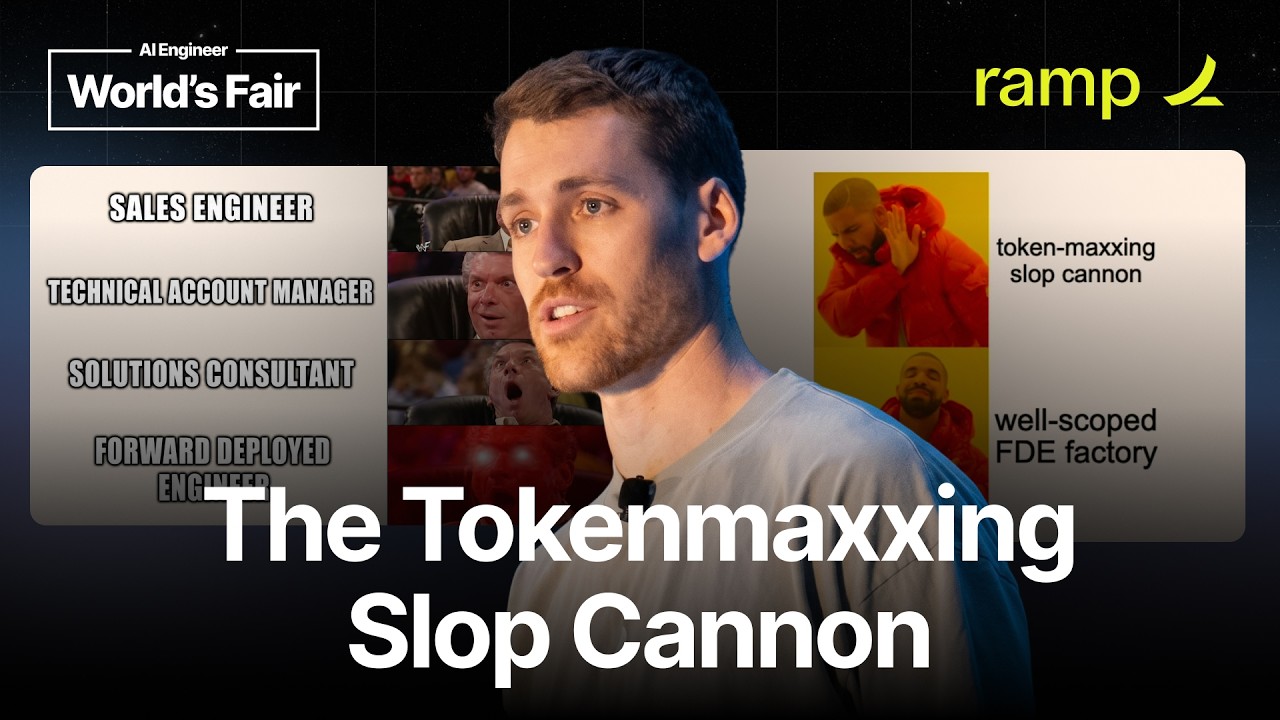
How Forward Deployed Engineering is done at Ramp — Leo Mehr thumbnail

· 14:05

How Forward Deployed Engineering is done at Ramp — Leo Mehr

The talk outlines two core principles for Forward Deployed Engineering (FDE): always scoping and scaling with tokens. FDE teams must resist the urge to simply say 'yes' to every request; instead, they must rigorously scope requirements by asking context-gathering questions to ensure the right product is built. To scale this function, the entire FDE pipeline—from initial intake to spec writing—must be automated using AI agents (scaling with tokens). This requires building robust agent harnesses and implementing validation loops using evals, rubrics, and human feedback.

Key takeaways

  1. Always Scope First 5:16

    FDEs must pause before accepting urgent requests (e.g., SAP S/4HANA integrations) to gather context and determine what is truly necessary for the customer's success, rather than simply fulfilling the immediate ask.

  2. Scale with Tokens 8:24

    The future of FDE requires automating every stage of the request lifecycle—from gathering context to writing a spec—by replacing manual work with AI agents and model capabilities.

  3. Hybrid Approach is Key

    Effective modern FDE needs both human judgment (for taste and final validation) and agent volume/automation to handle the sheer scale of incoming requests.

Watch on YouTube Full article

The Dirty Secret of Forward Deployed Engineering — Natalie Meurer, Sierra thumbnail

· 16:49

The Dirty Secret of Forward Deployed Engineering — Natalie Meurer, Sierra

Forward Deployed Engineering (FDE) is not a single discipline but an outcome-focused role that has evolved significantly from initial platform stability work (DevOps) to complex data integration and customer enablement. The core thesis is that as coding becomes cheap due to AI agents, the value of engineering shifts entirely to understanding the customer's problem, integrating disparate data sources, and being accountable for measurable business outcomes.

Key takeaways

  1. FDE is an outcome-based role, not a code-writing one. 0:12

    The durable part of FDE involves integrating data, understanding the customer context, and maintaining accountability to a specific result, rather than merely writing software code.

  2. FDE's evolution tracks platform maturity. 0:06

    Early FDE focused heavily on DevOps and ensuring platform stability (e.g., deploying on an EC2 instance). This evolved into data integration using concepts like the Ontology, leading to modern platforms like Foundry that focus on 'data to decision-making.'

  3. Pricing models reflect accountability. 0:13

    The shift from seat-based pricing (assuming a tool) toward usage or outcome-based pricing confirms that the value lies in guaranteeing results, which is the hallmark of FDE.

  4. AI agents are simply FDE reborn. 0:15

    Agent engineering is viewed as a subset and manifestation of FDE principles, where engineers use LLMs to enable outcomes for customers. The role requires combining product knowledge with customer-facing solutioning.

Watch on YouTube Full article