Why We Killed Our Multi-Agent Pipeline — Subbiah Sethuraman and Abhilash Asokan, ZS Associates
Summary
The video details the architectural overhaul of a multi-agent pipeline designed for complex pharma commercial analytics. The initial system failed because it attempted to mimic human analyst behavior by assigning separate agents to every step (signal detection, localization, attribution, synthesis), leading to context loss and incoherent reasoning. The rebuild focused on three key principles: 1) Separating deterministic signal detection into a pre-agent automated pipeline; 2) Consolidating core reasoning into a single agent that owns the end-to-end picture; and 3) Utilizing a Knowledge Graph (KG) not as a data lookup table, but as a 'control plane' to bound hypotheses and guide the investigation process. This resulted in a system capable of producing complex analyses in minutes, matching months of human effort.
Key takeaways
-
Deterministic vs. Agentic Workflow
11:41
Complex workflows must separate deterministic parts (like signal detection) into automated pipelines that run before the agent is activated. Agents should be reserved for investigation and reasoning, not initial data fetching or filtering.
-
Single Point of Reasoning Ownership
13:25
Instead of distributing judgment across multiple agents, consolidate the entire end-to-end reasoning process into a single main agent. This agent can use tools to spawn sub-agents only for focused lookups, ensuring coherence and maintaining ownership of the overall conclusion.
-
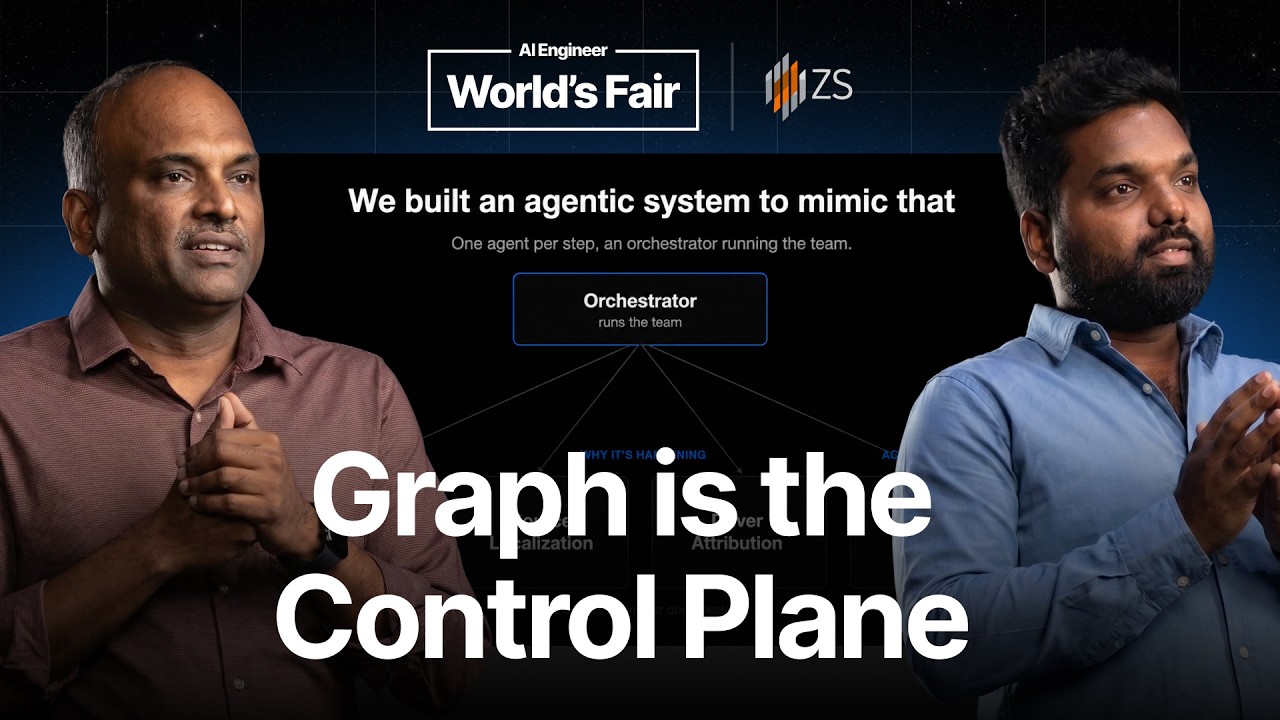
Knowledge Graph as Control Plane
A Knowledge Graph must be treated as a control plane—a mechanism that dictates what hypotheses an agent can test and what path it can take—rather than merely being a lookup table for data. This bounds the search space and ensures domain relevance.
Technical details
-
Pharma Commercial Analytics Pipeline
0s
The process involves four steps: Signal Detection (identifying anomalies like prescription drops), Root Cause Analysis (determining *why* the signal occurred, e.g., payer coverage changes), Action Recommendation (suggesting remedies, e.g., increasing sales reps), and Outlook/Synthesis (predicting performance improvement).
-
Multi-Agent Failure Modes
326s
Initial multi-agent systems failed due to context handoff loss between agents, resulting in incoherent outputs where the identified cause did not logically support the recommended action or outlook.
-
Deterministic Signal Detection
701s
Signal detection must be handled by a pure deterministic workflow (using statistical methods and guardrails) that runs before the agent is activated, ensuring signals are factual rather than merely inferred by an LLM.
-
Knowledge Graph Implementation
The KG maps domain entities (e.g., geographic areas, payers, brands, KPIs) and their relationships. It guides the agent's investigation by making every edge a testable hypothesis, thereby bounding the search space for root cause analysis.
Mentioned resources
- Claude Code
Channel & topics
Watch on YouTube · Back to latest
This independent, AI-assisted summary is provided for commentary and informational purposes. It may contain errors or omit important context. Please watch the original video for the creator's complete presentation. Video, thumbnail, and related copyrights belong to their respective owners.