Topic

Build Tools

All digests tagged Build Tools

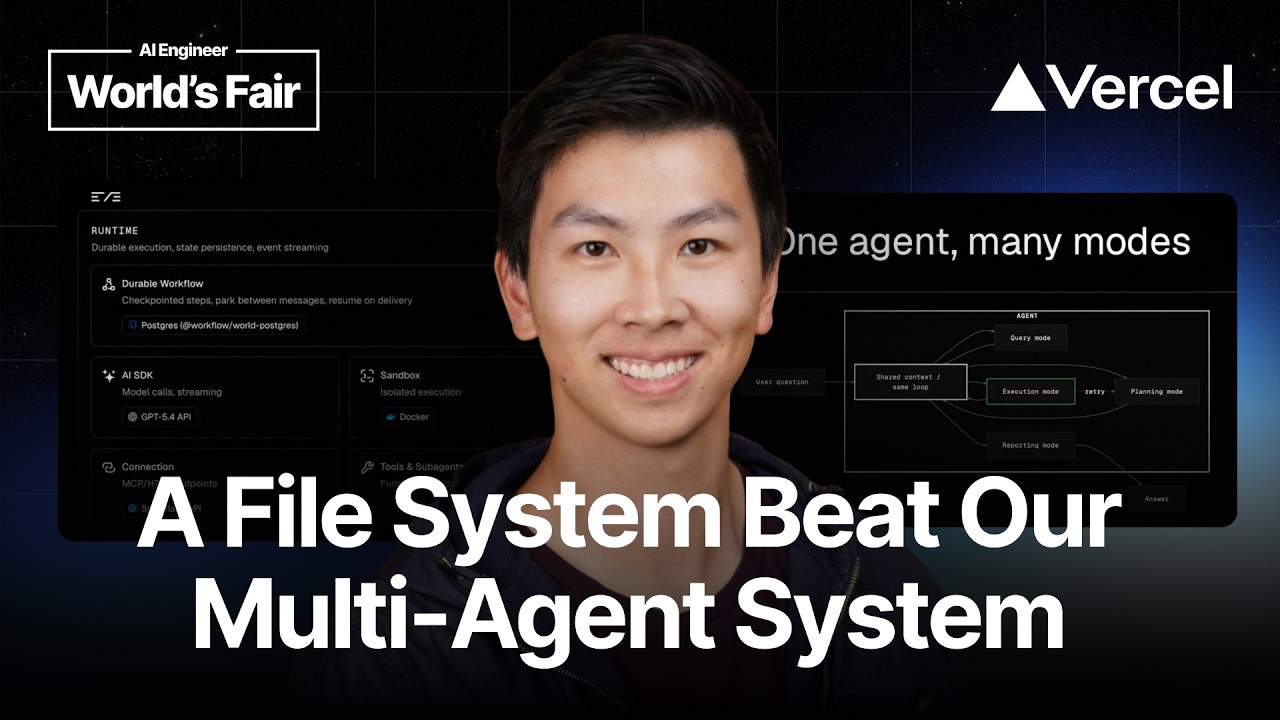
How We Solved Agent Building — Andrew Qu, Vercel thumbnail

· 17:34

How We Solved Agent Building — Andrew Qu, Vercel

Andrew Qu details Vercel's journey in solving agent building, evolving from initial manual data querying to complex, multi-step agent architectures. The major breakthrough was realizing that the core capability was not a clever toolset, but the simple file system (list, read, bash). This insight led to the development of Eve, a framework designed to bring file system conventions (like Next.js) to agents, enabling developers to build highly customized, production-ready agents with minimal effort.

Key takeaways

  1. The File System Unlock 11:57

    The most significant breakthrough was realizing that powerful agents could be built using a minimal set of tools—specifically, file system operations (list, read, run bash)—which models are already well-trained on. This approach allowed agents to explore and write where needed, leading to a massive increase in performance (the eval score basically doubled).

  2. Focus on Company-Specific Knowledge 17:00

    While off-the-shelf agents are useful, the speaker argues that the most effective agents are those stuffed with deep, company-specific knowledge. These custom agents provide the most 'juice' and save significant time across various departments (e.g., legal, finance, data science).

  3. The Need for a Framework (Eve) 15:40

    To simplify agent development, Vercel built Eve, described as the 'Next.js for agents.' It adopts file system conventions, allowing developers to easily declare skills, tools, and channels, making the process of building and iterating on agents highly manageable.

Watch on YouTube Full article

We let an AI agent execute Bash and lived to talk about it — Sarah Sanders, PostHog thumbnail

· 21:00

We let an AI agent execute Bash and lived to talk about it — Sarah Sanders, PostHog

The talk details the architecture and security challenges of building agentic CLI tools, exemplified by PostHog's 'Wizard.' The speaker emphasizes that an agent with command execution capabilities is essentially a 'malware starter pack.' Security must be layered, deterministic, and must account for dangerous inputs originating not only from users but also from the system's own supply chain (the 'Context Mill'). The solution involves implementing a dedicated, deterministic scanner (Warlock) and ensuring that the LLM layer acts only as an 'adviser,' never an enforcer.

Key takeaways

  1. The Danger of Agentic Tools 0:03

    An agent that can run commands is structurally similar to malware, requiring extreme caution. The threat model must account for how 'attacks compose' from multiple, seemingly innocent vulnerabilities.

  2. Context Supply Chain Risk 0:11

    The most dangerous input can come from the system's own supply chain (the Context Mill), such as a seemingly harmless prompt injection payload signed by the development team.

  3. Security Must Be Deterministic 0:15

    For enforcement, security mechanisms must be deterministic and mechanical. The LLM layer should only be an 'adviser' to reduce noise, never the primary enforcer, to prevent failure modes.

Watch on YouTube Full article

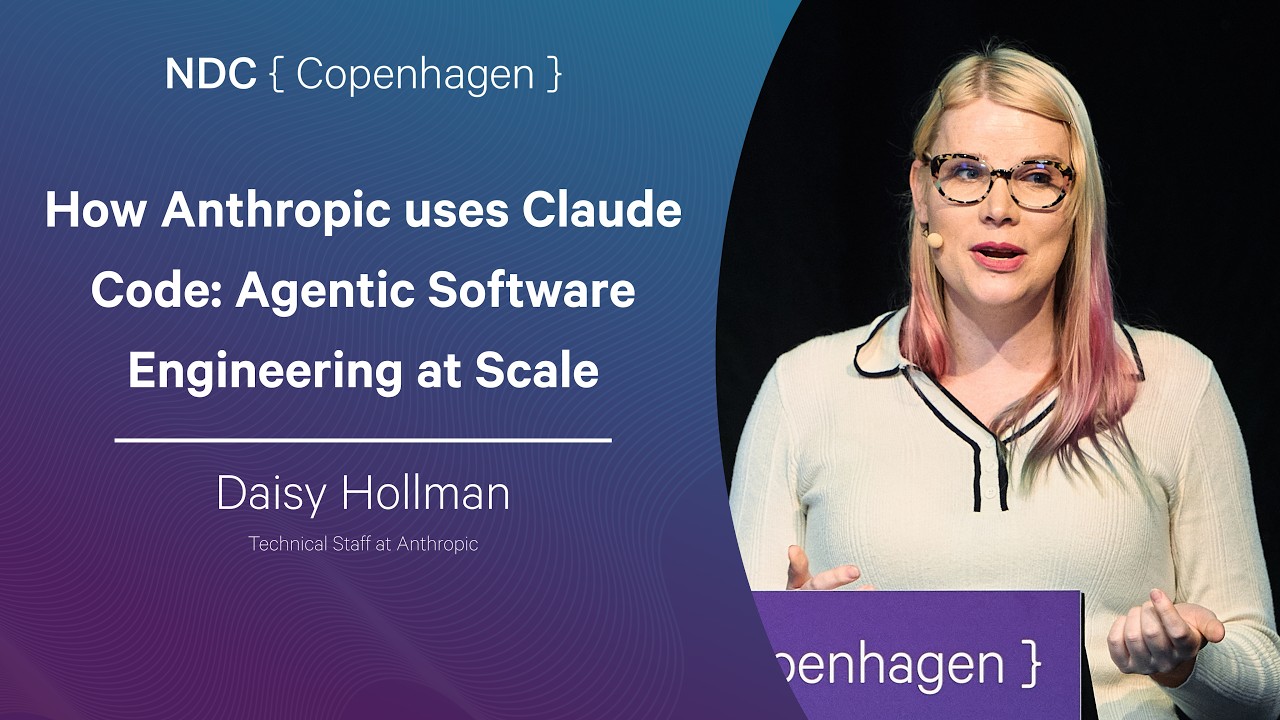
How Anthropic uses Claude Code: Agentic Software Engineering at Scale - Daisy Hollman thumbnail

· 1:00:25

How Anthropic uses Claude Code: Agentic Software Engineering at Scale - Daisy Hollman

This talk details the engineering challenges and advanced primitives required for achieving agentic software engineering at scale, particularly within large monorepos. The core thesis is that scaling agents requires sophisticated context management—moving beyond simply increasing model size to implementing abstractions like Skills, Sub-agents, and Hooks. Key focus areas include managing limited context windows (currently around 1 million tokens) by ensuring tools and knowledge are only injected when relevant, thereby enabling complex, long-horizon tasks across massive codebases.

Key takeaways

  1. Context Engineering is the New Discipline 21:45

    As agents become better at writing software, teaching them how to do it—managing context—is becoming the primary discipline of software engineering. This involves carefully selecting and injecting relevant information into the model's limited context window (the 'box').

  2. Scaling Requires Abstraction Primitives 26:45

    To handle massive codebases, simple tool definitions are insufficient. Advanced primitives like Skills (lazy system prompts), Sub-agents (out-of-context processing), and Hooks (event-driven execution) are necessary to ensure that only relevant information is consumed by the model.

  3. The Importance of Feedback Loops 17:15

    The fastest way to improve an agent's performance on a codebase is not necessarily a smarter model, but implementing tighter feedback loops (e.g., type checking, linting) that provide immediate, granular error detection during the tool-use process.

  4. Scaling Workflows Beyond Single Sessions 46:45

    For enterprise use, scaling requires managing multiple concurrent agent sessions. Techniques like using dedicated worktrees and visual cues (e.g., color coding) are essential to manage cognitive load and maintain persistent agent identities across different tasks.

Watch on YouTube Full article

Android Studio Quail 2, the Build with Gemini XPRIZE, and more! - Google Developer News July 2026 thumbnail

· 5:24

Android Studio Quail 2, the Build with Gemini XPRIZE, and more! - Google Developer News July 2026

This Google Developer News update details major advancements in Android development tools, including the stable release of Android Studio Quail 2. Key features include parallel agentic task management and enhanced memory leak detection via Leak Canary. Furthermore, the session covers updates to Android Bench for LLM evaluation using the Harbor framework, an inside look at YouTube's AI prototyping stack (Emergent), and details the Build with Gemini XPRIZE competition offering a $2 million prize pool.

Key takeaways

  1. Android Studio Quail 2 Stable Release

    The stable release introduces parallel chats for managing multiple agentic tasks simultaneously, upgrading Leak Canary integration into the profiler for faster heap analysis (up to five times faster), and integrating App Quality Insights with production reports (Firebase/Crashlytics) to automatically suggest or fix crash-causing code.

  2. Android Bench Methodology Upgrade 0:01

    Updates are rolling out to Android Bench, standardizing on the Harbor framework for model evaluation. Cloud fable 5 currently leads the leaderboard with a score of 84.5, and users can now submit unique development tasks to shape the benchmark.

  3. YouTube AI Prototyping Stack (Emergent) 0:02

    The series reveals how YouTube builds flexible, safe prototyping environments that minimize technical debt and system layers for rapid idea testing across Google's product lines.

  4. Build with Gemini XPRIZE Competition 0:02

    A $2 million competition challenges developers to build a real business using AI by solving a real-world problem, utilizing the full Google stack from Gemini app validation to Google Cloud scaling. The deadline is August 17.

Watch on YouTube Full article