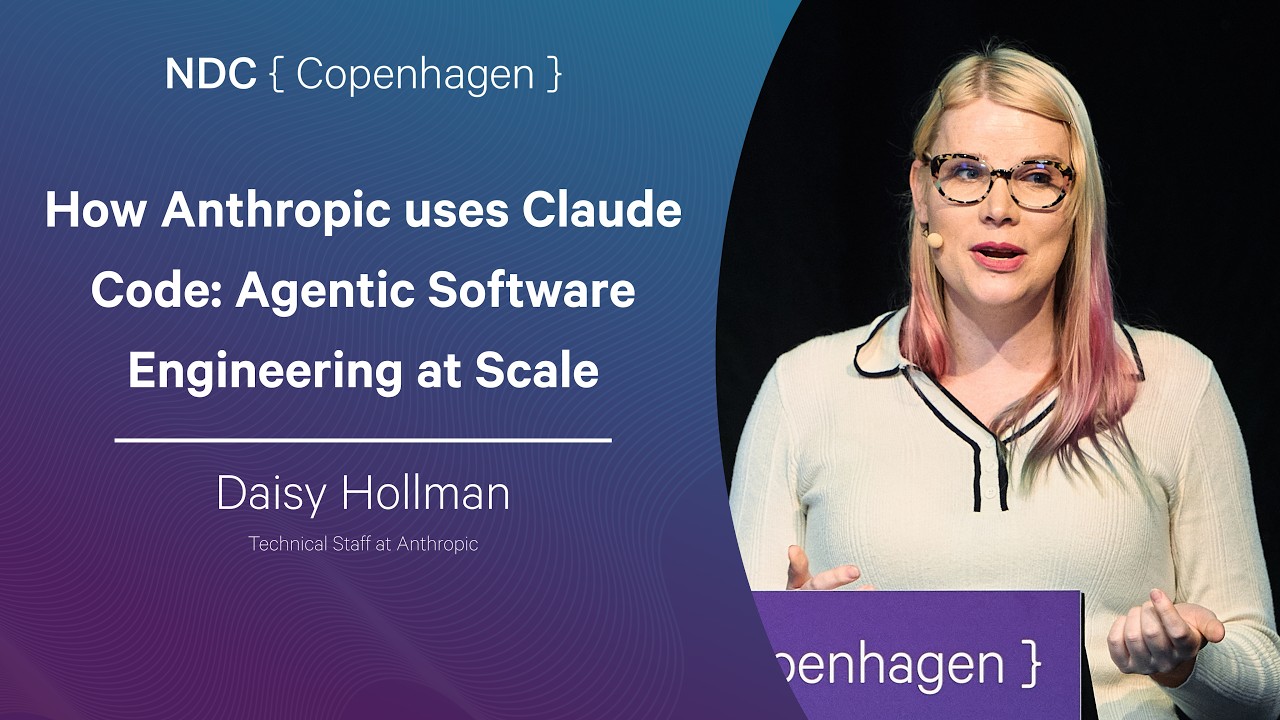
How Anthropic uses Claude Code: Agentic Software Engineering at Scale - Daisy Hollman
Summary
This talk details the engineering challenges and advanced primitives required for achieving agentic software engineering at scale, particularly within large monorepos. The core thesis is that scaling agents requires sophisticated context management—moving beyond simply increasing model size to implementing abstractions like Skills, Sub-agents, and Hooks. Key focus areas include managing limited context windows (currently around 1 million tokens) by ensuring tools and knowledge are only injected when relevant, thereby enabling complex, long-horizon tasks across massive codebases.
Key takeaways
-
Context Engineering is the New Discipline
21:45
As agents become better at writing software, teaching them how to do it—managing context—is becoming the primary discipline of software engineering. This involves carefully selecting and injecting relevant information into the model's limited context window (the 'box').
-
Scaling Requires Abstraction Primitives
26:45
To handle massive codebases, simple tool definitions are insufficient. Advanced primitives like Skills (lazy system prompts), Sub-agents (out-of-context processing), and Hooks (event-driven execution) are necessary to ensure that only relevant information is consumed by the model.
-
The Importance of Feedback Loops
17:15
The fastest way to improve an agent's performance on a codebase is not necessarily a smarter model, but implementing tighter feedback loops (e.g., type checking, linting) that provide immediate, granular error detection during the tool-use process.
-
Scaling Workflows Beyond Single Sessions
46:45
For enterprise use, scaling requires managing multiple concurrent agent sessions. Techniques like using dedicated worktrees and visual cues (e.g., color coding) are essential to manage cognitive load and maintain persistent agent identities across different tasks.
Technical details
-
Agent vs. Chatbot
420s
Agents evolve from simple chatbots by incorporating tool calling, allowing the model to execute external actions (e.g., shell commands, file edits) and make subsequent decisions based on the results, forming a loop of increasing autonomy.
-
The Edit Tool Primitive
605s
The core mechanism for code modification is the 'edit tool,' which requires specifying the old string, the file name, and the new string. This primitive is described as highly structured (e.g., requiring byte-for-byte matching) and foundational to agentic tooling.
-
Context Window Constraints
1350s
The context window size remains a major bottleneck; while model capabilities have exploded, the state-of-the-art models are still around 1 million tokens. This necessitates 'don't pay for what you don't use' principles when customizing context.
-
Plugin Abstractions (MCP/Skills/Hooks)
1700s
Plugins must scale beyond simple tool definitions. The Multiple Client Protocol (MCP) server adds schemas to the system prompt, but this fails at scale due to token bloat. Skills and Hooks are preferred because they operate lazily or outside the context window, only injecting text when triggered by an event.
-
KV Cache Constraint
2350s
The Key-Value (KV) cache mechanism for next token prediction is a critical constraint; predicting tokens based on previous inputs is computationally expensive. This complexity makes simple caching mechanisms insufficient, requiring advanced architectural solutions.
Mentioned resources
- Claude Code
- Anthropic
- MCP Server
- Skills
- Sub-agents
- Hooks
Channel & topics
Watch on YouTube · Back to latest
This independent, AI-assisted summary is provided for commentary and informational purposes. It may contain errors or omit important context. Please watch the original video for the creator's complete presentation. Video, thumbnail, and related copyrights belong to their respective owners.