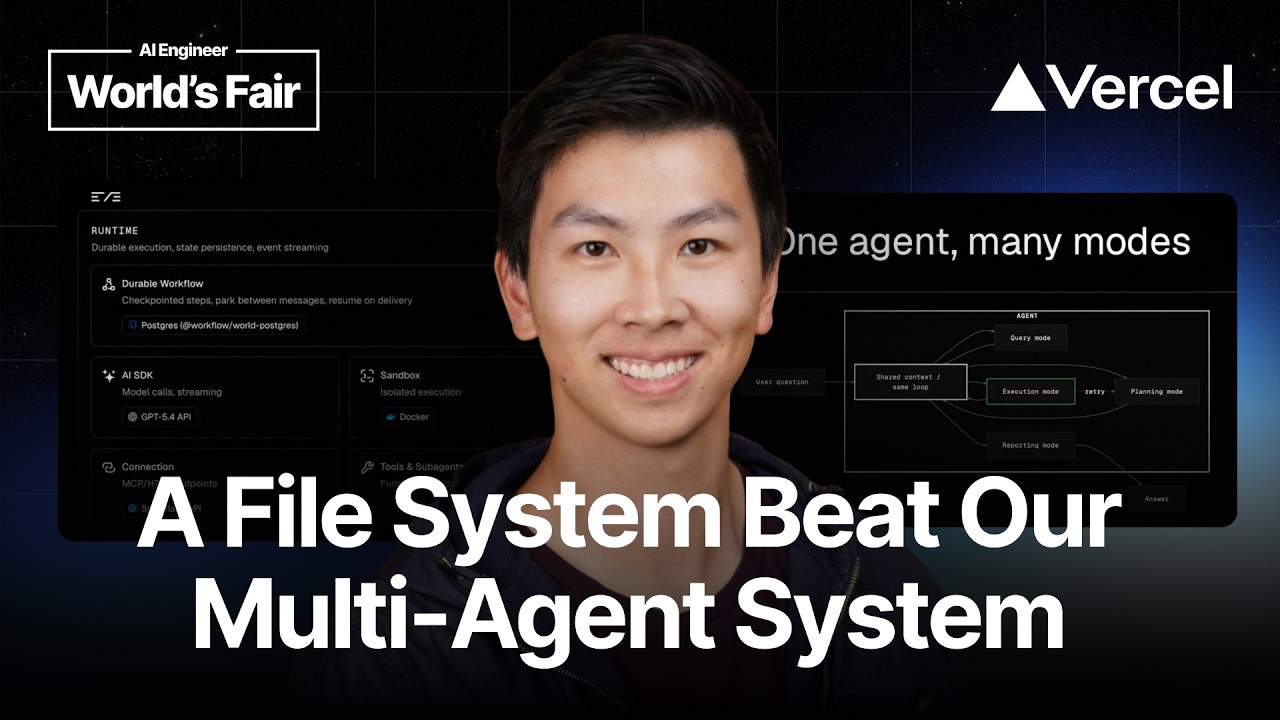
How We Solved Agent Building — Andrew Qu, Vercel
Andrew Qu details Vercel's journey in solving agent building, evolving from initial manual data querying to complex, multi-step agent architectures. The major breakthrough was realizing that the core capability was not a clever toolset, but the simple file system (list, read, bash). This insight led to the development of Eve, a framework designed to bring file system conventions (like Next.js) to agents, enabling developers to build highly customized, production-ready agents with minimal effort.
Key takeaways
-
The File System Unlock
11:57
The most significant breakthrough was realizing that powerful agents could be built using a minimal set of tools—specifically, file system operations (list, read, run bash)—which models are already well-trained on. This approach allowed agents to explore and write where needed, leading to a massive increase in performance (the eval score basically doubled).
-
Focus on Company-Specific Knowledge
17:00
While off-the-shelf agents are useful, the speaker argues that the most effective agents are those stuffed with deep, company-specific knowledge. These custom agents provide the most 'juice' and save significant time across various departments (e.g., legal, finance, data science).
-
The Need for a Framework (Eve)
15:40
To simplify agent development, Vercel built Eve, described as the 'Next.js for agents.' It adopts file system conventions, allowing developers to easily declare skills, tools, and channels, making the process of building and iterating on agents highly manageable.