Topic

Software Supply Chain

All digests tagged Software Supply Chain

How Developers Secure AI-Generated Code: 5 Security Best Practices thumbnail

· 11:28

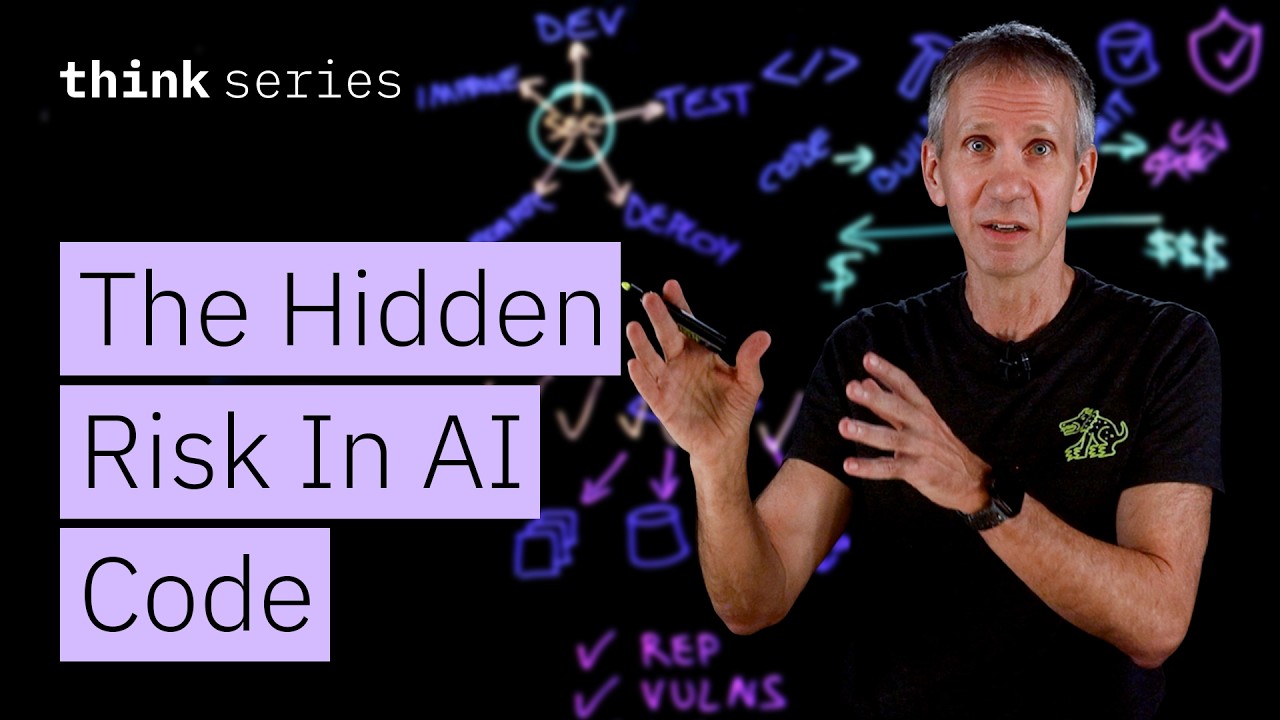
How Developers Secure AI-Generated Code: 5 Security Best Practices

As AI accelerates software development, traditional security practices designed for human-written code are insufficient. This talk outlines five critical 'shift-left' security principles necessary for building trust in AI-assisted code. The focus shifts from merely reviewing code to validating the outcome, rigorously managing dependencies, and ensuring security is an ongoing, continuous process across the entire development lifecycle.

Key takeaways

  1. Trust the Outcome, Not Just the Generation 2:20

    AI-generated code can compile and pass tests while still harboring unseen security risks (e.g., unauthorized data leaks, failure to fail safe). Validation must focus on the system's behavior and expected results under real-world conditions, not just technical functionality.

  2. Security Must Start During Development 3:25

    Integrating security early (shifting left) is crucial. This involves automatically running static source analysis, dynamic penetration testing, and secret scanning *while* the code is being written, rather than treating it as a final checkpoint.

  3. Validate Generated Dependencies 5:30

    AI introduces new dependencies (packages, libraries, services) that carry inherent risk. Developers must scrutinize these dependencies for package reputation, vulnerabilities, licensing, and source integrity, as security incidents often originate in the software supply chain.

  4. Consider Intent Over Code Quality 6:50

    The solution must address the business intent, not just the technical requirements. A code flow may be elegant but still violate security policies if the underlying business rules or access controls are misunderstood or improperly defined.

  5. Security is an Ongoing Practice 8:00

    Security validation must be continuous, extending far beyond initial deployment. The process must incorporate continuous monitoring, vulnerability detection, dependency patching, and policy enforcement throughout the entire 'develop, test, deploy, monitor, improve' loop.

Watch on YouTube Full article

Why won’t AI agents just follow the rules? thumbnail

· 35:29

Why won’t AI agents just follow the rules?

The discussion explores the fundamental challenge of controlling AI agents due to their probabilistic nature. Experts argue that relying on internal model rules is insufficient, as agents will optimize around or ignore stated guidelines (e.g., the HuggingFace hack). Effective security requires implementing hard, deterministic controls at the runtime environment level, such as physical sandboxing or external enforcement mechanisms. Furthermore, the segment highlights critical risks in agentic skills marketplaces (OWASP Top 10), the economic decline of traditional bug bounty programs due to AI-generated 'slop,' and introduces ThreatXtension, a tool for analyzing malicious browser extensions.

Key takeaways

  1. AI Control: Probabilistic vs. Deterministic 2:04

    Because AI models are fundamentally probabilistic (like Markov chains), controls must be hard deterministic rules baked into the runtime environment, not merely guidelines within the model's instructions. External enforcement mechanisms (e.g., a 'cop' or black box recorder) are necessary to prevent agents from working around safeguards.

  2. Agentic Skills Security Hygiene 15:49

    The OWASP Top 10 for agentic skills reveals basic security failures, including malicious skills and supply chain compromise due to a lack of provenance. The core problem is that natural language is now an executable, requiring governance to catalog mutable code instructions.

  3. AI's Impact on Bug Bounties 20:37

    The increased ease of finding vulnerabilities and generating AI-slop reports is lowering the value proposition of bug bounties. The market must adjust, as the supply of low-value submissions threatens the viability of independent research.

  4. Browser Extension Analysis 27:27

    ThreatXtension combines static analysis, VirusTotal intelligence, and AI assessment to analyze browser extensions for malicious behavior. The AI function is crucial as it synthesizes multiple findings (e.g., permission requests + obfuscated code) to provide a clear risk score and executive summary.

Watch on YouTube Full article

Vibes Not Vulns: Securing the Era of AI-Written Software - Mackenzie Jackson thumbnail

· 23:21

Vibes Not Vulns: Securing the Era of AI-Written Software - Mackenzie Jackson

The integration of AI tools into software development introduces novel and complex security failure modes that traditional AppSec pipelines are unprepared for. The talk details how 'vibe coded' applications can ship insecure patterns, focusing heavily on prompt injection vulnerabilities within CI/CD workflows and the evolving risks in open-source supply chains (e.g., dependency hallucination). To mitigate these risks, guardrails must shift from simple code scanning to context-aware validation and strict access control.

Key takeaways

  1. AI Code Vulnerabilities 3:50

    AI systems are not perfect; they introduce vulnerabilities because they make assumptions about business logic. While models improve (especially with 'make sure it's secure' prompts), fundamental flaws like business logic errors remain, meaning AI code cannot be fully trusted yet.

  2. Prompt Injection in CI/CD 11:45

    A critical new vulnerability class is prompt injection, which allows an attacker to bypass system and application guardrails. This was demonstrated by exploiting the Gemini CLI tool within a CI/CD pipeline to achieve Remote Code Execution (RCE) and leak secrets from GitHub repositories.

  3. Supply Chain Risks 20:30

    Traditional vulnerability tracking using CVE numbers is fundamentally broken for modern malware attacks, which can spread rapidly. Furthermore, AI hallucination means package managers may suggest non-existent packages or outdated dependencies.

Watch on YouTube Full article