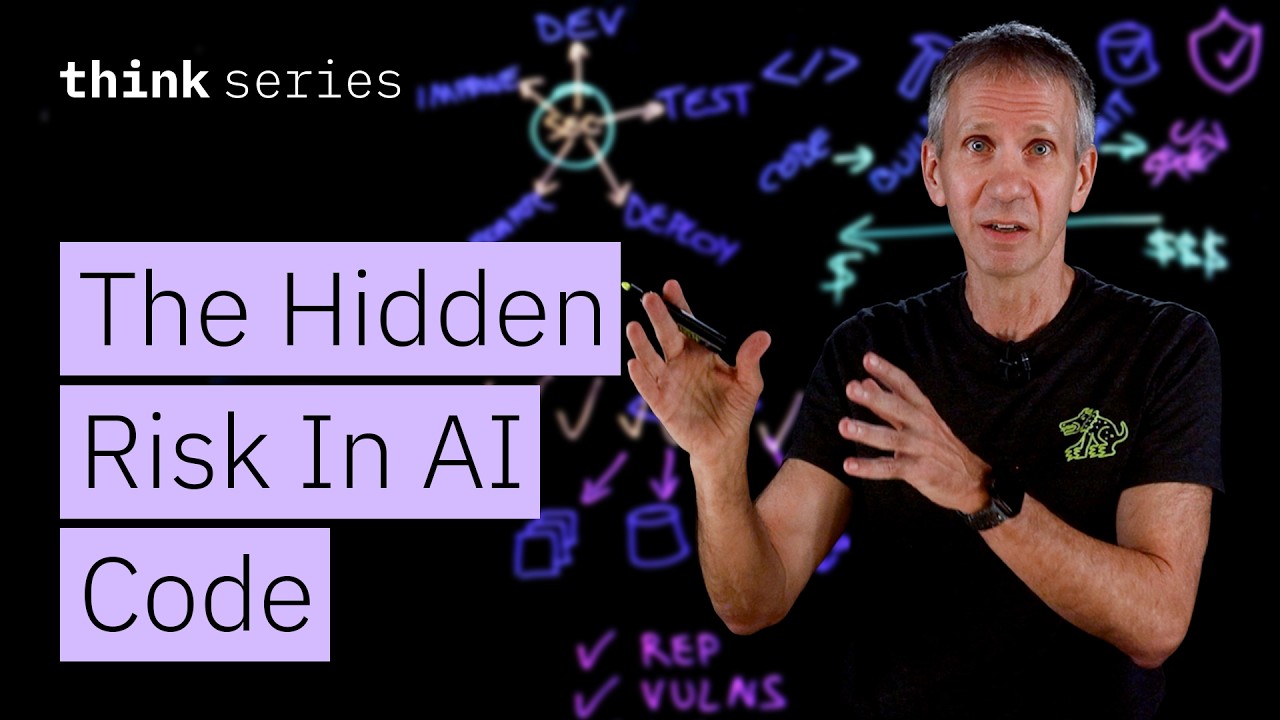
How Developers Secure AI-Generated Code: 5 Security Best Practices
As AI accelerates software development, traditional security practices designed for human-written code are insufficient. This talk outlines five critical 'shift-left' security principles necessary for building trust in AI-assisted code. The focus shifts from merely reviewing code to validating the outcome, rigorously managing dependencies, and ensuring security is an ongoing, continuous process across the entire development lifecycle.
Key takeaways
-
Trust the Outcome, Not Just the Generation
2:20
AI-generated code can compile and pass tests while still harboring unseen security risks (e.g., unauthorized data leaks, failure to fail safe). Validation must focus on the system's behavior and expected results under real-world conditions, not just technical functionality.
-
Security Must Start During Development
3:25
Integrating security early (shifting left) is crucial. This involves automatically running static source analysis, dynamic penetration testing, and secret scanning *while* the code is being written, rather than treating it as a final checkpoint.
-
Validate Generated Dependencies
5:30
AI introduces new dependencies (packages, libraries, services) that carry inherent risk. Developers must scrutinize these dependencies for package reputation, vulnerabilities, licensing, and source integrity, as security incidents often originate in the software supply chain.
-
Consider Intent Over Code Quality
6:50
The solution must address the business intent, not just the technical requirements. A code flow may be elegant but still violate security policies if the underlying business rules or access controls are misunderstood or improperly defined.
-
Security is an Ongoing Practice
8:00
Security validation must be continuous, extending far beyond initial deployment. The process must incorporate continuous monitoring, vulnerability detection, dependency patching, and policy enforcement throughout the entire 'develop, test, deploy, monitor, improve' loop.