Topic

Vector Databases

All digests tagged Vector Databases

What Is Chunkless RAG? How Docling & AI Agents Navigate Documents thumbnail

· 7:00

What Is Chunkless RAG? How Docling & AI Agents Navigate Documents

The video contrasts traditional Retrieval Augmented Generation (RAG), which relies on chunking documents and similarity search, with a novel approach called Chunkless RAG. Traditional methods discard crucial document structure (headings, tables) by flattening the content into small text chunks. Chunkless RAG proposes that AI agents navigate the inherent tree structure of a document—retaining context and allowing for complex reasoning across sections—rather than relying solely on vector similarity matching. This requires specialized tools like Docling to reconstruct the hierarchical structure from formats like PDFs.

Key takeaways

  1. Limitations of Traditional RAG

    Standard RAG chunks documents (e.g., every 500 words) and uses similarity search on these small text blobs. This process discards the original document structure, making it difficult for the model to understand relationships between separated sections or tables.

  2. Concept of Chunkless RAG 2:00

    Chunkless RAG utilizes AI agents that navigate the document's inherent tree structure (sections, subsections) rather than matching by similarity. This allows for answering questions that span multiple, disconnected parts of a long document.

  3. Role of Docling 4:10

    Since PDFs often bury the author's hierarchy, specialized tools like Docling are necessary to process a PDF and output a structured 'Docling document,' which preserves sections, headings, reading order, and table integrity.

  4. Trade-offs of Structure-Aware Retrieval 5:50

    While structure-aware retrieval provides superior precision on long, organized documents, it is more complex than chunking. It involves multiple passes and increased model back-and-forth (latency), making the choice dependent on whether fuzzy search or structural precision is needed.

Watch on YouTube Full article

Why RAG Solutions Fail with Complex Documents & Vector Databases thumbnail

· 7:46

Why RAG Solutions Fail with Complex Documents & Vector Databases

Standard Retrieval Augmented Generation (RAG) solutions often fail when processing complex, ambiguous, or contradictory real-world documents (such as evolving laws or policies). The video outlines practical architectural improvements—including robust document management and clarification loops—to ensure that AI systems can accurately handle data ambiguity and avoid presenting single answers where multiple valid interpretations exist.

Key takeaways

  1. RAG Failure Point: Data Contradiction 2:33

    Because real-world document sets are compiled over time by multiple people, they frequently contain contradictions (e.g., a 2012 law contradicting a 1912 law). A standard RAG solution must be designed to handle the possibility of multiple correct answers rather than assuming singularity.

  2. Solution 1: Preventing Unforced Errors 3:55

    Implement strong document management processes to prevent 'unforced errors' in the vector database. This means ensuring that outdated or superseded policies are removed, preventing confusion when a newer policy replaces an older one.

  3. Solution 2: Implementing Clarification Loops 4:45

    A clarification loop is a mechanism built into the AI solution that prompts the user to rephrase or specify their question if it is too vague (e.g., asking 'Who won the championship in 2010?' without specifying the sport). This ensures the input question is specific enough for accurate retrieval.

Watch on YouTube Full article

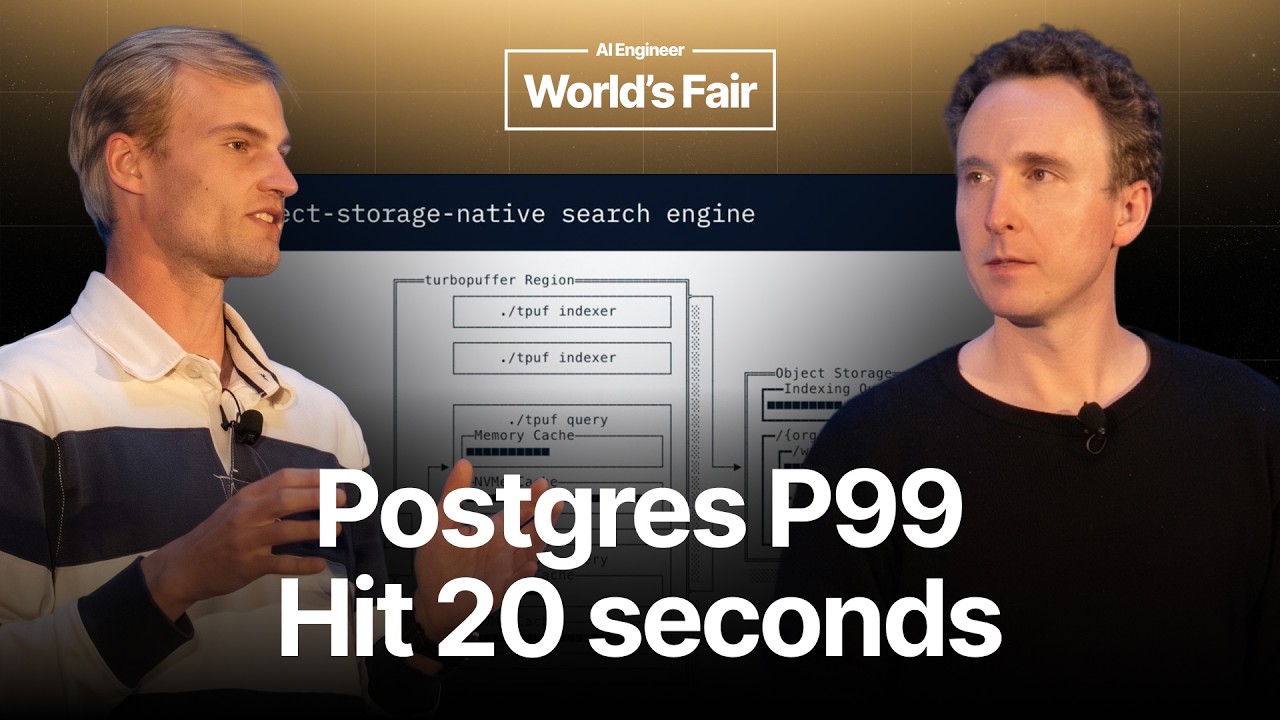
Building retrieval harness for enterprise agents thumbnail

· 1:09:03

Building retrieval harness for enterprise agents

This technical walkthrough details the architecture of an enterprise agentic retrieval harness, moving beyond traditional Retrieval Augmented Generation (RAG) systems. The core argument is that effective data access requires giving agents a comprehensive set of tools—including local file system traversal (GP), semantic search, keyword search, and multimodal analysis—rather than relying on a single indexing method. Key focus areas include managing complex document parsing, ensuring multi-tenancy via custom metadata, and optimizing vector storage for scale and cost.

Key takeaways

  1. Harness over RAG 2:00

    The most capable approach is not to select a single retrieval method (e.g., pure semantic search or pure GP access) but to build an agentic harness that allows the agent to decide how to combine multiple tools for data exploration and verification.

  2. The Role of File Primitives 4:20

    For document-driven workflows, critical primitives include: (1) Retrieval (hybrid search), (2) Directory listing/hierarchy traversal, (3) Grep for exact text matching, (4) Chunk-by-chunk analysis, and (5) Multimodal processing via localized screenshots.

  3. Enterprise Scaling Challenges 6:45

    Scaling to multi-tenant or million-file situations requires specialized indexing pipelines that manage data freshness, security, and permissioning. Using custom metadata attached during the parsing process is crucial for filtering access at the vector storage layer.

Watch on YouTube Full article