Topic

Information Architecture

All digests tagged Information Architecture

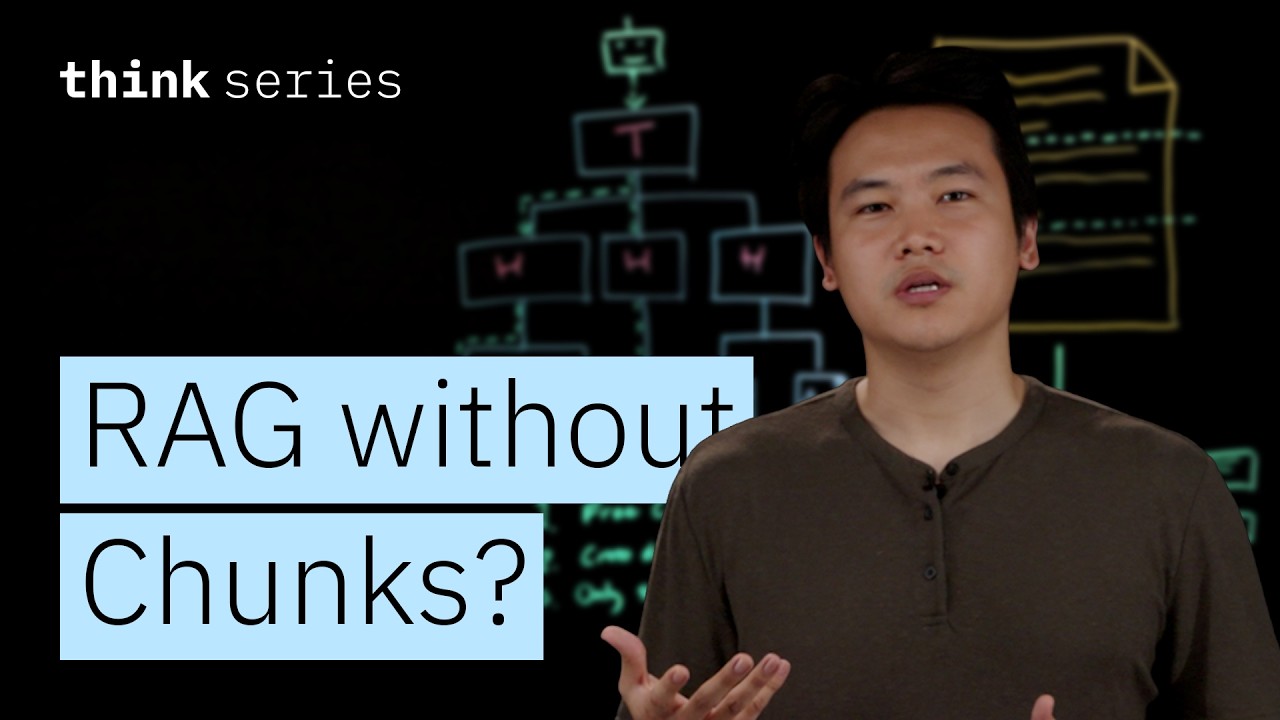
What Is Chunkless RAG? How Docling & AI Agents Navigate Documents thumbnail

· 7:00

What Is Chunkless RAG? How Docling & AI Agents Navigate Documents

The video contrasts traditional Retrieval Augmented Generation (RAG), which relies on chunking documents and similarity search, with a novel approach called Chunkless RAG. Traditional methods discard crucial document structure (headings, tables) by flattening the content into small text chunks. Chunkless RAG proposes that AI agents navigate the inherent tree structure of a document—retaining context and allowing for complex reasoning across sections—rather than relying solely on vector similarity matching. This requires specialized tools like Docling to reconstruct the hierarchical structure from formats like PDFs.

Key takeaways

  1. Limitations of Traditional RAG

    Standard RAG chunks documents (e.g., every 500 words) and uses similarity search on these small text blobs. This process discards the original document structure, making it difficult for the model to understand relationships between separated sections or tables.

  2. Concept of Chunkless RAG 2:00

    Chunkless RAG utilizes AI agents that navigate the document's inherent tree structure (sections, subsections) rather than matching by similarity. This allows for answering questions that span multiple, disconnected parts of a long document.

  3. Role of Docling 4:10

    Since PDFs often bury the author's hierarchy, specialized tools like Docling are necessary to process a PDF and output a structured 'Docling document,' which preserves sections, headings, reading order, and table integrity.

  4. Trade-offs of Structure-Aware Retrieval 5:50

    While structure-aware retrieval provides superior precision on long, organized documents, it is more complex than chunking. It involves multiple passes and increased model back-and-forth (latency), making the choice dependent on whether fuzzy search or structural precision is needed.

Watch on YouTube Full article

Robert Overweg - One Brain, No Filtering - AI Native DevCon June 2026 thumbnail

· 31:25

Robert Overweg - One Brain, No Filtering - AI Native DevCon June 2026

The presentation details a 'One Brain' concept—a centralized, AI-native knowledge management layer designed to eliminate information silos and improve decision-making by weaving together research, client context, and operational data. The system uses an orchestrator (OpenClaw) and structured vaults to allow agents to access and synthesize organizational knowledge in real time, shifting focus from manual file retrieval to idea generation and proactive insights.

Key takeaways

  1. Shift from File Search to Idea Synthesis 5:40

    The core value lies in moving beyond searching for specific files; the system allows users to search for 'ideas' or 'contacts.' Agents can interpret natural language queries (e.g., asking about CI/CD steps) and provide contextually accurate answers based on stored knowledge.

  2. Structured Knowledge Flow 7:10

    Knowledge is categorized into 'company knowledge' (new developments, research wikis) and the 'creation pipeline.' Information must be promoted to a central vault from various sources (e.g., Obsidian notes, meeting transcripts) to gain grounding in reality before being shared widely.

  3. Scaling and Security Challenges 17:32

    While the system is powerful, scaling remains a challenge, particularly regarding data segregation (permissions) across different client or team buckets. The local setup on one person's laptop was initially used for testing, but enterprise rollout requires careful consideration of security boundaries.

Watch on YouTube Full article