What Is Context Engineering? Why It Matters for AI Agents
Summary
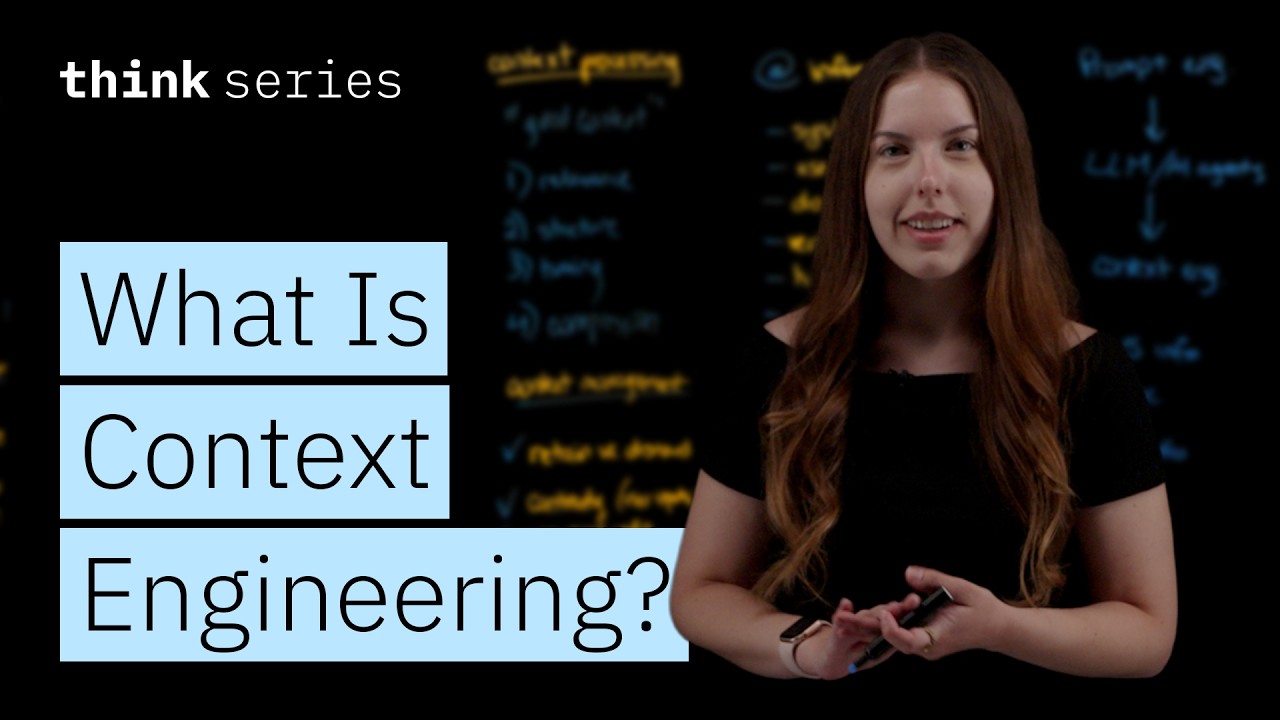
The industry is shifting focus from prompt engineering—which only addresses instruction phrasing—to Context Engineering. Context Engineering is defined as the deliberate practice of structuring and optimizing all information provided to an LLM or AI agent to ensure accurate and reliable outputs. For complex agents that reason across multiple steps, context management is critical because performance can degrade (context rot) when too much irrelevant or poorly structured data is included.
Key takeaways
-
Context Engineering vs. Prompt Engineering
Prompt engineering focuses solely on phrasing instructions for an LLM. Context engineering, however, addresses the entire information environment provided to the model, recognizing that prompt engineering is merely one component of context.
-
The Danger of Over-Context
3:33
More context does not guarantee better performance. Providing too much irrelevant or poorly structured data can lead to 'context rot,' resulting in worse reasoning and increased hallucinations.
-
Core Components of Context
4:10
Context includes the system prompt, user query, retrieved documents (e.g., from a vector database), interaction history, tool outputs, and API results.
Technical details
-
Good Context Characteristics
310s
Effective context must possess four key characteristics: Relevance (every piece aids the task), Structure (clear organization with labels), Timing (introduced only when needed in agentic systems), and Compression (summarizing or filtering raw data, known as 'context processing').
-
Context Management Lifecycle
360s
This ongoing process involves: 1) Deciding what to retain/discard; 2) Maintaining continuity across interactions; 3) Prioritizing data (based on relevance, recency, or importance); 4) Handling the information life cycle by invalidating outdated data; and 5) Ensuring consistency and coherence.
-
Agentic System Example
430s
In a healthcare scheduling assistant, context engineering moves beyond a simple user prompt to include structured inputs like clinic policies, doctor's real-time availability, patient medical history, and API tool outputs for accurate decision-making.
Mentioned resources
Channel & topics
Watch on YouTube · Back to latest
This independent, AI-assisted summary is provided for commentary and informational purposes. It may contain errors or omit important context. Please watch the original video for the creator's complete presentation. Video, thumbnail, and related copyrights belong to their respective owners.