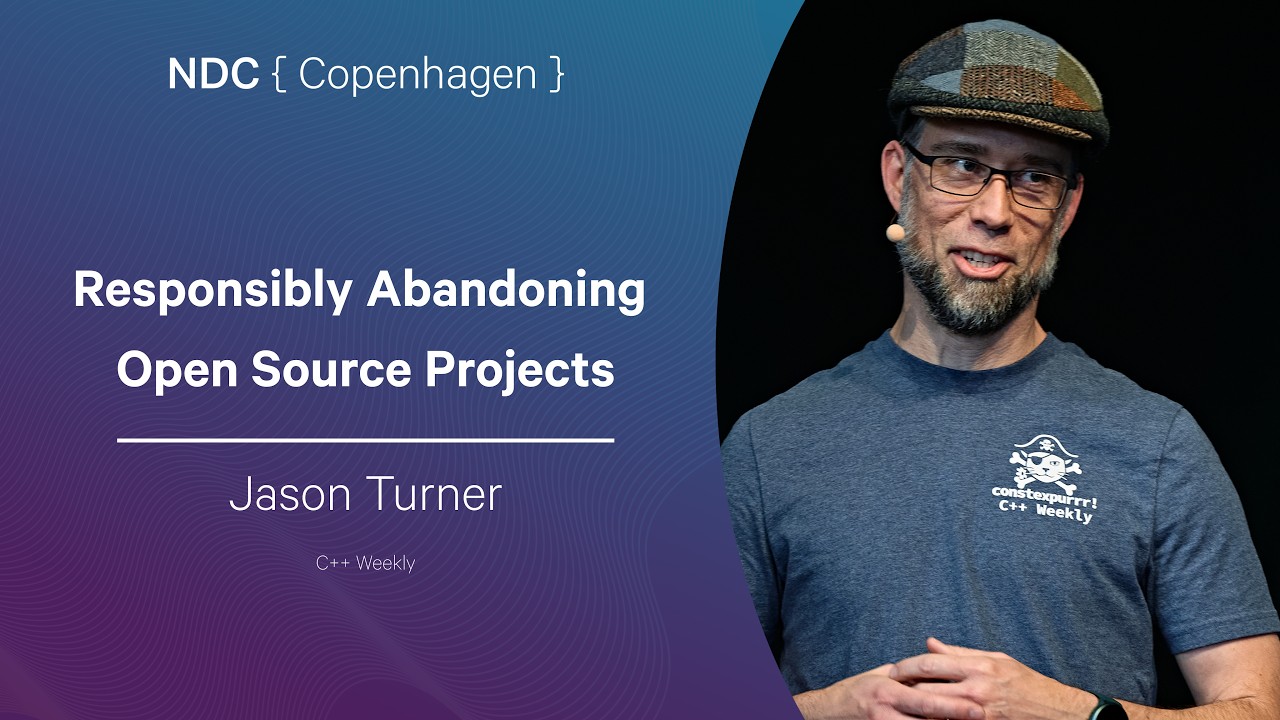
Responsibly Abandoning Open Source Projects - Jason Turner - NDC Copenhagen 2026
Summary
This talk outlines best practices for developing and maintaining open-source projects to ensure they can be responsibly abandoned or handed off years later without becoming 'legacy' or 'abandoned.' The core focus is on achieving a state of 'completeness' by implementing rigorous automation across the entire development lifecycle—from static analysis and comprehensive testing (including path coverage, fuzzing, and mutation testing) to simplified build processes. Key recommendations include automating all quality gates within CI/CD pipelines and minimizing technical debt related to tooling complexity.
Key takeaways
-
Achieve 'Completed,' Not 'Abandoned'
20:30
When concluding work on a project, aim for the status of 'completed' rather than 'abandoned.' This requires proactive measures like maintaining clear documentation and ensuring continuous automation.
-
Automate All Quality Gates
29:55
Implement automated checks for every possible tool (static analysis, dynamic analysis, formatting) to ensure consistency and reduce friction for future maintainers. This should be fully integrated into the build process.
-
Prioritize Strong Typing
34:45
Adopting strongly typed systems (e.g., using type hints in Python or dedicated types like `Point` and `Color`) makes code less prone to order-of-operations errors, significantly improving robustness.
-
Minimize Build Setup Friction
32:10
A new contributor should be able to set up the development environment and run all tests/analysis in a minimal number of steps (ideally five lines or less).
Technical details
-
Code Quality & Analysis
2150s
Implement static analysis tools (e.g., Sonar, Clang-Tidy) and ensure warnings are treated as errors during the build process to enforce high code quality.
-
Testing Depth & Coverage
2650s
Move beyond simple line coverage (100%) by measuring branch coverage and path coverage. Path coverage is highly valuable but computationally expensive; it should be targeted function-by-function.
-
Advanced Testing Techniques
3150s
Utilize fuzz testing (generating pseudo-random inputs to find unexpected memory errors) and mutation testing (swapping operations in code to ensure the test suite is comprehensive enough to detect subtle bugs).
-
Build System Automation
3400s
The build process must be fully automated via CI/CD tools (e.g., GitHub Actions) and should enforce passing tests for all merges into the main branch.
-
Code Formatting & History
2470s
Use automatic code formatters (like `rustfmt` or Black) to eliminate style arguments during pull requests. Maintain a clean history by using squash and merge judiciously.
Mentioned resources
- Clang-Tidy
- Sonar
- Black / Prettier
- GitHub Actions
Channel & topics
Watch on YouTube · Back to latest
This independent, AI-assisted summary is provided for commentary and informational purposes. It may contain errors or omit important context. Please watch the original video for the creator's complete presentation. Video, thumbnail, and related copyrights belong to their respective owners.