Topic

Software Engineering Productivity

All digests tagged Software Engineering Productivity

Locknote: Reasons to be Cheerful: 0, 1, 2 - Emmz Rendle - NDC Copenhagen 2026 thumbnail

· 57:04

Locknote: Reasons to be Cheerful: 0, 1, 2 - Emmz Rendle - NDC Copenhagen 2026

The talk presents a highly optimistic overview of technological progress across multiple domains, arguing that advancements in AI, quantum computing, and biotechnology are solving complex global problems. While addressing concerns about job displacement and climate change, the speaker emphasizes that these technologies—such as specialized LLMs (Gemma 4, Qwen 3.6) for code generation or CRISPR for personalized medicine—are tools that enhance human capability rather than replace it entirely. The presentation also touches on hardware advancements like shared memory architectures and post-quantum cryptography standards.

Key takeaways

  1. AI in Diagnostics and Genomics 5:20

    AI models are revolutionizing medicine by analyzing complex data sets, such as MRI scans (sub-millimeter slice images) to flag issues for radiologists. Furthermore, DNA/RNA analysis can detect hereditary disease risks and enable custom per-patient cancer treatments.

  2. Quantum Computing Threat and Solution 12:30

    The advent of powerful quantum computers (e.g., those capable of running Shor's algorithm) will render current classical cryptography (RSA, Diffie-Hellman, EDCSA) obsolete. The industry is responding by adopting post-quantum cryptography standards approved by NIST, specifically mentioning Dilithium and Kyber.

  3. AI for Software Productivity 17:30

    LLMs are not replacing programmers but acting as a new programming paradigm. They can generate functional code that is safe to put into production, allowing developers to focus on engineering the system's logic rather than manual typing.

  4. Advancements in Robotics and Automation 23:20

    Robotics are advancing through LLM-driven operating systems (like Gemini Robotics 1.5) that allow robots to reason through steps necessary for tasks, enabling scalable deployment across multiple units.

  5. Sustainable Energy and Climate Solutions 31:40

    New technologies include solar windows (generating electricity while visible) and 'solar canals,' which use floating panels over irrigation channels to prevent water evaporation and generate power.
Watch on YouTube Full article

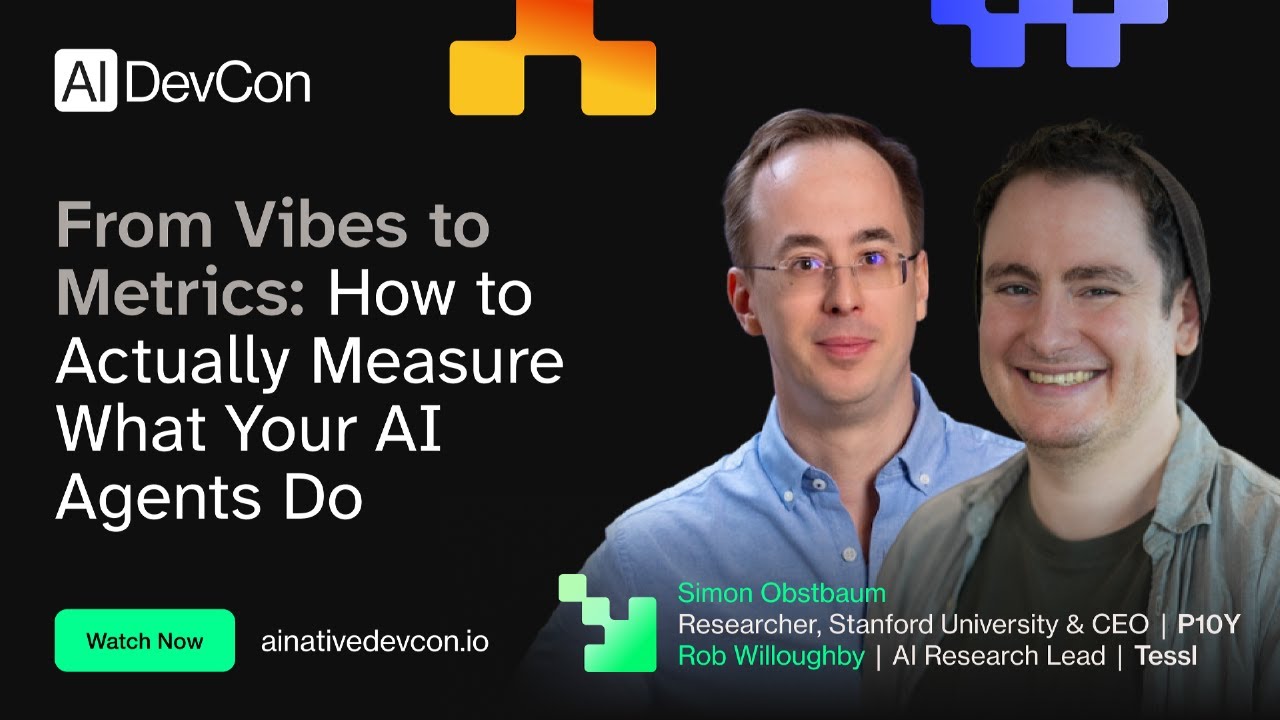
Simon Obstbaum & Rob Willoughby - Why evals are hard and how we're solving it - AI Native DevCon Jun thumbnail

· 36:39

Simon Obstbaum & Rob Willoughby - Why evals are hard and how we're solving it - AI Native DevCon Jun

This session introduces advanced methods for evaluating AI agents, arguing that relying solely on 'output evals' (what came out) is insufficient. The focus must shift to 'trajectory evals,' which measure whether the agent followed the correct steps and utilized the right tools. By instrumenting agent behavior—specifically through structured skills and context—teams can significantly improve metrics like PR throughput, decrease cognitive complexity, and ensure adherence to unique organizational conventions (e.g., internal API choices or security policies).

Key takeaways

  1. Shift from Output Evals to Trajectory Evals 29:56

    Evaluating agents requires measuring not just the final output, but also whether the agent activated the correct skills and followed the intended workflow (trajectory) [0:35:46]. Separating activation, trajectory, and outcome is essential for optimizing performance.

  2. Structured Context Improves Code Quality 5:46

    The analysis shows that moving from unstructured (L1) to structured context (L3) significantly improves code quality metrics. Specifically, L2 and L3 teams show increased PR throughput, decreased revert rates, and lower cognitive complexity compared to L1 [0:58:46].

  3. Instruction Following is the Key Differentiator 6:32

    While task completion may remain high regardless of structure, 'instruction following' (grounded in skills) measures adherence to unique organizational rules. This metric shows the biggest lift and represents the value of encoding proprietary business IP into the agent's context [1:03:52].

  4. The System, Not Just the Model, Matters 10:52

    Performance is highly dependent on the entire system stack. Testing must account for the specific model harness (e.g., Opus 4 8 in Claude Code vs. OpenHands), as changing the harness can move scores by up to 100% [1:09:52].

Watch on YouTube Full article