Topic

Software Automation

All digests tagged Software Automation

Inside Kikimora: We Built a Dark Software Factory thumbnail

· 15:51

Inside Kikimora: We Built a Dark Software Factory

The presentation introduces the concept of a 'Dark Factory'—an autonomous software development model where processes run without constant human supervision. The speaker details how rapid advancements in coding agents have broken traditional bottlenecks built for slow software. This factory approach uses tools like Tessl Agent to automate workflows (e.g., taking an issue from Linear, solving it with an agent, and opening a GitHub PR that self-corrects until merged). The core shift is moving the engineer's value proposition from writing code to understanding complex systems and trusting autonomous results.

Key takeaways

  1. The Dark Factory Concept 1:41

    A dark factory involves building software in a highly autonomous way, where human supervision is minimized. It is modeled after manufacturing factories with no lights on (i.e., no humans inside).

  2. Bottleneck Breaking Point 3:23

    As coding agents increased speed, existing processes designed for slower development began to break down, necessitating a fundamental shift in how software was built.

  3. The Shift in Engineering Value 7:16

    The value of an engineer is shifting from the ability to write code (which agents can do) to understanding the system's architecture and interlocking technical/business constraints. Trusting autonomous results is the new challenge.
Watch on YouTube Full article

Put an Agent Inside Your App in 10 Minutes or Less with the GitHub Copilot SDK - Daniel Ward thumbnail

· 57:28

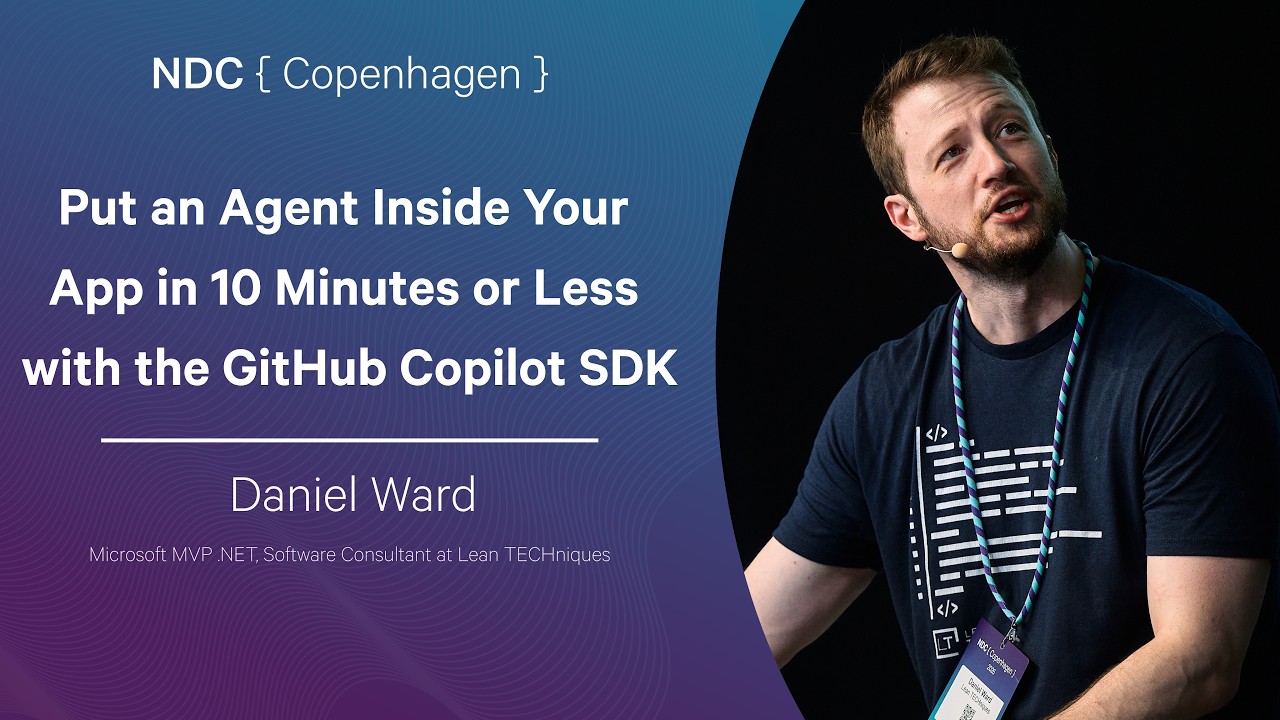
Put an Agent Inside Your App in 10 Minutes or Less with the GitHub Copilot SDK - Daniel Ward

This talk demonstrates how to rapidly embed custom AI agents into existing applications using the GitHub Copilot SDK. The session covers agent architecture—defining an agent as an LLM augmented with tools and a looping mechanism—and provides two coding demos (in C#) showing basic functionality like weather queries, streaming responses, and creating custom tools. For build engineers, the focus is on advanced use cases such as automated incident response (generating suggested fixes and opening Pull Requests from production logs) and building comprehensive daily briefing systems that integrate multiple enterprise services (Jira, Teams, GitHub).

Key takeaways

  1. Agent Architecture 17:53

    An AI agent is fundamentally an LLM combined with external tools and a looping mechanism. The LLM handles the creative analysis, while the tools allow it to perform deterministic actions (e.g., fetching web data or querying APIs).

  2. Copilot SDK Functionality 3:35

    The Copilot SDK is an open-source library that allows calling GitHub Copilot (or other LLMs like Anthropic/OpenAI) from code. It supports multiple languages (TypeScript, Python, Go, C#, etc.) and provides granular control over sessions, including event handling (`onEvent`) for streaming responses.

  3. Automated Incident Response 51:01

    A powerful use case is connecting production errors to automated fixes. The process involves the SDK collecting logs, using Copilot to suggest a fix based on stack traces, and then programmatically opening a draft Pull Request (PR).

  4. Reliability vs. Prompting 53:21

    For repeatable, mission-critical workflows (like daily reports), using deterministic code with the SDK is significantly more reliable than relying solely on prompt chaining, as failures in a chain compound exponentially.

Watch on YouTube Full article