Morgan Stanley's ALPHALAB: Multi-Agent Research Across Optimization Domains — Brendan Rappazzo
Summary
Morgan Stanley's AlphaLab is a multi-agent research system designed to automate quantitative finance research by managing the entire experimental lifecycle. Unlike simple code generation, AlphaLab accepts a problem in plain language and autonomously handles hypothesis formation, backtesting setup, cluster job submission (using tools like Slurm), statistical testing, and iterative refinement. The core innovation lies in its focus on building proprietary, verifiable evaluation environments—treating them as critical data inputs—allowing the system to self-improve and encode deep enterprise knowledge.
Key takeaways
-
Full Research Automation Cycle
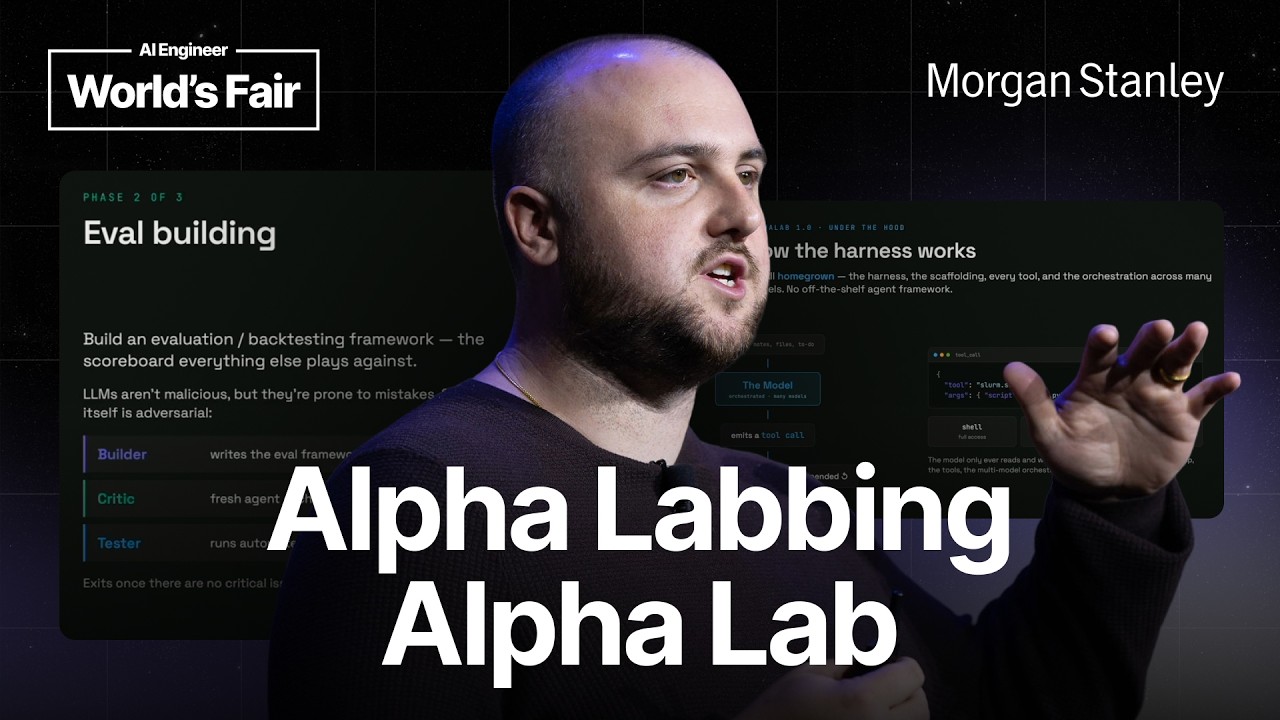
AlphaLab operates in three phases: 1) Research (building context/hypotheses), 2) Evaluation Building (creating robust backtests, involving multiple critic agents to prevent forward leakage), and 3) Mass Experimentation. This allows the system to move from a natural language goal to a suite of trained models.
-
Architecture: Strategist and Workers
15:36
The process is managed via a Kanban/Jira-like board. A 'Strategist' agent proposes experiments, which are then assigned to 'Worker' agents responsible for writing code, configuring Slurm jobs (e.g., requiring 4 H100s), submitting the job, and performing postmortem analysis.
-
The Value of Verifiable Environments
The system's robustness hinges on building custom evaluation environments (evals) that mimic a private Kaggle competition. This strict format, which includes held-out validation sets, is crucial for measuring performance and encoding proprietary enterprise knowledge.
-
Self-Improving Meta-Harness
The ultimate goal (AlphaLab 2.0) is a self-improving system where the LLM performs meta-optimization, analyzing results and improving the harness itself, rather than just executing tasks within it.
Technical details
-
System Architecture
320s
AlphaLab is built as a proprietary agentic harness using functional tool calling, ensuring model agnosticism (supporting OpenAI, Anthropic, or open-source providers). Key tools include full shell access for environment setup and code execution, web search for state-of-the-art research, and Slurm abstraction for GPU cluster management.
-
Evaluation Robustness
580s
To ensure reliability, the evaluation phase uses a multi-agent framework: one agent builds the eval code, which is then reviewed by two critic agents—one for high-level conceptual errors (e.g., forward leakage) and one for programmatic unit/integration tests.
-
Experimentation Workflow
936s
The mass experimentation phase uses a Kanban board structure where workers submit jobs requiring specific hardware resources (e.g., '4 H100s'). Results are analyzed to generate postmortem reports, which feed back to the Strategist for self-evolution and hypothesis refinement.
Mentioned resources
- AlphaLab
- GitHub
Channel & topics
Watch on YouTube · Back to latest
This independent, AI-assisted summary is provided for commentary and informational purposes. It may contain errors or omit important context. Please watch the original video for the creator's complete presentation. Video, thumbnail, and related copyrights belong to their respective owners.