Topic

Automation

All digests tagged Automation

Robotics Has Been Stuck for 70 Years — Deepak Pathak, Skild AI thumbnail

· 28:18

Robotics Has Been Stuck for 70 Years — Deepak Pathak, Skild AI

Deepak Pathak argues that robotics progress has stalled for approximately 70 years because the field has been treated as a hardware problem rather than a general intelligence problem. He introduces the concept of 'omni-bodied intelligence'—a single brain model applicable to any robot and any task, regardless of hardware. This approach leverages a 'data flywheel' that combines highly scalable data (simulation, human video) with high-quality, low-volume data (teleoperation) and, critically, real-world deployment data. Demonstrations include complex tasks like AirPods insertion, omelet cooking on $4,000 arms, and robust GPU assembly for NVIDIA's factory, showcasing the system's ability to handle real-world disturbances and zero-shot transfers.

Key takeaways

  1. Robotics Stagnation and the General Brain 5:57

    Robotics has historically been limited by approaching it as a hardware problem. The field is constrained by the lack of a general brain, leading to the 'Moravec's paradox' (what is easy for humans is hard for machines, and vice versa).

  2. The Data Bottleneck 9:02

    Collecting robot data via teleoperation is extremely slow and expensive. To reach the data scale of models like GPT-3, the entire US population would take over a century, highlighting the need for scalable data sources.

  3. Omni-bodied Intelligence and the Data Flywheel 12:02

    The proposed solution is an 'omni-bodied brain': one model for any robot and any task. This system utilizes a data flywheel, pre-training on scalable data (simulation, human video), post-training on teleoperation, and continuous improvement via deployment data.

  4. Real-World Deployment and Robustness

    The system demonstrates extreme robustness, performing tasks like GPU assembly in a randomized, noisy factory environment, and adapting to disturbances (e.g., recovering movement after disabling legs) without explicit mapping or planning.

Watch on YouTube Full article

Schedules for Managed Deep Agents: Cron jobs, prompts, and Slack delivery thumbnail

· 3:26

Schedules for Managed Deep Agents: Cron jobs, prompts, and Slack delivery

This video demonstrates how to implement automated, recurring tasks using Schedules for Managed Deep Agents. By configuring cron jobs, agents can run autonomously to generate and deliver structured reports (e.g., a weekly Salesforce pipeline summary) to external channels like Slack, without manual intervention. The process involves defining the schedule syntax, deploying the agent to LangSmith, and ensuring the agent has access to necessary tools and context.

Key takeaways

  1. Automated Reporting via Cron Jobs

    Schedules allow agents to send recurring messages that invoke tools or leverage context, such as generating a weekly pipeline summary for the sales team.

  2. Schedule Configuration 0:01

    Schedules are defined by creating a file in the schedules directory, specifying a cron job, a time zone, a prompt, and optional input context.

  3. Deployment and Monitoring 0:01

    The scheduled agent must be deployed to LangSmith using a deploy command, allowing users to inspect the configured cron jobs and prompts within the LangSmith UI.

Watch on YouTube Full article

How I automate my own job at Hugging Face using agents — Niels Rogge, Hugging Face thumbnail

· 20:37

How I automate my own job at Hugging Face using agents — Niels Rogge, Hugging Face

Niels Rogge details how he automated his role at Hugging Face—the 'Google Drive to the hub' team—which focuses on improving the discoverability of machine learning artifacts. He built two systems: an initial deterministic workflow for outreach (using cron jobs and LLM APIs) and a subsequent fully autonomous agent loop for follow-up actions. The architecture leverages modern tooling like Modal, Bash CLI skills, and advanced models (e.g., GLM 5.2) to scale the process of identifying missing artifacts and prompting researchers to publish them on Hugging Face.

Key takeaways

  1. The Problem: Artifact Discoverability

    ML weights and datasets are often published on third-party services (Google Drive, Zenodo) rather than the centralized platform (Hugging Face), hindering discoverability. The goal is to automate outreach to authors.

  2. Initial Automation: Deterministic Workflow 11:43

    The first phase used a deterministic workflow, running as a nightly cron job on GitHub Actions. This approach utilized LLM APIs in predefined steps without an agent framework, offering high predictability and control.

  3. Advanced Automation: Autonomous Agent Loop 15:36

    The follow-up process was automated using a fully autonomous agent loop (e.g., leveraging the Claude agents SDK). This flexible approach allows the agent to use tools and skills, such as Bash and the Hugging Face CLI, to interact with GitHub issues.

Watch on YouTube Full article

Grok Bot Is The First AI Agent You Just Install. Is It Worth $200? thumbnail

· 18:56

Grok Bot Is The First AI Agent You Just Install. Is It Worth $200?

Grokbot is presented as a consumer multi-agent product that significantly lowers the barrier to entry for AI automation, making advanced agent capabilities accessible to non-technical users. The system operates on a single, dedicated cloud computer (the security perimeter), which allows agents to seamlessly integrate with services like email and calendars through simple authorization processes. While the subscription cost is high ($200/month), its value proposition lies in its ability to automate complex business functions—such as building a storefront or managing an entire workflow—that would otherwise require significant manual effort.

Key takeaways

  1. Simplified Agent Integration

    Grokbot solves the 'agent signup pain point' by centralizing authorization. Users authorize services (e.g., email, calendar) once within one conversation with one bot; this authorization applies across all other bots and services used on the platform. This process uses remote login screens rather than requiring plain text passwords.

  2. Centralized Security Perimeter 2:00

    The entire system operates within one dedicated cloud computer (located in Silicon Valley), establishing a single security perimeter. Adding more agents does not increase this risk, providing greater confidence than systems relying on multiple scattered machines.

  3. High-Value Automation Bots 8:10

    Recommended bots include the 'Superdoerbot' (which proactively works on real tasks like drafting presentations based on calendar events) and the 'Business In a Box' bot, which helps users build and manage an entire business using AI agents.

  4. Technical Accessibility 0:10

    Grokbot is designed to be non-technical ('No code, just install'), crossing the chasm that previously required users to understand complex agent setups (like those needed for OpenClaw or Codex).

Watch on YouTube Full article

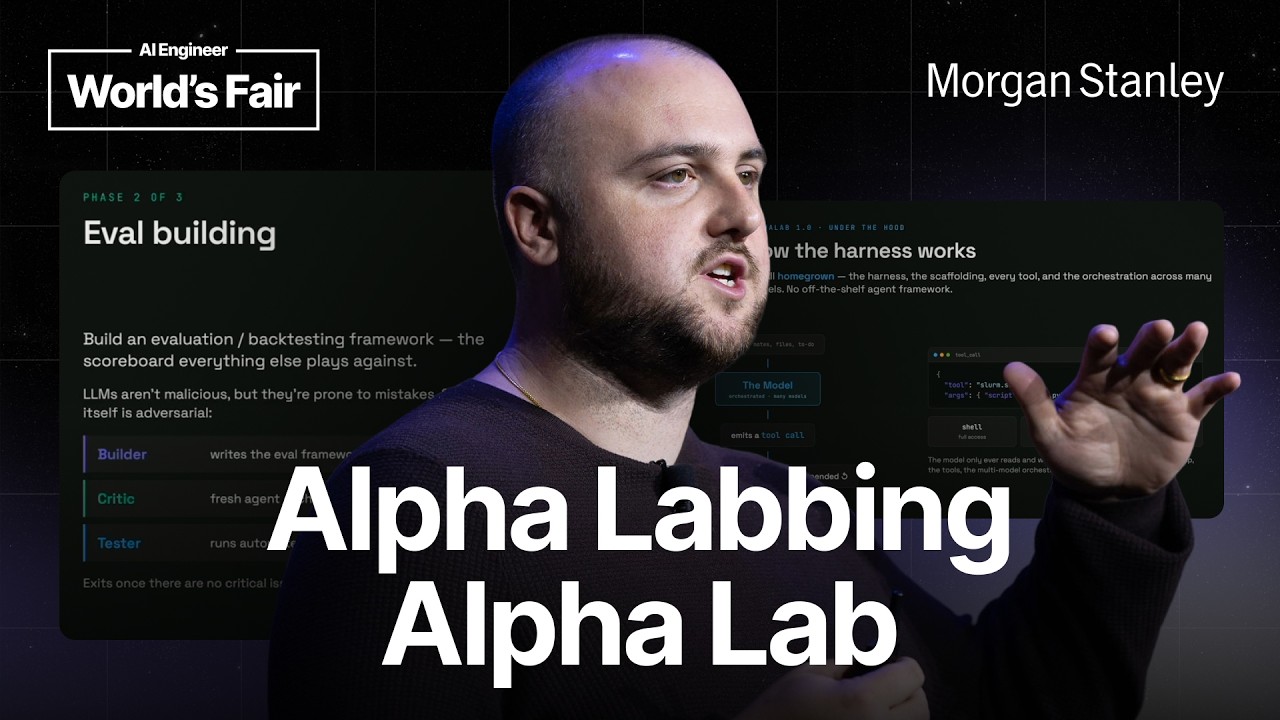
Morgan Stanley's ALPHALAB: Multi-Agent Research Across Optimization Domains — Brendan Rappazzo thumbnail

· 20:07

Morgan Stanley's ALPHALAB: Multi-Agent Research Across Optimization Domains — Brendan Rappazzo

Morgan Stanley's AlphaLab is a multi-agent research system designed to automate quantitative finance research by managing the entire experimental lifecycle. Unlike simple code generation, AlphaLab accepts a problem in plain language and autonomously handles hypothesis formation, backtesting setup, cluster job submission (using tools like Slurm), statistical testing, and iterative refinement. The core innovation lies in its focus on building proprietary, verifiable evaluation environments—treating them as critical data inputs—allowing the system to self-improve and encode deep enterprise knowledge.

Key takeaways

  1. Full Research Automation Cycle

    AlphaLab operates in three phases: 1) Research (building context/hypotheses), 2) Evaluation Building (creating robust backtests, involving multiple critic agents to prevent forward leakage), and 3) Mass Experimentation. This allows the system to move from a natural language goal to a suite of trained models.

  2. Architecture: Strategist and Workers 15:36

    The process is managed via a Kanban/Jira-like board. A 'Strategist' agent proposes experiments, which are then assigned to 'Worker' agents responsible for writing code, configuring Slurm jobs (e.g., requiring 4 H100s), submitting the job, and performing postmortem analysis.

  3. The Value of Verifiable Environments

    The system's robustness hinges on building custom evaluation environments (evals) that mimic a private Kaggle competition. This strict format, which includes held-out validation sets, is crucial for measuring performance and encoding proprietary enterprise knowledge.

  4. Self-Improving Meta-Harness

    The ultimate goal (AlphaLab 2.0) is a self-improving system where the LLM performs meta-optimization, analyzing results and improving the harness itself, rather than just executing tasks within it.

Watch on YouTube Full article

Jack Wotherspoon - Humans vs. Slop: Rewriting the Rules of Open-Source - AI Native DevCon thumbnail

· 32:17

Jack Wotherspoon - Humans vs. Slop: Rewriting the Rules of Open-Source - AI Native DevCon

The rise of powerful AI agents is fundamentally changing open-source development by making code generation nearly free and abundant, leading to a flood of low-quality contributions ('AI slop'). This shift threatens the traditional human-to-human social contract of open source. Maintainers must implement new governance models—such as requiring issues before pull requests (PRs), rate limiting external contributors, and utilizing automation—to manage the influx of code while preserving quality and accountability.

Key takeaways

  1. The Open Source Shift 2:00

    Open-source development is moving from a human-to-human experience to one involving AI agents. The core challenge is that while generating code is cheap (sometimes free), reviewing, maintaining, and trusting the generated code remains expensive and difficult.

  2. Guardrails Against Slop 6:25

    To combat 'drive-by PRs' (where users submit fixes without prior discussion) and uncontrolled agent activity, maintainers should require contributors to file an Issue before submitting a Pull Request. This is cited as eliminating approximately 90% of drive-by PRs.

  3. Rate Limiting Contributions 7:00

    Implement rate limits on external contributors (e.g., limiting the number of active PRs) to prevent automated swarms of nonsensical code submissions, which can overwhelm maintainers.

  4. Trust and Governance Systems 9:40

    New systems are emerging to restore trust: 'Vouch' acts as a referral system for contributors, while 'Open Source Vacation' allows projects or solo maintainers to temporarily halt contributions when needed. Projects should also use context files (like `agents.md`) to guide all AI tools.

  5. Codifying Best Practices with Skills 11:20

    Implementing 'agent skills' (e.g., PR creator, docs writer) into the repository helps enforce best practices—such as running tests and following templates—for both human and AI contributors, thereby raising the overall quality bar.

Watch on YouTube Full article