Topic

Deep Learning

All digests tagged Deep Learning

Robotics Has Been Stuck for 70 Years — Deepak Pathak, Skild AI thumbnail

· 28:18

Robotics Has Been Stuck for 70 Years — Deepak Pathak, Skild AI

Deepak Pathak argues that robotics progress has stalled for approximately 70 years because the field has been treated as a hardware problem rather than a general intelligence problem. He introduces the concept of 'omni-bodied intelligence'—a single brain model applicable to any robot and any task, regardless of hardware. This approach leverages a 'data flywheel' that combines highly scalable data (simulation, human video) with high-quality, low-volume data (teleoperation) and, critically, real-world deployment data. Demonstrations include complex tasks like AirPods insertion, omelet cooking on $4,000 arms, and robust GPU assembly for NVIDIA's factory, showcasing the system's ability to handle real-world disturbances and zero-shot transfers.

Key takeaways

  1. Robotics Stagnation and the General Brain 5:57

    Robotics has historically been limited by approaching it as a hardware problem. The field is constrained by the lack of a general brain, leading to the 'Moravec's paradox' (what is easy for humans is hard for machines, and vice versa).

  2. The Data Bottleneck 9:02

    Collecting robot data via teleoperation is extremely slow and expensive. To reach the data scale of models like GPT-3, the entire US population would take over a century, highlighting the need for scalable data sources.

  3. Omni-bodied Intelligence and the Data Flywheel 12:02

    The proposed solution is an 'omni-bodied brain': one model for any robot and any task. This system utilizes a data flywheel, pre-training on scalable data (simulation, human video), post-training on teleoperation, and continuous improvement via deployment data.

  4. Real-World Deployment and Robustness

    The system demonstrates extreme robustness, performing tasks like GPU assembly in a randomized, noisy factory environment, and adapting to disturbances (e.g., recovering movement after disabling legs) without explicit mapping or planning.
Watch on YouTube Full article

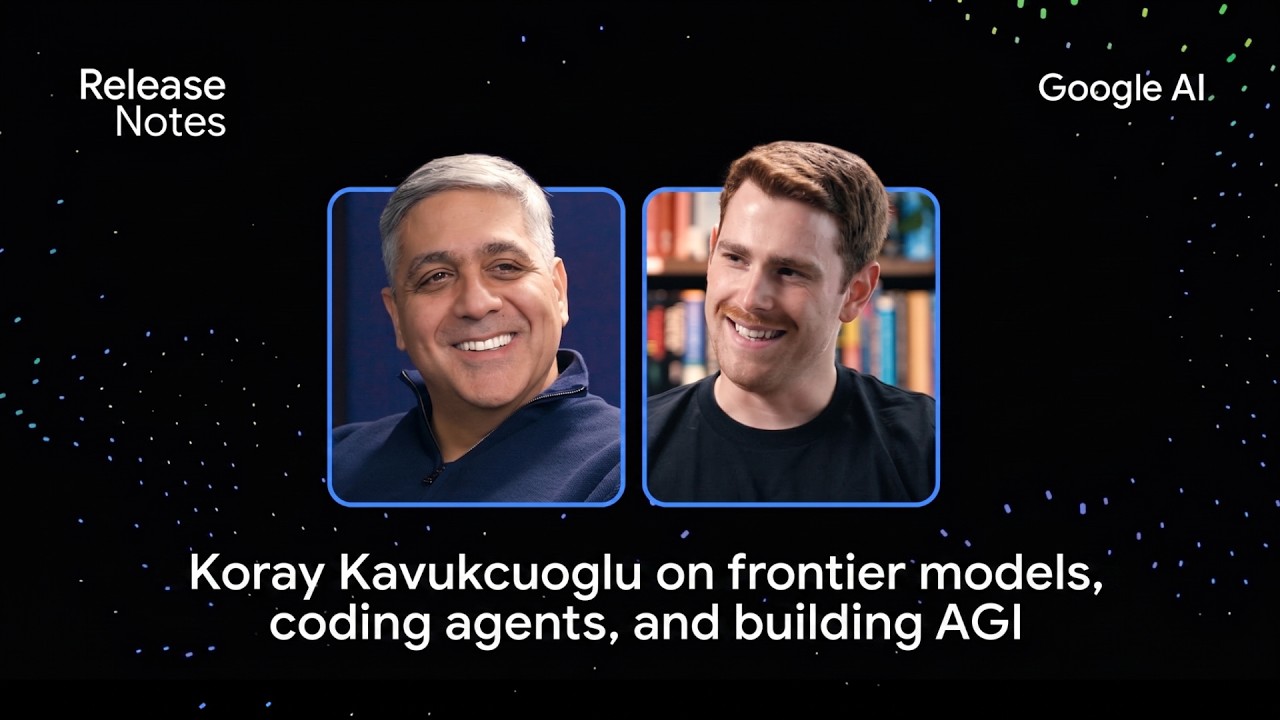
Koray Kavukcuoglu on frontier models, coding agents, and building AGI thumbnail

· 26:47

Koray Kavukcuoglu on frontier models, coding agents, and building AGI

Google DeepMind SVP Koray Kavukcuoglu discusses the ambitious journey toward Artificial General Intelligence (AGI), emphasizing that success relies on moving models from simple coding capabilities to full software engineering and agentic workflows. The discussion highlights the continuous progress of the Gemini model family (e.g., 3.7, Flash) through parallel research tracks and stresses that real-world user interaction is critical for guiding development toward AGI.

Key takeaways

  1. AGI lacks a definitive test or benchmark 14:53

    There is no single standardized test to determine if an AI has reached AGI; progress is measured by the overall journey and capability build-up, not a sudden threshold. (08:53)

  2. The focus shifted from coding to software engineering 2:48

    A major breakthrough in model development was understanding that true intelligence requires more than just writing code; it involves mastering the full scope of 'software engineering,' including working with tools and functions, effectively turning the model into an agent. (02:48)

  3. Gemini 4 is positioned as a major research milestone 3:17

    The team announced Gemini 4 as the most ambitious pre-training run to date, representing a significant step in combining multiple learnings and architectural improvements into one model. (03:17)

  4. User interaction is the guide for AGI development 11:59

    The path to building AGI depends heavily on continuous user interaction and feedback, whether users are performing daily tasks (e.g., emails) or conducting advanced scientific research. This usage spectrum guides problem-solving efforts. (11:39)

Watch on YouTube Full article

Building AI That Learns and Adapts: A Case Study in MRI Diagnostics - Agata Chudzińska thumbnail

· 48:41

Building AI That Learns and Adapts: A Case Study in MRI Diagnostics - Agata Chudzińska

This technical talk explores Continual Learning (CL), positioning it as a critical missing piece for building robust, adaptive AI systems. Using a case study in MRI diagnostics for detecting Focal Cortical Dysplasias (FCDs) in epilepsy patients, the speaker details how CL techniques mitigate issues like data drift and catastrophic forgetting. The presentation covers advanced ML architectures (Encoder-Decoder), preprocessing steps (e.g., segmentation, Junction/Extension filters), and three main CL methods: regularization-based, memory-based, and architecture-based. The goal is to enable models to adapt continuously in privacy-sensitive environments without requiring full retraining.

Key takeaways

  1. Continual Learning (CL) addresses core ML deployment challenges. 3:30

    CL allows AI models to learn and adapt over time from new data streams without forgetting previously acquired knowledge, solving issues like catastrophic forgetting and data drift. This is crucial for high-stakes fields like medicine.

  2. Medical imaging requires specialized preprocessing and architectures. 6:50

    For FCD detection from MRI scans, the process involves brain tissue segmentation and applying feature enhancement filters (e.g., Junction and Extension) before feeding data into an Encoder-Decoder variant of a neural network architecture.

  3. CL methods offer solutions for resource constraints. 10:05

    Instead of retraining from scratch (which is costly, time-consuming, and raises privacy concerns), CL utilizes regularization-based, memory-based, or architecture-based approaches to maintain performance while adapting to new tasks.

  4. The future of AI requires continuous adaptation. 20:05

    The speaker emphasizes that CL is not just a 'nice to have' feature but a strategic architectural choice for any production-level ML system dealing with evolving data and strict privacy requirements.

Watch on YouTube Full article