Topic

Google Developers

All digests tagged Google Developers

Koray Kavukcuoglu on frontier models, coding agents, and building AGI thumbnail

· 26:47

Koray Kavukcuoglu on frontier models, coding agents, and building AGI

Google DeepMind SVP Koray Kavukcuoglu discusses the ambitious journey toward Artificial General Intelligence (AGI), emphasizing that success relies on moving models from simple coding capabilities to full software engineering and agentic workflows. The discussion highlights the continuous progress of the Gemini model family (e.g., 3.7, Flash) through parallel research tracks and stresses that real-world user interaction is critical for guiding development toward AGI.

Key takeaways

  1. AGI lacks a definitive test or benchmark 14:53

    There is no single standardized test to determine if an AI has reached AGI; progress is measured by the overall journey and capability build-up, not a sudden threshold. (08:53)

  2. The focus shifted from coding to software engineering 2:48

    A major breakthrough in model development was understanding that true intelligence requires more than just writing code; it involves mastering the full scope of 'software engineering,' including working with tools and functions, effectively turning the model into an agent. (02:48)

  3. Gemini 4 is positioned as a major research milestone 3:17

    The team announced Gemini 4 as the most ambitious pre-training run to date, representing a significant step in combining multiple learnings and architectural improvements into one model. (03:17)

  4. User interaction is the guide for AGI development 11:59

    The path to building AGI depends heavily on continuous user interaction and feedback, whether users are performing daily tasks (e.g., emails) or conducting advanced scientific research. This usage spectrum guides problem-solving efforts. (11:39)
Watch on YouTube Full article

Build voice-first apps with Gemini 3.5 Transcribe thumbnail

· 1:44

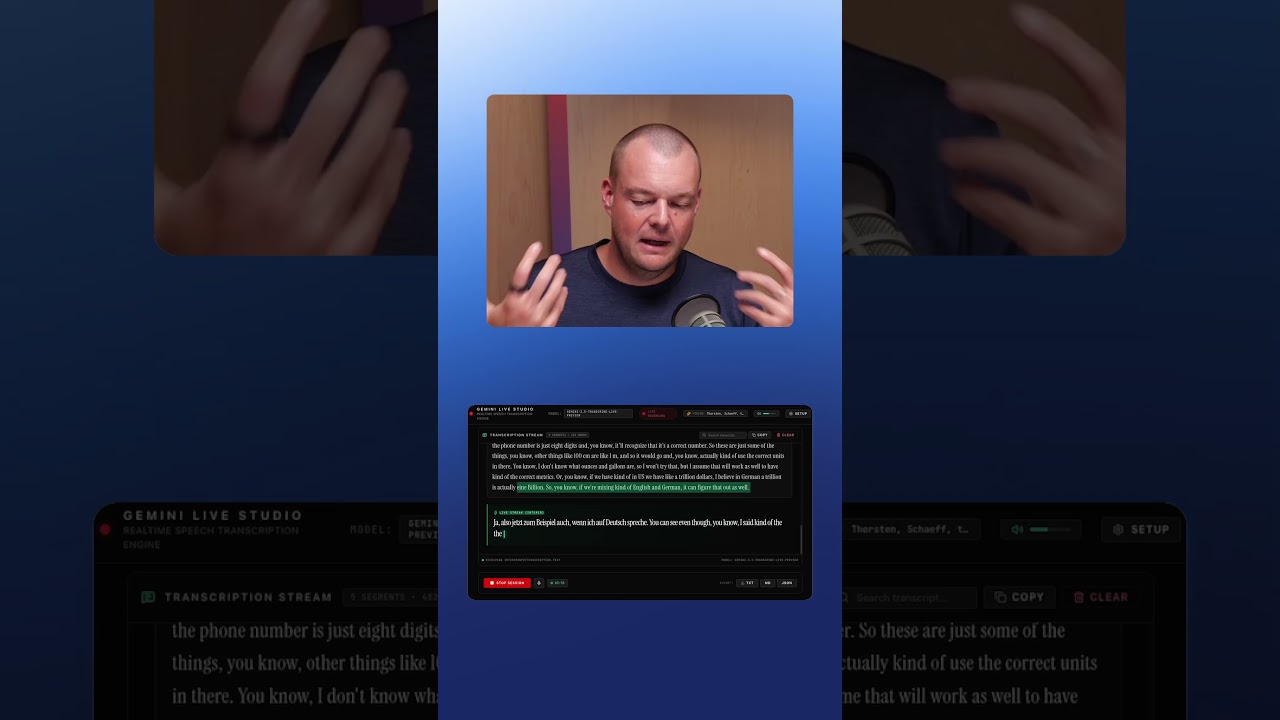
Build voice-first apps with Gemini 3.5 Transcribe

Google launched Gemini 3.5 Transcribe, an advanced LLM-based model designed for building voice-first applications. This model is available via both the Interactions API and the Live API, offering fast, contextually accurate transcription of multi-speaker recordings. Key strengths include superior recognition of structured data like email addresses and phone numbers, as well as robust support for over 70 different languages.

Key takeaways

  1. Model Availability

    Gemini 3.5 Transcribe is available on both the Interactions API and the Live API.

  2. Structured Data Recognition

    The LLM-based model excels at transcribing alphanumerics, such as email addresses (e.g., thorwebdev@google.com) and recognizing correct US phone number formats.

  3. Multi-Language Support

    The model can recognize and transcribe over 70 different languages, even when language hints are set to English.

Watch on YouTube Full article

How to build with Gemini 3.5 Transcribe thumbnail

· 4:50

How to build with Gemini 3.5 Transcribe

Google DeepMind launched Gemini 3.5 Transcribe, an LLM-based transcription model available via both the Interactions API and the Live API. This model significantly enhances accuracy by correctly transcribing complex data types—such as email addresses, phone numbers, and mixed units of measurement—and maintaining high performance across over 85 supported languages, even when language codes are set to English.

Key takeaways

  1. LLM-Based Transcription Model

    The model's LLM foundation allows it to handle complex data structures and context better than traditional transcription models. For example, it can correctly identify and edit email addresses even if spoken phonetically (e.g., 'tosten at google.com').

  2. Handling Complex Data Types 2:00

    Gemini 3.5 Transcribe accurately recognizes specific formats, including US phone numbers and international variations (e.g., Singapore's 8-digit format). It can also correctly interpret units of measure (e.g., meters vs. centimeters).

  3. Multilingual and Customization Support 0:40

    The model supports over 85 languages, automatically recognizing spoken language even if language hints are set to English. Accuracy can be further improved by providing custom vocabulary (e.g., names of people in a meeting) or setting specific language codes.

Watch on YouTube Full article

What are the new features in Android Studio Quail 2? thumbnail

· 1:52

What are the new features in Android Studio Quail 2?

Android Studio Quail 2 introduces significant updates aimed at unifying and accelerating the development and debugging cycle. Key enhancements include parallel multitasking for agentic tasks via Gemini, direct integration of Leak Canary into the Android Studio profiler for faster memory leak detection, and integrating App Quality Insights to analyze production crashes, suggest fixes across multiple files, and deploy those fixes for verification.

Key takeaways

  1. Multitasking with Parallel Agents

    The Gemini app agent mode has been redesigned to allow users to initiate, run, and manage multiple agentic tasks simultaneously across different chats, eliminating the need to wait for one task to complete before starting another.

  2. Built-in Memory Leak Detection

    The Leak Canary library is now built directly into the Android Studio profiler. This streamlines memory leak detection, making it faster and easier to identify issues without slowing down test devices.

  3. App Quality Insights Integration

    Android Studio can now analyze production crashes using App Quality Insights. It has the ability to fix complex, multi-file crashes and deploy those fixes to an emulator for verification.

Watch on YouTube Full article