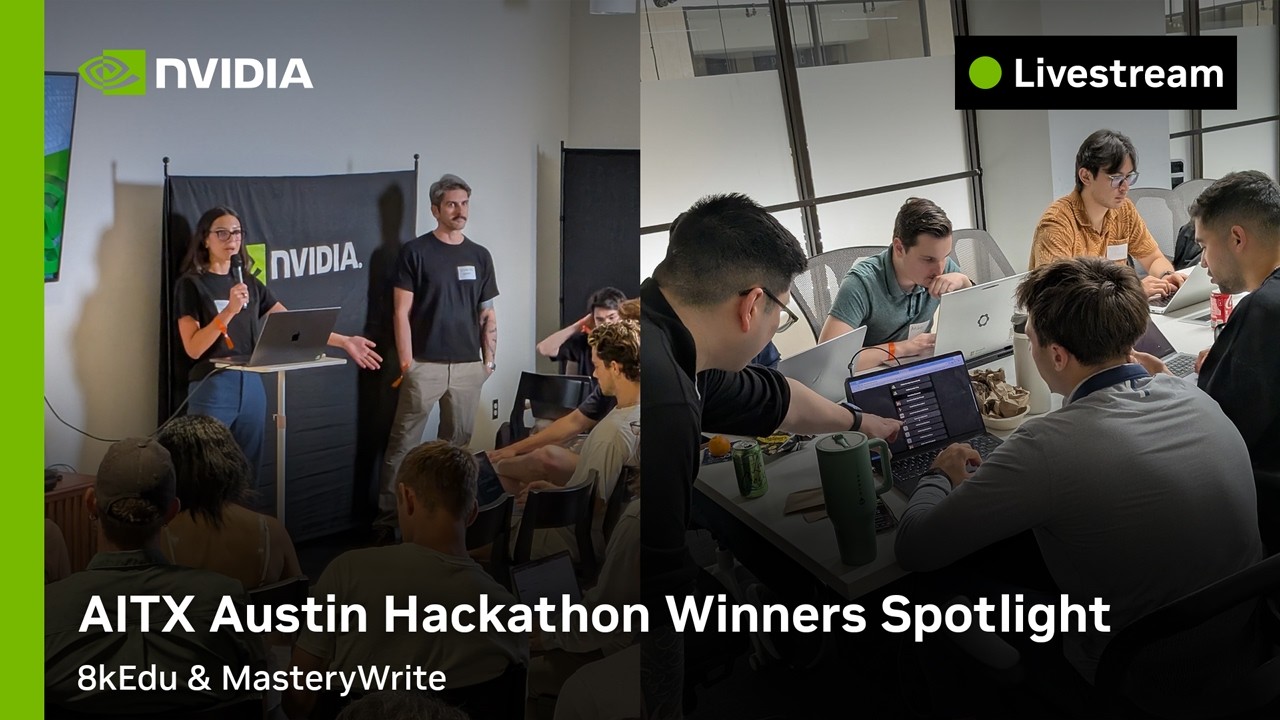
AITX Austin Hackathon Winners Spotlight
Summary
This technical spotlight details two winning autonomous agent applications from the AITX Hackathon: MasteryWrite and 8kEdu. Both projects demonstrate advanced capabilities beyond simple chat, focusing on taking real-world action in educational technology (EdTech). Key architectural takeaways include using specialized frameworks like NemoClaw/OpenShell to enforce policies around student PII data, implementing continuous self-improvement loops for assessment grading, and leveraging Visual Language Models (VLMs) to transform video lectures into interactive learning widgets.
Key takeaways
-
MasteryWrite: Autonomous Assessment Engine
2:00
This agent scores student essays against a rubric, explains its reasoning, and uses an autonomous evaluation loop to improve its own grading criteria over time. The system is designed to handle complex educational assessment while maintaining strict policies around student PII data.
-
8kEdu: Interactive Video Learning
5:05
The agent transforms YouTube lectures into interactive learning experiences. Instead of relying on the entire transcript, it focuses on specific video frames (e.g., a matrix calculation) to generate editable widgets (charts, notebooks), allowing users to learn concepts from multiple sources and build recursive learning graphs.
-
Local Model Deployment for Edge Cases
7:50
The teams highlighted the utility of running models locally (e.g., using DGX Spark) to manage costs, ensure privacy, and run complex video-based inferences without constant reliance on external APIs.
Technical details
-
Agent Frameworks & Guardrails
160s
The use of NemoClaw/OpenShell was crucial for implementing policies that govern agent actions, specifically preventing the misuse or leakage of student PII data and ensuring reliable scraping of public rubrics.
-
Visual Language Models (VLMs)
320s
The 8kEdu project utilizes Neotron's omni model to understand content within specific video frames, allowing the system to recognize and generate widgets based on both the visual data and the accompanying transcript.
-
Self-Improvement Loops
120s
MasteryWrite incorporates an autonomous evaluation loop that allows the grading engine to iteratively improve its performance, moving beyond simple prompt-based scoring and aiming for deterministic results.
-
Model Efficiency & Cost Management
470s
The teams noted that hyper-optimizing smaller, local models (e.g., running on DGX Spark) can achieve performance surprisingly close to larger cloud models for specific use cases, mitigating high API costs.
Mentioned resources
- MasteryWrite Repository
- 8kEdu Project Demo/Repo
- NVIDIA Developer Discord
Channel & topics
Watch on YouTube · Back to latest
This independent, AI-assisted summary is provided for commentary and informational purposes. It may contain errors or omit important context. Please watch the original video for the creator's complete presentation. Video, thumbnail, and related copyrights belong to their respective owners.