Topic

Local Inference

All digests tagged Local Inference

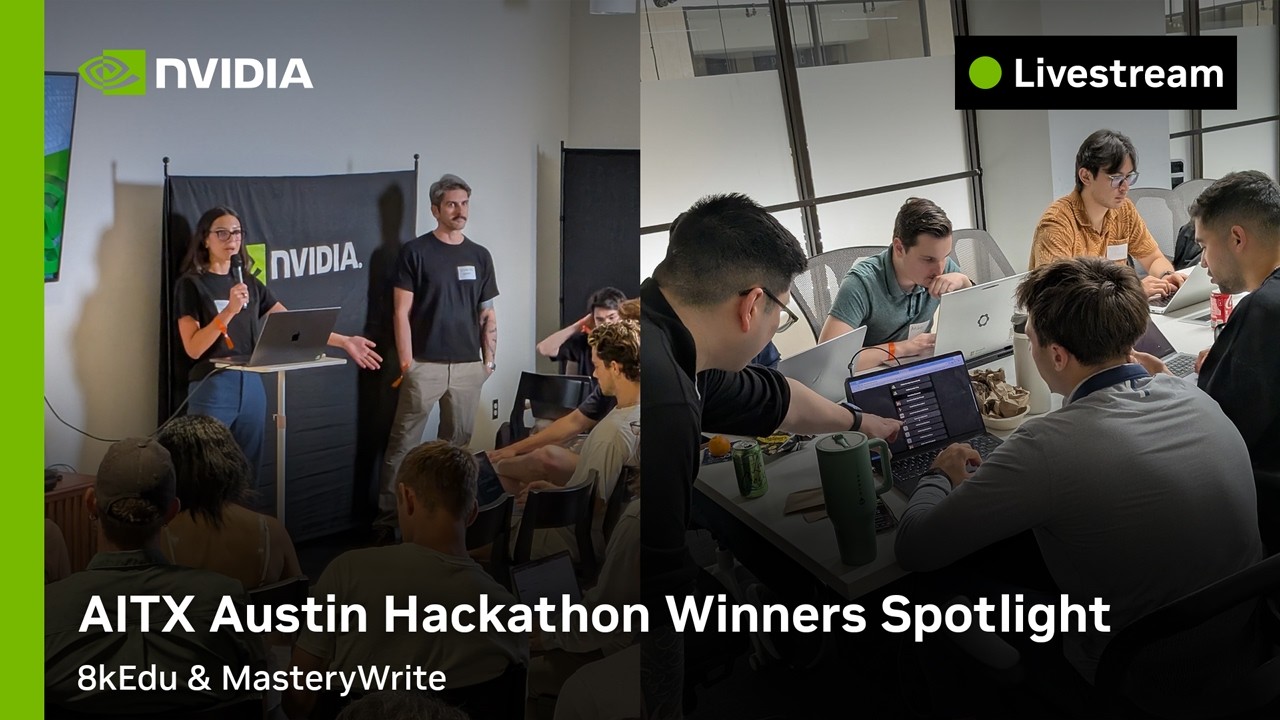
AITX Austin Hackathon Winners Spotlight thumbnail

· 36:43

AITX Austin Hackathon Winners Spotlight

This technical spotlight details two winning autonomous agent applications from the AITX Hackathon: MasteryWrite and 8kEdu. Both projects demonstrate advanced capabilities beyond simple chat, focusing on taking real-world action in educational technology (EdTech). Key architectural takeaways include using specialized frameworks like NemoClaw/OpenShell to enforce policies around student PII data, implementing continuous self-improvement loops for assessment grading, and leveraging Visual Language Models (VLMs) to transform video lectures into interactive learning widgets.

Key takeaways

  1. MasteryWrite: Autonomous Assessment Engine 2:00

    This agent scores student essays against a rubric, explains its reasoning, and uses an autonomous evaluation loop to improve its own grading criteria over time. The system is designed to handle complex educational assessment while maintaining strict policies around student PII data.

  2. 8kEdu: Interactive Video Learning 5:05

    The agent transforms YouTube lectures into interactive learning experiences. Instead of relying on the entire transcript, it focuses on specific video frames (e.g., a matrix calculation) to generate editable widgets (charts, notebooks), allowing users to learn concepts from multiple sources and build recursive learning graphs.

  3. Local Model Deployment for Edge Cases 7:50

    The teams highlighted the utility of running models locally (e.g., using DGX Spark) to manage costs, ensure privacy, and run complex video-based inferences without constant reliance on external APIs.

Watch on YouTube Full article

Llama.cpp vs vLLM: Which Local LLM Engine Actually Scales? thumbnail

· 10:36

Llama.cpp vs vLLM: Which Local LLM Engine Actually Scales?

The video compares Llama.cpp and vLLM, two leading engines for running Large Language Models (LLMs) locally. Llama.cpp is optimized for accessibility on consumer hardware (CPU/GPU), utilizing techniques like quantization and the GGUF format to run models efficiently on personal devices or edge environments. Conversely, vLLM focuses on maximizing efficiency at production scale, supporting diverse accelerators (NVIDIA, TPU, etc.) and implementing advanced optimizations such as continuous batching and paged attention for high-throughput workloads in cloud or Kubernetes deployments.

Key takeaways

  1. Llama.cpp Use Case

    Ideal for running LLMs on consumer hardware (laptops, Raspberry Pi) or edge devices due to its focus on accessibility and CPU/GPU optimization. Key features include quantization (reducing precision from FP16 to INT8/INT4) and packaging models into a single .gguf file.

  2. vLLM Use Case 4:10

    Designed for high-throughput, production-scale workloads in environments like VMs or Kubernetes. It supports diverse hardware accelerators (NVIDIA GPUs, TPUs, etc.) and advanced features like continuous batching and paged attention to manage KV cache efficiently.

  3. Model Deployment Strategy 8:10

    The choice depends on the environment: use Llama.cpp for personal/offline use cases, and vLLM when deploying in a high-performance, multi-user production setting.

Watch on YouTube Full article