Your Agent Didn't Fail. Your Harness Did. — Vinoth Govindarajan, OpenAI
Summary
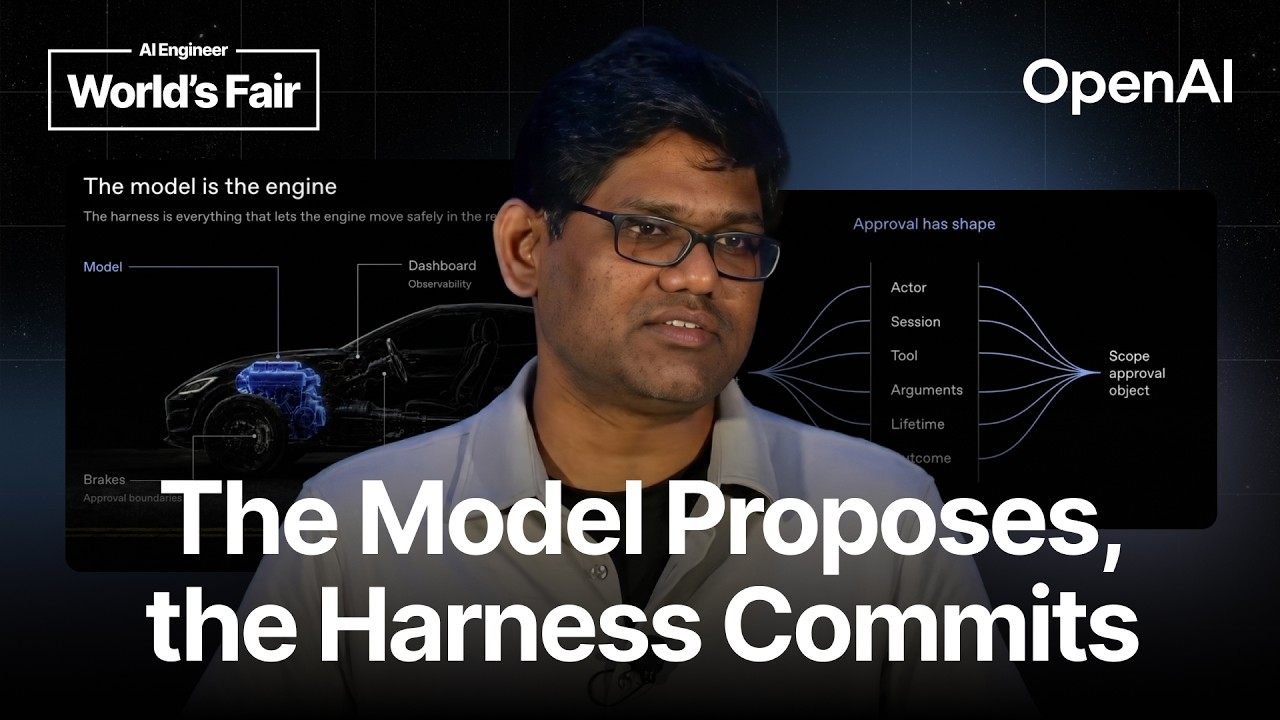
The talk argues that most production failures in AI agents are not due to model hallucination or poor reasoning, but rather 'harness failures'—flaws in the underlying system architecture. The core principle is establishing a clear boundary: while a model can only propose an action, the surrounding harness must own the state transition, enforce ordered commits, and provide verifiable proof (the receipt) that the action was successfully executed and observed by the user.
Key takeaways
-
Model Proposes, Harness Commits, Receipt Proves
4:06
The model generates capability; the harness provides control. The system must own state transitions, enforce ordered mutations, and use a receipt to prove that an action was executed and visible to the user.
-
Own the State, Order the Mutation, Prove the Action
5:20
These three principles are critical for reliable agent systems. A fact must have a single owner (system of record) and a clear replay path; mutable state requires one ordered commit path.
-
The Run Receipt Audit
To audit an agent system, ask five questions: What woke it up (trigger)? What state did it inherit? Which authority did it use? What executed? And what evidence survived?
Technical details
-
State Ownership and Persistence
414s
The system of record (owner) must be defined for every fact. If no named owner can reliably replay a fact, the agent has not truly remembered it. The harness rebuilds working state from multiple sources (transcript, session state, memory, policy).
-
Overlapping Writes and Concurrency
548s
The 'last writer wins' approach is insufficient. To maintain consistency, the system must enforce one ordered commit path for a mutable state boundary using mechanisms like queues (Q), mutexes (mutx), transactions, or locks.
-
Lifecycle Failure Modes
1009s
The run cannot wait indefinitely. Every external boundary needs a terminal outcome: Success, failure, timeout, cancel, or max attempts. Runs must implement deadlines and cancellation mechanisms to prevent the system from getting stuck.
-
Authority Scoping (Approval Drift)
Capability is not execution; requestability is not authority. Approvals must be treated as scoped execution states, binding to a specific action and remaining tied to it even during retries or callbacks. The principle of least privilege should narrow the tool surface.
-
Proof vs. Claim (Missing Edge Proof)
Internal component success does not equate to external proof. A successful API call only proves the internal path accepted the request; it does not prove the user saw the result. The receipt must confirm the outcome at the user-visible boundary.
Mentioned resources
- OpenClaw
- The Agent Stack
Channel & topics
Watch on YouTube · Back to latest
This independent, AI-assisted summary is provided for commentary and informational purposes. It may contain errors or omit important context. Please watch the original video for the creator's complete presentation. Video, thumbnail, and related copyrights belong to their respective owners.