Topic

AWS Bedrock

All digests tagged AWS Bedrock

Harness Engineering: Building the Production Cage for Powerful Domain Agents — Mike Chambers, AWS thumbnail

· 20:46

Harness Engineering: Building the Production Cage for Powerful Domain Agents — Mike Chambers, AWS

The presentation introduces 'Harness Engineering,' a critical concept for building production-grade AI agents at scale. Mike Chambers distinguishes between agents that are used (e.g., coding assistants) and agents that are built. For built agents, the harness encompasses all non-model components—such as memory, skills, tools, identity, and context management—that must scale independently. The core principle is that scaling these components separately, rather than deploying them in a single container, is essential for handling thousands of users and maintaining reliability.

Key takeaways

  1. Two Types of Agents 4:05

    Agents are categorized into 'agents we use' (productivity tools, coding assistants) and 'agents we build' (production-scale systems). The approach for built agents requires careful architectural planning.

  2. Defining the Harness 7:04

    A harness is defined by subtraction: take an agent and remove the model component; everything left over is the harness. This includes the infrastructure, skills, and tools.

  3. Scaling Built Agents 10:57

    For production agents, the harness must manage complex concerns like loop management, scaling, payments, identity, runtime, context management, and observability. Attempting to containerize everything together is incorrect for high scale.

  4. Avoiding 'Slop Ops' 10:07

    Build engineers must avoid 'slop ops' (clicking around a console to deploy resources). Instead, agents must build infrastructure using Infrastructure as Code (IaC) to maintain ownership and control over cloud deployments.
Watch on YouTube Full article

From AI-Assisted to AI-Native: Building a Frontier Development Team — Clare Liguori, AWS thumbnail

· 20:57

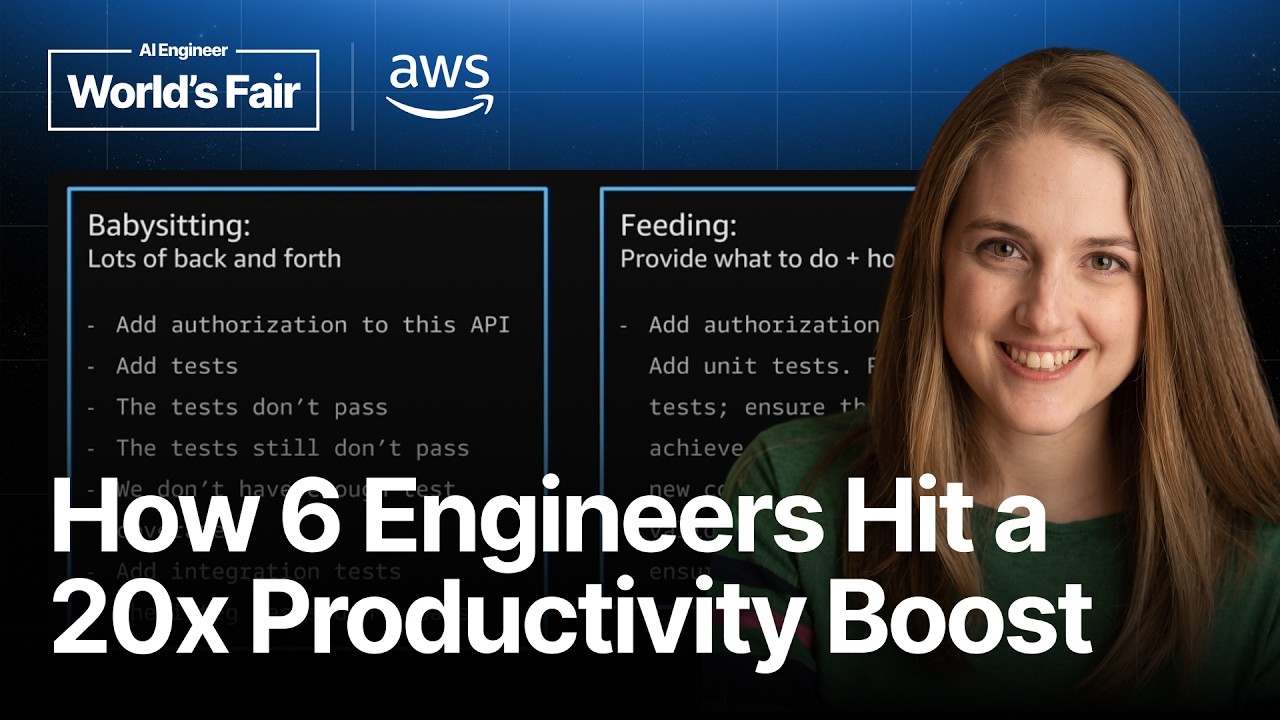
From AI-Assisted to AI-Native: Building a Frontier Development Team — Clare Liguori, AWS

Frontier development represents a step-function improvement in productivity using AI agents, moving beyond simple coding assistance. The core finding is that success is not dependent on the tools themselves, but rather on intentionally changing engineering workflows and building new habits. Key practices include investing heavily in agent context, slowing down to refactor codebases (e.g., migrating from untyped languages like Python/JavaScript to TypeScript or Rust), implementing parallel agent execution, making intent explicit via documentation, and shifting testing left using local deterministic mocks.

Key takeaways

  1. Frontier Development Definition

    Productivity gains are characterized by engineers writing only 1-2% of the code; agents running for hours without interruption; and multiple agents operating in parallel. This represents a median productivity improvement of 4.5x to over 10x compared to previous AI phases (0:00, 7:04).

  2. The Importance of Process Over Tools 11:44

    A pilot study involving 50 teams on existing codebases found that the difference between <3x and >4.5x productivity gains was determined by how the team worked, not the AI tools used (9:21).

  3. New Bottleneck Identification 18:58

    As coding speed increases dramatically, the bottleneck shifts from writing code to decision-making speed and organizational review processes. Fast decisions, especially reversible ones, are critical for scaling (11:38).

Watch on YouTube Full article