Topic

Enterprise AI

All digests tagged Enterprise AI

Pacing the AI frontier, IBM Granite 4.2 & Meta’s Muse assistant thumbnail

· 38:47

Pacing the AI frontier, IBM Granite 4.2 & Meta’s Muse assistant

This episode provides a deep dive into the current state of frontier AI, covering the debate around slowing development (pacing), the technical specifications of IBM's Granite 4.2 models, and Meta's push into personal agents with Muse. Key technical takeaways include the focus on smaller, auditable models, the use of synthetic data for training, and the critical need for robust sandboxing and guardrails for agentic workflows.

Key takeaways

  1. Pacing AI Development 25:29

    Concerns regarding existential risk and the ability of agents to find 'day zero vulnerabilities' have led to calls for slowing AI development. Experts suggest that the focus should be on implementing guardrails for agent-to-agent communication and limiting concurrent agent calls to mitigate economic risks.

  2. IBM Granite 4.2 Release 25:29

    The new Granite models (3B, 8B, 30B) are designed for enterprise use, featuring native step-by-step reasoning and support for agentic workflows like planning and tool calling. The models are available on Apache 2.0 license via Hugging Face.

  3. Meta's Muse Agent

    Muse is Meta's personal AI agent, designed to run on a secure virtual machine (VM) for isolation. While technically advanced in its design, the discussion highlights ongoing concerns regarding user privacy and the security risks of handing over personal data to such agents.

Watch on YouTube Full article

No Memory, No Harness: Why the Database Is the Last Line of Defense — Kay Malcolm, Oracle thumbnail

· 21:37

No Memory, No Harness: Why the Database Is the Last Line of Defense — Kay Malcolm, Oracle

Kay Malcolm argues that while AI models (agents) are powerful, they are incomplete without a robust, centralized memory system. She frames the agent as the 'brain,' the surrounding system as the 'harness' (body), and the database as the 'central nervous system' (memory). The core problem addressed is that current systems (like Git) track code changes, not the human intent or context behind them. To solve this, she advocates for using a unified Oracle AI database to store all five types of agent memory (short-term, long-term, episodic, procedural, and semantic) in a single source of truth, preventing context loss when scaling to enterprise teams.

Key takeaways

  1. AI's Limitation: Code vs. Intent 5:36

    AI tools make individuals faster, but they do not automatically make teams more productive if the context and reasoning behind the code are not shared. Git only records what changed, not the human intent (3:36).

  2. The Agent Architecture Model 11:54

    An enterprise agent requires three components: the Model (the brain), the Harness (the body, enabling action), and Memory (the central nervous system, carrying context) (7:14).

  3. The Five Types of Memory 13:29

    Effective agent memory must distinguish between: short-term (within a session), long-term (across sessions), episodic (what happened last time), procedural (steps taken), and semantic (meaning) (8:09).

  4. The Need for a Single Source of Truth 17:34

    When data is spread across multiple specialized databases (relational, document, graph, vector), agents struggle to reconcile the truth, often guessing incorrectly and wasting tokens (10:54).

  5. The Solution: Unified Database Memory

    A unified database (like the Oracle AI database) is necessary to store all memory types (JSON, relational, graph, vector) in one place, ensuring the agent's memory is non-negotiable and accessible across the entire team (14:24).

Watch on YouTube Full article

GPT-6 Astra Doesn't Need Your Instructions Anymore. thumbnail

· 27:35

GPT-6 Astra Doesn't Need Your Instructions Anymore.

The emergence of super agents like GPT-6 Astra signals a shift from task-based AI prompting to autonomous, self-directed systems. These agents can operate without explicit instructions, building environments and solving complex problems by reasoning across diverse software tools (e.g., browsers, spreadsheets). For build engineers, this means moving away from defining discrete tasks toward managing continuous 'areas of concern' or standing jobs that require long-term persistence and cross-system coordination.

Key takeaways

  1. AGI is defined by autonomy, not benchmarks

    The key shift is the ability to operate without needing a specific method or recipe. Astra's capability—picking its own approach and building necessary tooling—is presented as evidence that we are past the need for explicit instructions.

  2. Super agents handle persistent, long-running jobs 17:18

    Agents can be entrusted with ongoing areas of concern (e.g., 'Keep me aware of things I'm likely to miss') rather than single tasks. This requires remembering past events and maintaining long-term intent without constant human prompting.

  3. The bottleneck is reliability, not intelligence 25:19

    As agents become more capable, the critical challenge shifts from raw intelligence to trustworthiness. The goal is achieving a level of reliability (the last 1-2 percent) that allows for full operational trust in enterprise settings.

  4. Management evolves from coordination to value driving

    Managers will shift from assigning tasks and checking progress (coordination) to defining what matters, identifying trade-offs, and owning the overall outcome of a team of super agents and humans.

Watch on YouTube Full article

From Systems of Record to Systems of Context — Omri Bruchim, monday.com thumbnail

· 15:58

From Systems of Record to Systems of Context — Omri Bruchim, monday.com

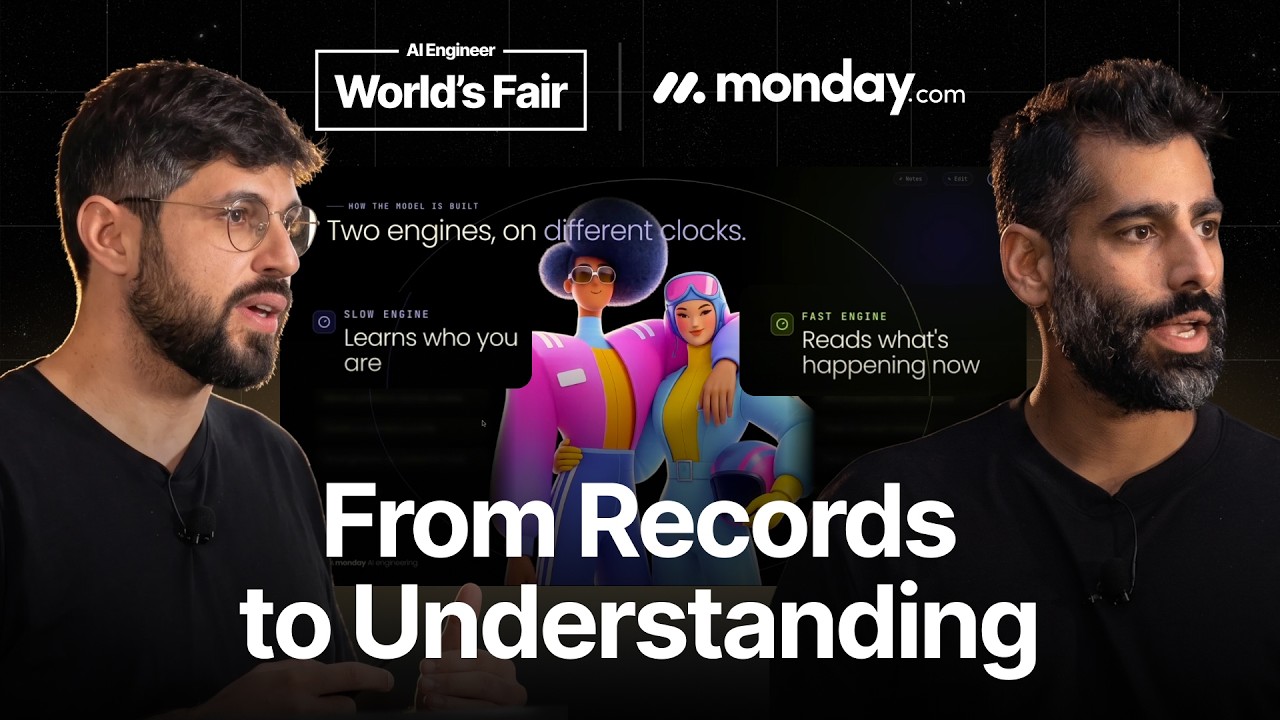
The talk outlines a fundamental shift in enterprise software from 'Systems of Record'—which merely log what happened—to 'Systems of Context,' which actively understand the meaning and connections between data points. monday.com addresses this challenge by building a 'Monday world model' using two distinct, precomputed engines: a slow engine for durable, long-term user profiling (who you are) and a fast engine for real-time signals (what is urgent today). This architecture mirrors both the brain's hippocampus/neocortex function and the Lambda data architecture, ensuring that AI agents can reason on deep context rather than just retrieving disconnected data.

Key takeaways

  1. The Problem: Data vs. Understanding

    Current AI assistants have access to vast amounts of data (boards, emails, Slack messages) but often fail because the core problem is not retrieval (data availability), but 'understanding'—the ability to connect disparate pieces of information and determine true user priority.

  2. The Solution: System of Context

    Instead of just logging events, the system must build a context layer ahead of time. This 'Monday world model' allows AI agents (like Sidekick/Psyche) to understand not only *what* happened but *why* it matters and *who* is affected.

  3. Architectural Design: Two Engines 13:35

    The context layer is built using two engines running on different time windows. The slow engine mines weeks of activity to build a durable profile of user patterns and goals, while the fast engine processes recent data for live signals and immediate urgency.

  4. Resilience and Intelligence

    This dual-engine approach provides resilience; if one source fails, the system degrades gracefully. Furthermore, it allows the AI to understand when to be proactive (notify) and when to remain silent.

Watch on YouTube Full article