Topic

AI Agent Development

All digests tagged AI Agent Development

Managed Deep Agents explained in 20 minutes thumbnail

· 18:17

Managed Deep Agents explained in 20 minutes

Managed Deep Agents provides an integrated framework to simplify the entire lifecycle of building, running, and deploying AI agents into production. It addresses the complexity of agent infrastructure by bundling the open-source Deep Agents harness with necessary components like durable execution, context management (via Context Hub), sandboxes, and scheduling capabilities, allowing developers to move from local business logic directly to a scalable, managed deployment on LangSmith.

Key takeaways

  1. Agent Architecture Components

    An agent requires three layers: 1) Business Logic (provided by the user, e.g., prompts/tools); 2) Harness (orchestrates context and passes data to the model); and 3) Infrastructure (runtime, sandboxes, etc.). Managed Deep Agents bundles these into a seamless package.

  2. Production Readiness 2:05

    The framework handles complex production requirements such as durable execution, fault tolerance, streaming, queueing, run cancellation, and rollbacks, which are necessary when moving agents from local development to cloud serving.

  3. Decoupled Context Management 5:05

    Context (instructions and skills) is stored in the dedicated Context Hub. This allows non-developers to edit and maintain agent context via a UI without requiring code changes or redeployments, significantly improving collaboration.

  4. Deployment Workflow 10:30

    The process involves initializing the project using `MDA innit research assistant`, defining components (e.g., tools in `tools/search.py`), and deploying via `MDA deploy`. This pushes context to Context Hub and creates a deployment on LangSmith.

Watch on YouTube Full article

Voice Agent observability with LangSmith thumbnail

· 7:38

Voice Agent observability with LangSmith

This session details how to implement robust observability for voice agents built using the Google ADK and Gemini Live model by integrating LangSmith tracing. The process involves defining a custom plugin that captures not only the conversation transcript but also the full audio stream (user input and agent output). This visibility allows engineers to debug complex interactions, analyze tool usage, track interruption events, and monitor token-level costs for production readiness.

Key takeaways

  1. Gemini Live Model Functionality

    Gemini Live is Google's native audio model that operates in a speech-to-speech manner. It takes audio directly as input and produces audio as output without transcribing to text, resulting in low latency and natural, emotive voice quality.

  2. LangSmith for Observability 2:05

    LangSmith is a platform built by LangChain specifically for AI agent observability and evaluations. It provides visibility into the internal workings of the voice agent, which is crucial for safe production deployment.

  3. Capturing Conversation Audio 4:00

    To ensure the 'source of truth' for a voice interaction is captured, the tracing setup must include functions to record both user audio and agent audio. Recording agent audio requires careful placement (e.g., using a `set play callback` on the audio out class) to capture only what the user actually heard.

Watch on YouTube Full article

Brian Douglas - The beginners guide to training AI on your own code - AI Native DevCon June 2026 thumbnail

· 31:44

Brian Douglas - The beginners guide to training AI on your own code - AI Native DevCon June 2026

This talk outlines a closed-loop system for training AI agents using proprietary code execution traces. The core concept involves capturing every agent interaction (telemetry) via an open-source proxy (tapes.dev), structuring this data into a content-addressable Merkle DAG. This raw trace data is then processed by streaming tools like Kafka and Flink SQL to detect anomalies, which feeds back into the agent's next run—creating a 'self-healing loop.' The captured traces are used for supervised fine-tuning (SFT) or Direct Preference Optimization (DPO) to embed learned skills directly into local models, eliminating reliance on external training data.

Key takeaways

  1. Closed-Loop Agent Training 3:50

    Agents generate data by running in an environment; this telemetry is captured and used immediately for model improvement. This creates a self-healing infrastructure loop, allowing agents to learn from failures (anomalies) and successes.

  2. Data Capture Infrastructure 10:30

    The open-source proxy, tapes.dev, intercepts LLM API calls to build a content-addressable Merkle DAG of every conversation turn, requiring zero instrumentation.

  3. Anomaly Detection and Feedback 2:00

    Streaming pipelines (Kafka/Flink SQL) run continuous anomaly detection on session data (e.g., stuck loops, token spikes). Alerts generated by Flink are read by the agent before its next execution, enabling self-correction.

  4. Knowledge Transfer Methods 22:00

    Captured traces can be used for Specialized Fine-Tuning (SFT) or Direct Preference Optimization (DPO). SFT embeds skills into the model, while DPO uses preference data derived from successful vs. failed sessions.

Watch on YouTube Full article

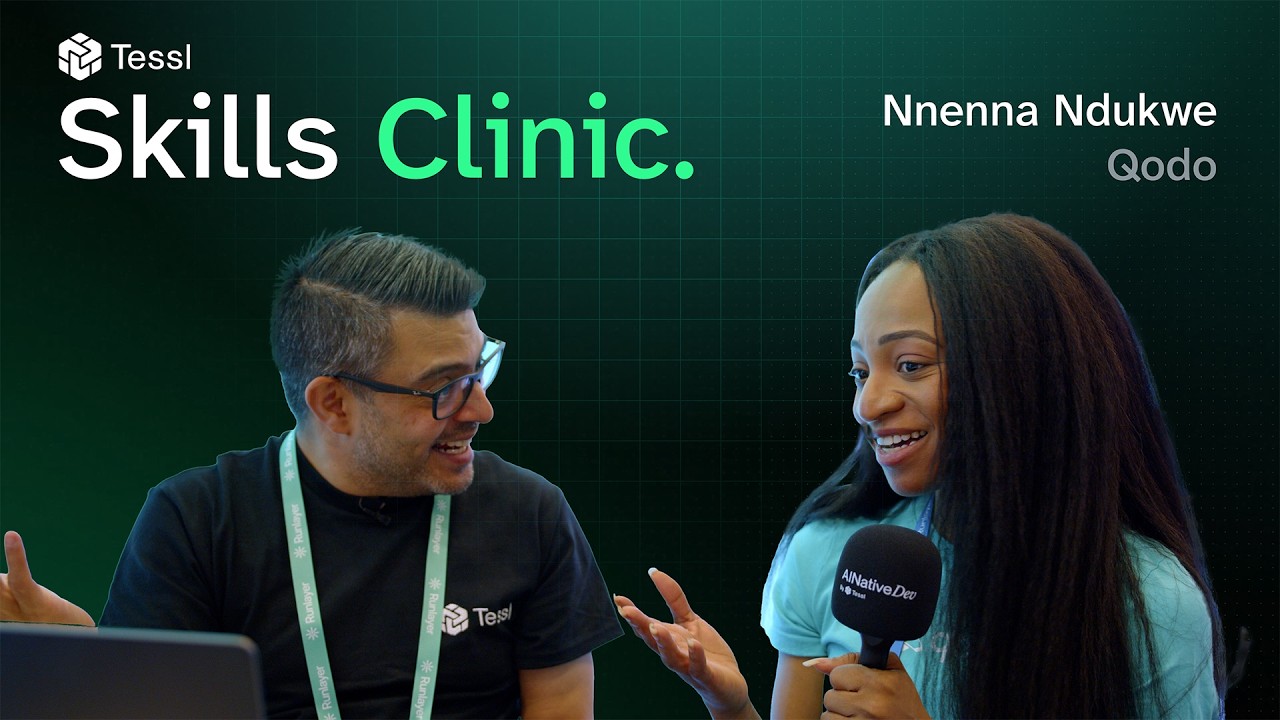
Tessl Skills Clinic - Nnenna Ndukwe from Qodo thumbnail

· 16:56

Tessl Skills Clinic - Nnenna Ndukwe from Qodo

The session demonstrates how automated AI agent skills can be rigorously tested and improved using Tessl's review process against Anthropic's best practices. By applying human-guided refinements—particularly enhancing the skill description with natural trigger phrases and optimizing structure—the Qodo PR Resolver skill score jumped from 78% to 89%. This highlights that while AI generation is powerful, manual validation and refinement are crucial for achieving high-quality, reliable agent performance in production workflows.

Key takeaways

  1. Skill Description is Critical for Agent Triggering

    The skill's description metadata is identified as the single biggest factor determining if an agent will use it. Improving this by adding natural trigger phrases (e.g., 'coding issues,' 'code reviews') significantly increases discoverability and usage likelihood.

  2. Human Refinement Boosts Skill Quality

    Research suggests that while AI-generated skills are useful, validated and refined skills (human intervention) show a significant performance uplift. The average jump observed was approximately 14% for human-written skills.

  3. The Importance of Post-Fix Verification

    It is a best practice to include a validation step (e.g., running linters and static analysis) after an agent has applied fixes, ensuring the code remains compliant even after automated changes.

Watch on YouTube Full article