Topic

Google AI

All digests tagged Google AI

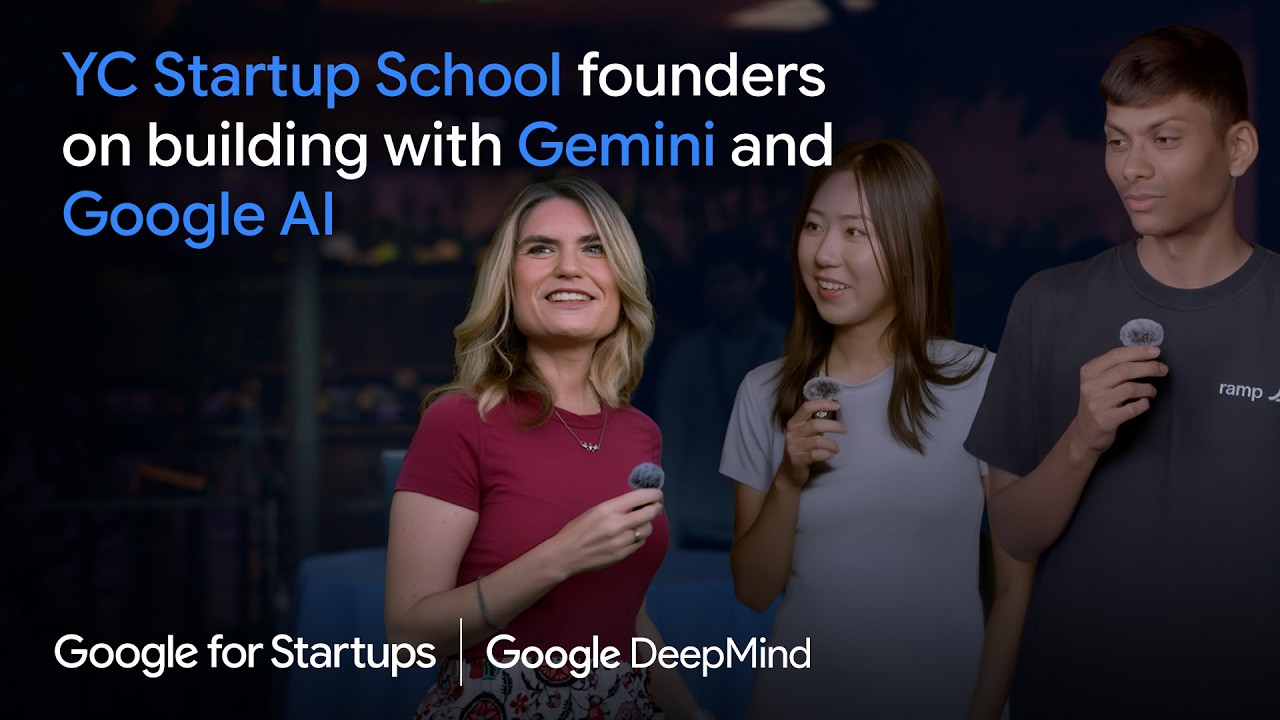
How builders at YC Startup School are using Gemini & Google AI thumbnail

· 2:05

How builders at YC Startup School are using Gemini & Google AI

Founders and students at the YC Startup School demonstrated diverse applications of Google AI tools, including Gemini and Gemma. Use cases ranged from leveraging Gemini 3.1 Flash for multilingual document parsing (e.g., international receipts) to utilizing AlphaFold for visualizing bacterial mutations related to antibiotic resistance research. The speakers highlighted the efficiency and context window capabilities of models like Gemini Flash for complex tasks.

Key takeaways

  1. Multilingual Document Parsing 0:25

    Gemini 3.1 Flash is used to parse international receipts from various locations (e.g., Japan, Korea), demonstrating robust multilingual capabilities.

  2. Antibiotic Resistance Research 0:37

    AlphaFold is employed to visualize and study different bacterial mutations, supporting global impact in the pharma and drug discovery industry.

  3. AI for Deep Research Synthesis 0:58

    Gemini's research mode (Deep Research) assists with synthesizing ideas and connecting concepts, particularly useful for neuroscience research or academic papers.

Watch on YouTube Full article

How are large language models trained? thumbnail

· 10:09

How are large language models trained?

Large Language Models (LLMs) undergo two core training phases: pre-training and post-training. Pre-training uses next token prediction on massive datasets to build foundational language knowledge. Post-training refines this model for safety, helpfulness, and instruction following using techniques like Supervised Fine-Tuning (SFT) and Reinforcement Learning (RL). The process requires complex engineering at scale, including managing petabytes of data and utilizing advanced evaluation methods like auto-raters.

Key takeaways

  1. Pre-training: Foundational Knowledge

    The initial phase trains the model using next token prediction (a self-supervised task). This allows the LLM to implicitly learn language patterns and world knowledge without manual labeling. Scaling this process is a massive engineering challenge, requiring complex parallelism across thousands of interconnected GPUs, automated recovery systems, and pipelines for petabytes of data.

  2. Post-training: Alignment and Refinement 5:40

    This phase focuses on aligning the model to be safe, helpful, and accurate. It primarily involves Supervised Fine-Tuning (SFT) using gold standard examples, or Reinforcement Learning (RL), where a separate Reward Model grades responses for quality, pushing the LLM toward desired behaviors.

  3. Evaluation and Measurement 7:40

    Measuring model success requires defining clear criteria. While pre-training measures next word prediction accuracy, post-training focuses on alignment (e.g., helpfulness). Evaluation is scaled using a second LLM—an auto rater—to score responses against defined criteria.

Watch on YouTube Full article

Get started with the Interactions API thumbnail

· 8:51

Get started with the Interactions API

The Interactions API is now generally available and serves as a unified interface for interacting with various Gemini models and agents. It simplifies complex interactions—ranging from synchronous model calls to multi-step agent workflows in remote environments—by providing a single API endpoint. The API supports stateful operations by allowing users to pass the previous interaction ID, enabling iterative refinement of outputs (e.g., image editing) without re-uploading source data.

Key takeaways

  1. Unified Model Access 0:10

    The Interactions API provides easy access to all Gemini models and agents through a single interface, simplifying development across various Google AI capabilities.

  2. Stateful Interactions 4:05

    The API is stateful; developers can pass the previous interaction ID to build upon prior results, which is crucial for iterative processes like image editing or complex data processing.

  3. Advanced Capabilities 0:18

    New features include managed agents, background execution tool improvements, Deep Research, and media generation (e.g., Nano banana for images, Lyriq 3 for music, TTS for speech).

Watch on YouTube Full article