Topic

Video Synthesis

All digests tagged Video Synthesis

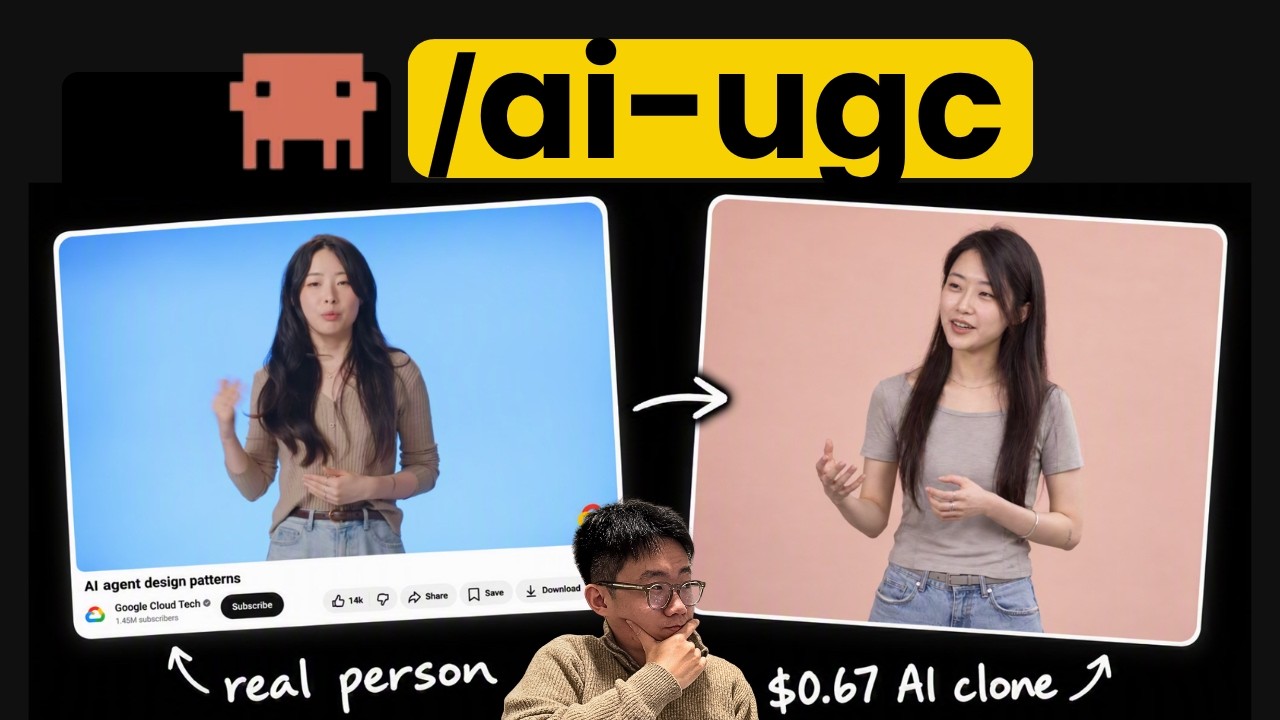
How to run your first AI UGC campaign (step-by-step guide) thumbnail

· 13:47

How to run your first AI UGC campaign (step-by-step guide)

This guide details an automated, multi-stage workflow for generating hyperrealistic User-Generated Content (UGC) at scale, significantly reducing costs from $20-$50 per video to mere cents per second. The process involves analyzing trending content to identify effective hooks and characters, using advanced AI prompting techniques (like JSON output) to create digital characters with specific 'vibes,' and finally generating the video using specialized APIs (such as Cance 2.5) combined with audio cloning and automated scripting.

Key takeaways

  1. UGC Strategy Foundation

    Effective UGC content requires two parts: a strong hook and a product demo. Scaling involves pairing one product demo with multiple variations (5-10) of hooks to test performance.

  2. Character Generation Techniques 1:48

    To generate a character with a specific 'vibe' while maintaining realism, it is crucial to restrict the model's exploratory space by using JSON-based prompts. This prevents the 'AI slop' look often associated with default model outputs.

  3. Model Comparison for Realism 2:20

    While multiple models (e.g., GPT image 2.5, Gemini 3 Pro) can generate characters, the speaker claims Gemini 3 Pro currently yields the most super-realistic results for character generation.

  4. Automated Video Production Workflow 5:20

    The full workflow uses a tool like 'track' to pull trending data, create a character image, and then use the Cance 2.5 model (via a restricted endpoint) to generate the final video. The process can be automated using a dedicated skill that handles scripting, voice cloning, and captioning.

Watch on YouTube Full article

SOTA Generative Media Panel — Dumitru Erhan, Shane Gu & Nicole Brichtova, Google DeepMind thumbnail

· 56:59

SOTA Generative Media Panel — Dumitru Erhan, Shane Gu & Nicole Brichtova, Google DeepMind

The session provided an overview of SOTA generative media models, highlighting new APIs like NanoBanana 2 Lite and Gemini Omni Flash. Key architectural discussions centered on the limitations of language as a sole intermediate representation for complex sensory data (taste, smell, skin tone). The consensus points toward a future requiring unified 'World Models' that integrate visual, temporal, and symbolic reasoning, moving beyond single-modality generation. Evaluation remains highly dependent on human judgment, making robust testing and field feedback critical.

Key takeaways

  1. New APIs Launched for Developers 0:15

    Google launched NanoBanana 2 Lite (the fastest/cheapest image model in the family) and the Gemini Omni Flash APIs. The Omni Flash API enables video generation and editing, priced similarly to V3 fast, making it accessible for developers [0:15-0:40].

  2. Generative Media Capabilities 2:00

    Models can now take diverse inputs (e.g., a storyboard of images, an audio track) to generate video. Furthermore, natural language processing allows for advanced video editing tasks like adding or removing elements from existing footage [1:20-3:00].

  3. The Limitation of Language as Representation 1:50

    Speakers argued that language is an insufficient intermediate representation for highly sensitive sensory data (e.g., taste, smell, skin tone). This suggests a need for more foundational representations, potentially including code or direct binary/latent space conditioning [1:50-2:30].

  4. Evaluation Challenges and Reward Hacking 0:35

    While human preference often favors AI output (e.g., sharper, more saturated images), this metric is unreliable for optimization. External testers have found 'reward hacking' artifacts, such as the model consistently adding wedding rings to hands [0:35-0:45].

Watch on YouTube Full article