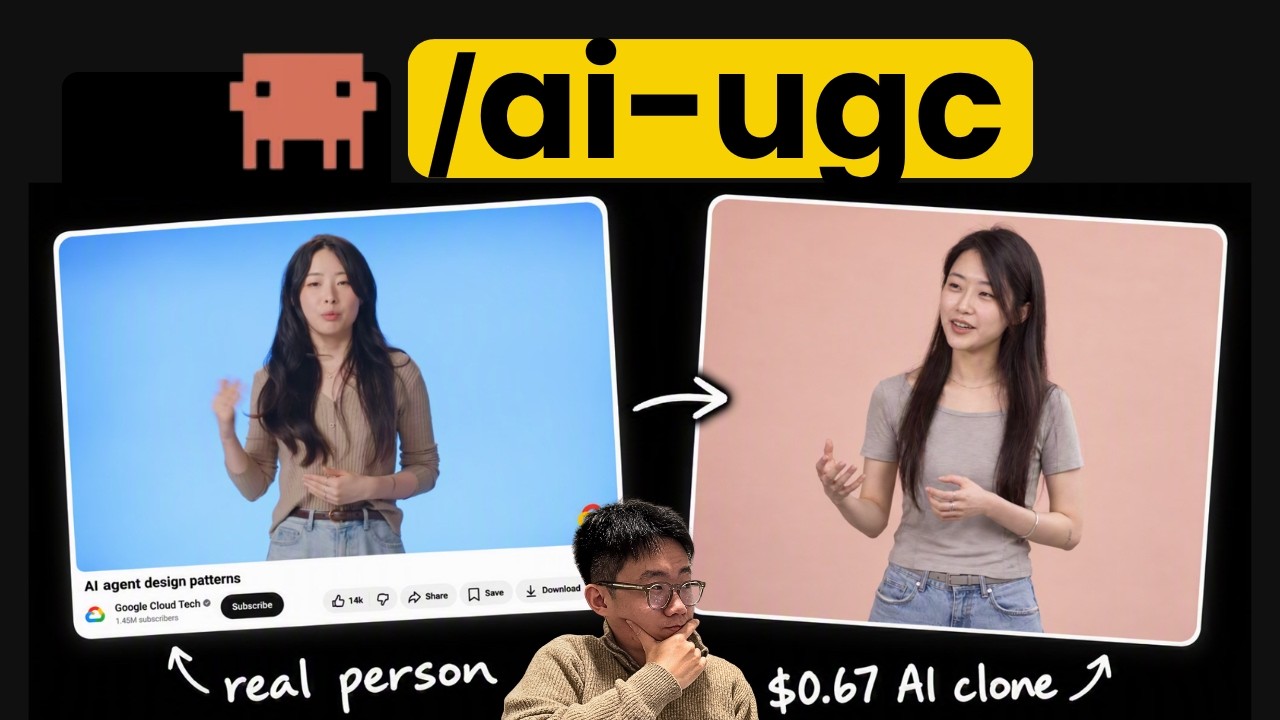
How to run your first AI UGC campaign (step-by-step guide)
This guide details an automated, multi-stage workflow for generating hyperrealistic User-Generated Content (UGC) at scale, significantly reducing costs from $20-$50 per video to mere cents per second. The process involves analyzing trending content to identify effective hooks and characters, using advanced AI prompting techniques (like JSON output) to create digital characters with specific 'vibes,' and finally generating the video using specialized APIs (such as Cance 2.5) combined with audio cloning and automated scripting.
Key takeaways
-
UGC Strategy Foundation
Effective UGC content requires two parts: a strong hook and a product demo. Scaling involves pairing one product demo with multiple variations (5-10) of hooks to test performance.
-
Character Generation Techniques
1:48
To generate a character with a specific 'vibe' while maintaining realism, it is crucial to restrict the model's exploratory space by using JSON-based prompts. This prevents the 'AI slop' look often associated with default model outputs.
-
Model Comparison for Realism
2:20
While multiple models (e.g., GPT image 2.5, Gemini 3 Pro) can generate characters, the speaker claims Gemini 3 Pro currently yields the most super-realistic results for character generation.
-
Automated Video Production Workflow
5:20
The full workflow uses a tool like 'track' to pull trending data, create a character image, and then use the Cance 2.5 model (via a restricted endpoint) to generate the final video. The process can be automated using a dedicated skill that handles scripting, voice cloning, and captioning.