Topic

MCP Gateway

All digests tagged MCP Gateway

AI-Native Organisations Run on Skills: How to Structure and Scale Them — Imad Touil, QuantumBlack thumbnail

· 20:31

AI-Native Organisations Run on Skills: How to Structure and Scale Them — Imad Touil, QuantumBlack

The talk argues that in AI-native organizations, organizational know-how resides primarily within 'skills.' While skills offer deterministic outcomes for complex workflows, ungoverned skills quickly accumulate as a form of technical debt due to duplication and quality decay. To scale effectively, organizations must adopt governance principles—borrowing from the microservices era—by implementing a centralized skills platform that provides metadata, search, versioning, access control, and clear ownership.

Key takeaways

  1. Skills are the core of organizational know-how 11:43

    The agentic software stack relies heavily on 'skills' (the deterministic component) within its outer workflow loop. If skills are unstructured, the resulting workflow is not truly deterministic.

  2. Governance prevents technical debt 20:30

    Without governance, teams repeatedly build similar skills (duplication), quality degrades because skills aren't retested against new models, and ownership is unclear. This creates a new class of technical debt.

  3. A centralized platform is mandatory for scale

    Scaling requires a central skills catalog with metadata, dependency mapping, versioning (to pull the current release), access control, and named human owners across architecture, infrastructure, and security.
Watch on YouTube Full article

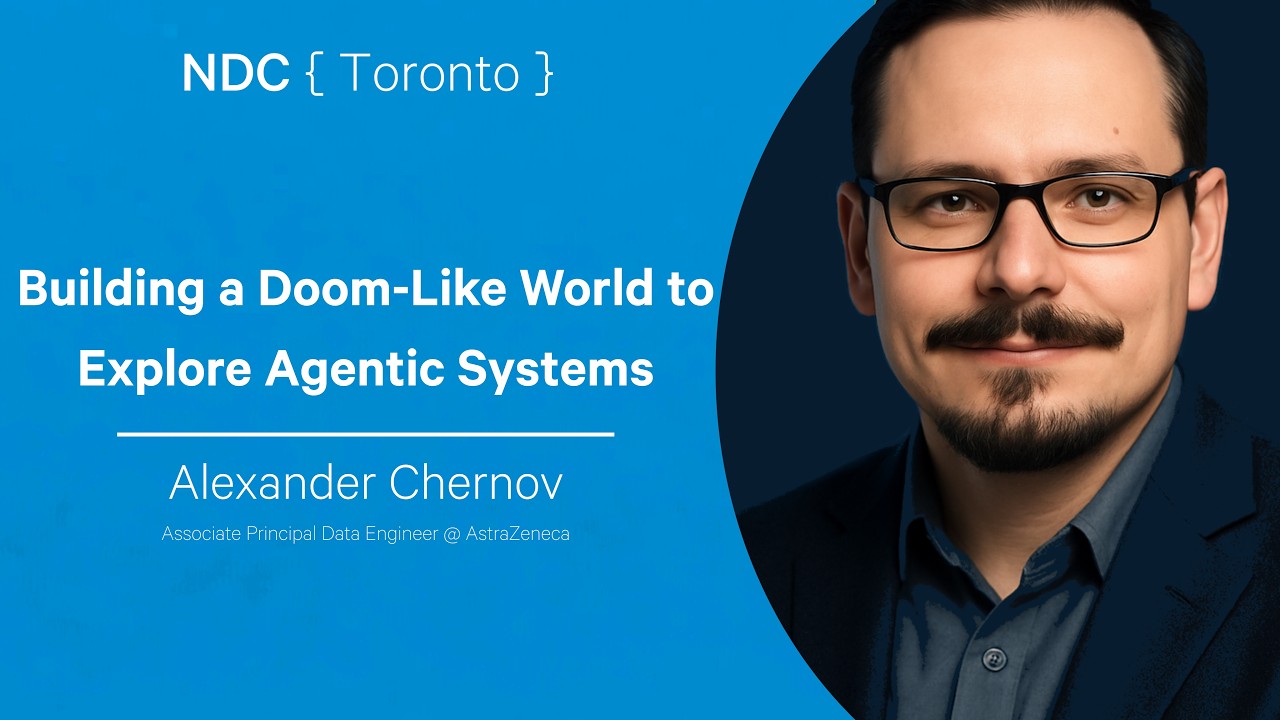
Building a Doom-Like World to Explore Agentic Systems - Alexander Chernov - NDC Toronto 2026 thumbnail

· 52:42

Building a Doom-Like World to Explore Agentic Systems - Alexander Chernov - NDC Toronto 2026

This talk presents an architectural framework for building complex agentic systems using a modified Doom-like game engine as a controlled testbed. The core concept is treating agents as 'semantic mirrors' of the game world state, allowing non-player characters (NPCs) to act autonomously while maintaining strict observability and reproducibility. The architecture emphasizes decoupling AI reasoning from the game loop via specialized components like the MCP Gateway, enabling real-world application of simulation techniques in fields such as pharmaceutical R&D.

Key takeaways

  1. Agentic Systems Architecture 2:00

    The system models agents as autonomous entities that perceive the environment and make decisions. The architecture is designed to be observable, attributable, and reproducible through structured world state changes (the 'semantic mirror').

  2. Two-Tiered Agentic Vision 4:20

    To manage latency, a two-tier vision system is implemented: a fast, deterministic observer swarm (7 Hz) for basic tracking, and a slower, LLM-powered tier using 'Lenses' to extract complex semantic information from the environment.

  3. Architectural Components 5:40

    Key components include the Policy Guard system (defining what agents can/cannot do), the MCP Gateway (Model Context Protocol) for external integration, and a Semantic Cache (Mosquito Dog) to reduce latency and cost by caching LLM responses.

  4. Reproducibility and Validation 7:50

    The design ensures determinism through fixed control loops (e.g., 35 ticks per second), state machine transitions, and structured logging of events (JSONL). This allows for full replay and behavioral regression testing.

Watch on YouTube Full article