
Topic

Digital Twins

All digests tagged Digital Twins

Simulating Humanity: from Generative Agents to 8 Billion Digital Twins — Joon Sung Park, Simile AI thumbnail

· 1:11:01

Simulating Humanity: from Generative Agents to 8 Billion Digital Twins — Joon Sung Park, Simile AI

Simile AI aims to simulate human society by creating 'digital twins' of populations, moving beyond current Large Language Model (LLM) capabilities. The core thesis is that predicting human behavior requires modeling underlying 'social physics' and causal mechanisms, not just pattern recognition from web data. The company's approach integrates three primary data types—qualitative interviews, observational/transactional data, and Randomized Controlled Trials (RCTs)—to build highly accurate population and individual-level models. These simulations are intended to help solve 'wicked problems' like climate change and democratic instability by testing policies and interventions before real-world deployment.

Key takeaways

  1. The Ambition: Simulating Society 2:00

    The ultimate goal is to simulate the world to answer complex societal questions (e.g., climate change, democratic instability) that are difficult to solve in reality. This is framed as a move from prediction to understanding the path to a desired outcome, similar to Thomas Schelling's work on agent-based modeling.

  2. Modeling Accuracy and Limitations 5:40

    Simile claims to have created digital twins that reproduce human behavior and attitudes 85% as accurately as people reproduce their own responses. They argue that frontier LLMs are optimized to be 'super rational,' while human behavior is often irrational, requiring bespoke training on behavioral data.

  3. The Necessity of Causal Data 7:28

    To model human decision-making, the most critical data is not just what people say (attitudinal) or what they do (observational), but the data describing the *cause and mechanism* of their decisions, best acquired through Randomized Controlled Trials (RCTs).

  4. Simulation vs. Prediction 10:00

    Simulation's highest form is not answering 'what will happen' (prediction), but defining the necessary steps to reach a specific goal (e.g., 'What path must we take to keep unrest to 1,000 years?'). This allows for counterintuitive, yet optimal, interventions.
Watch on YouTube Full article

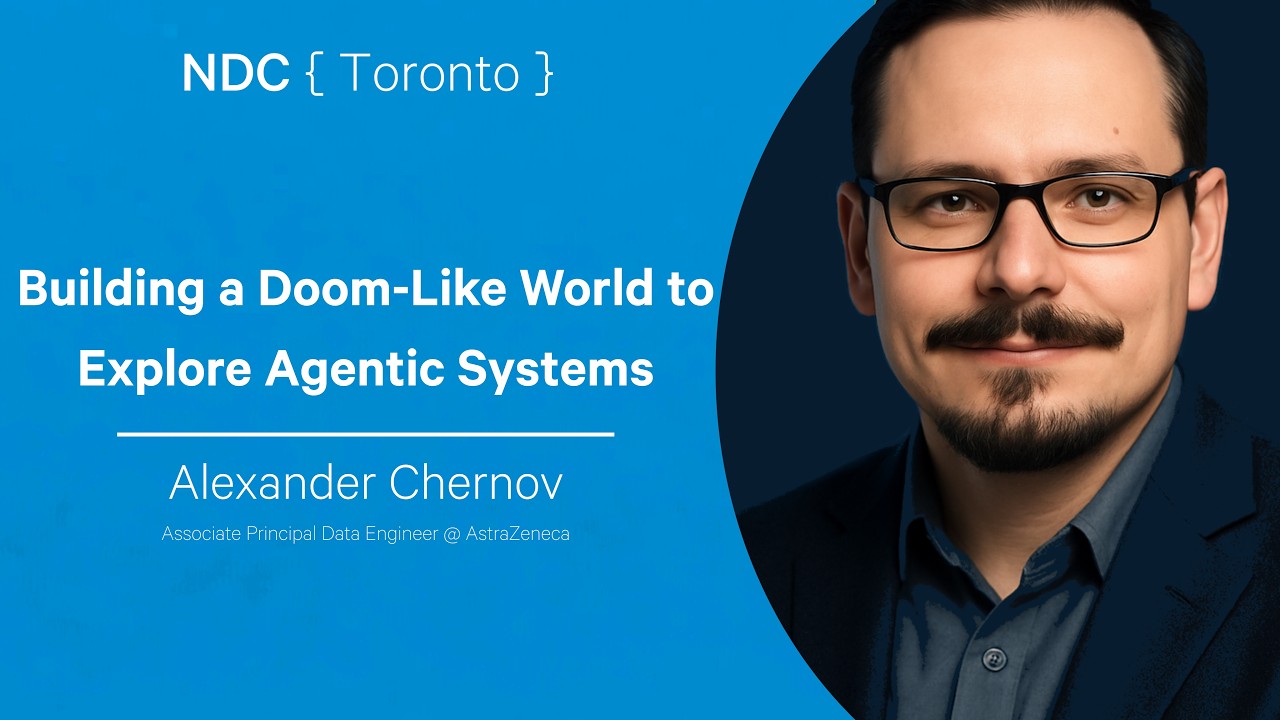
Building a Doom-Like World to Explore Agentic Systems - Alexander Chernov - NDC Toronto 2026 thumbnail

· 52:42

Building a Doom-Like World to Explore Agentic Systems - Alexander Chernov - NDC Toronto 2026

This talk presents an architectural framework for building complex agentic systems using a modified Doom-like game engine as a controlled testbed. The core concept is treating agents as 'semantic mirrors' of the game world state, allowing non-player characters (NPCs) to act autonomously while maintaining strict observability and reproducibility. The architecture emphasizes decoupling AI reasoning from the game loop via specialized components like the MCP Gateway, enabling real-world application of simulation techniques in fields such as pharmaceutical R&D.

Key takeaways

  1. Agentic Systems Architecture 2:00

    The system models agents as autonomous entities that perceive the environment and make decisions. The architecture is designed to be observable, attributable, and reproducible through structured world state changes (the 'semantic mirror').

  2. Two-Tiered Agentic Vision 4:20

    To manage latency, a two-tier vision system is implemented: a fast, deterministic observer swarm (7 Hz) for basic tracking, and a slower, LLM-powered tier using 'Lenses' to extract complex semantic information from the environment.

  3. Architectural Components 5:40

    Key components include the Policy Guard system (defining what agents can/cannot do), the MCP Gateway (Model Context Protocol) for external integration, and a Semantic Cache (Mosquito Dog) to reduce latency and cost by caching LLM responses.

  4. Reproducibility and Validation 7:50

    The design ensures determinism through fixed control loops (e.g., 35 ticks per second), state machine transitions, and structured logging of events (JSONL). This allows for full replay and behavioral regression testing.

Watch on YouTube Full article