Topic

Reliability Engineering

All digests tagged Reliability Engineering

AWS's Marc Brooker: Specs, Not Code, Are the Hard Part thumbnail

· 56:50

AWS's Marc Brooker: Specs, Not Code, Are the Hard Part

The core argument is that the hardest part of modern software development is no longer writing code, but defining the specification—a complete, detailed description of what the system should do. Marc Brooker, VP and Distinguished Engineer at AWS, emphasizes that advanced automation, particularly agentic AI, is making the building and maintenance of reliable implementations increasingly automated. This shifts the engineering focus to specification, rigorous testing, and managing complex system failures, such as metastable failures. Key technical advancements include specialized policy languages (like Dogwood) and advanced memory systems that allow agents to learn from historical postmortems and organizational context.

Key takeaways

  1. The Shift to Specification 33:44

    The most challenging aspect of software development is creating a complete, detailed specification of what is desired. Once this specification is established, the building and maintenance of reliable implementations are expected to become increasingly automated (00:32:14).

  2. The Importance of Postmortems 11:11

    Analyzing thousands of postmortems teaches engineers a 'deep sense of humility' regarding system failures and highlights the need to understand complex failure modes like metastable failures (00:11:23).

  3. Agentic Policy vs. Classic Authorization 20:14

    Classic authorization models are insufficient for autonomous agents. Agentic policy requires a specialized language (like Dogwood) to deterministically define what an agent is allowed to do, and in what order, providing necessary boundaries for trust (00:20:14).

  4. Learning from Failure 11:14

    Agents can be trained to learn from postmortems by using tools to semantically search historical incidents and build procedural memory, allowing them to anticipate and circumvent past failures (01:14:32).
Watch on YouTube Full article

AI Agents Are Just Distributed Systems Now — Salman Munaf, TikTok thumbnail

· 19:48

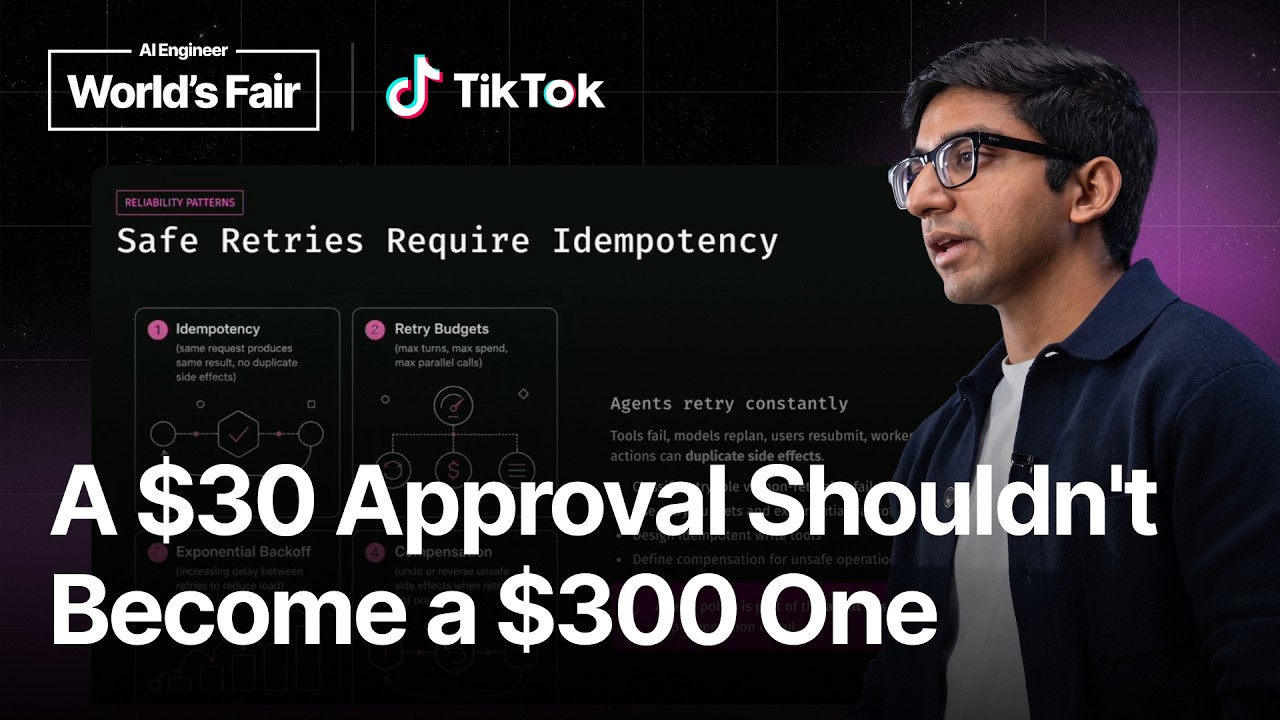
AI Agents Are Just Distributed Systems Now — Salman Munaf, TikTok

The core argument is that AI agents, once they interact with external services (tools/APIs), cease being purely model problems and become complex distributed systems challenges. Building reliable agents requires incorporating robust distributed systems thinking—focusing on failure modes, state management, transactionality, and security controls—rather than just improving the LLM itself.

Key takeaways

  1. AI Agents as Probabilistic Coordinators 5:46

    Unlike traditional deterministic workflows that follow a predefined decision tree, AI agents act as probabilistic coordinators. This variability necessitates strong external controls (e.g., circuit breakers, spending ceilings) to ensure determinism and prevent severe consequences.

  2. Handling Failure: Timeout vs. Failure 11:59

    A timeout does not mean failure; it means unknown. To prevent unsafe side effects (like double refunds), agents must utilize request IDs and idempotency keys, allowing for status lookups to confirm if an action already succeeded.

  3. State Management and Context 17:37

    Context that influences an action is state. This state can become stale or conflict with the authoritative source of truth, requiring explicit invalidation and provenance tracking, much like managing a cache.

  4. Security and Control Boundaries

    Agents must operate with scoped credentials (separate read/write permissions) and limited tool access. Furthermore, human approval should be bound to specific actions, actors, and expiry times, not blanket privileges.

Watch on YouTube Full article

Productionizing LLM Gateways: Architecture, Tradeoffs and Hard Lessons — Kanish Manuja, Twilio thumbnail

· 16:24

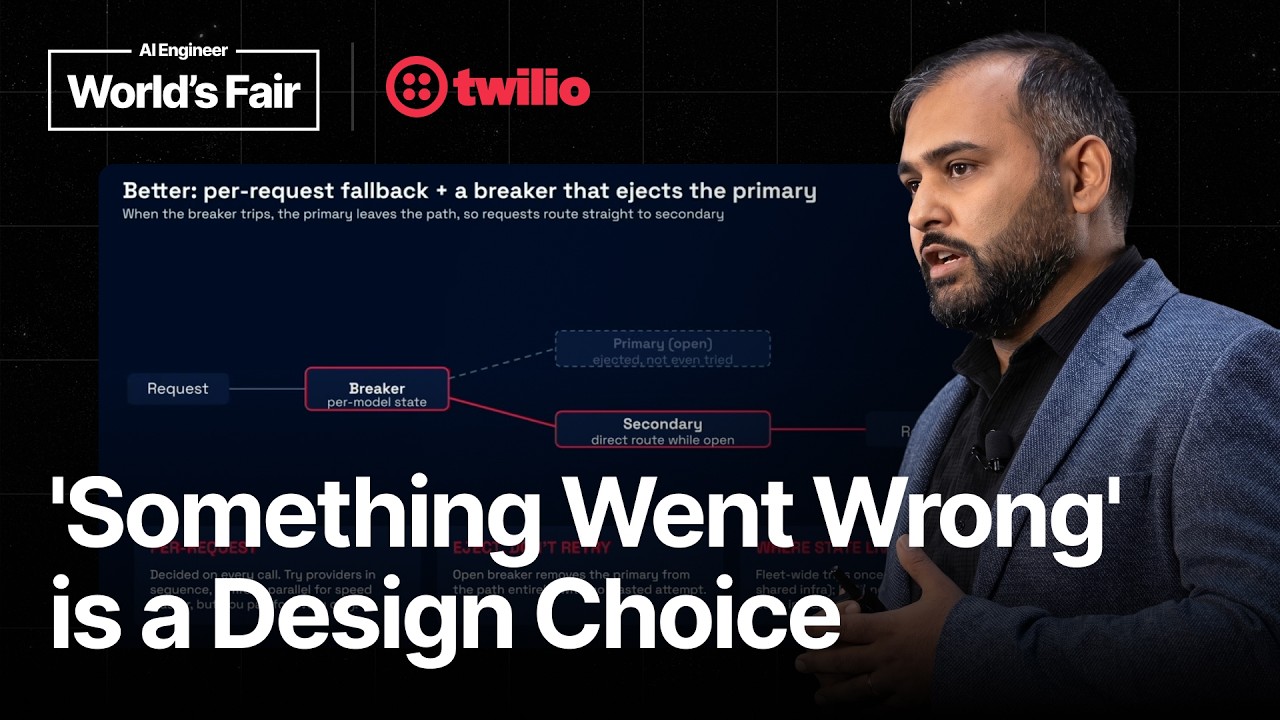
Productionizing LLM Gateways: Architecture, Tradeoffs and Hard Lessons — Kanish Manuja, Twilio

This talk details the architecture and trade-offs involved in building an LLM Gateway—a middleware layer managing routing, authentication, fallbacks, and governance between applications and model providers. The core challenge is that availability, latency, guardrails, and cost cannot all be maximized simultaneously during degradation. Key architectural advice includes preferring per-request fallbacks over blind retries or circuit breakers, tracking P99 latency per model/route (not gateway-wide), and treating guardrails as unreliable services requiring fail-open/fail-close decisions.

Key takeaways

  1. LLM Gateway Core Trade-offs 2:11

    An LLM gateway must manage a permanent fight between availability, latency, guardrails, and cost. Degradation forces the system to sacrifice one of these four elements (1:21).

  2. Fallback Strategy 2:33

    Instead of blind retries or circuit breakers, implement per-request fallbacks (trying Model A, then B if A fails) or parallel requests for low-latency needs. This prevents multiplying cost and tail latencies (2:33).

  3. Latency Measurement Best Practices 7:08

    Do not measure gateway-wide latency; instead, track P99 per model and per route. Setting timeouts on a per-model/per-route basis is critical to preventing silent outages (7:08).

  4. Guardrails as Services 10:40

    Treat guardrails (e.g., toxicity filters, PII checks) like any other service that can fail. Teams must decide in advance whether the system should 'fail open' (serve request despite failure) or 'fail close' (block request) (10:40).

  5. Centralization vs. Governance 13:02

    While many teams seek a central gateway, the underlying need is often centralized governance (e.g., cost tracking, rate limiting), which can be achieved by decentralizing traffic while centralizing policy enforcement (13:02).

Watch on YouTube Full article

Perception Agents — Antje Barth, Amazon AGI Lab thumbnail

· 21:45

Perception Agents — Antje Barth, Amazon AGI Lab

Current AI agents excel at discrete tasks like clicking or calling APIs but fail in complex, end-to-end knowledge work because they lack reliable perception and verification capabilities. The talk introduces 'Perception Agents,' which close the architectural gap by enabling agents to perceive rendered UIs (not just underlying code), maintain shared context, and verify their own output against design specs or user flows, mimicking human collaboration.

Key takeaways

  1. The Gap in Agent Capability

    Current agents struggle with end-to-end workflows because the 'real work' lives within the seams of multiple applications. While they can perform individual steps, they cannot manage the full process reliability required for critical tasks (e.g., deleting a database).

  2. The Need for Reliability and Verification 3:50

    Unlike code, which is verifiable through unit tests, most knowledge work is 'messy' and lacks easy verification methods. This lack of verifiability is the primary hurdle to building trust in agents.

  3. Perception Agents: Closing the Loop 7:40

    A perception agent must perceive the screen (rendered layout, state) like a human, not just scrape code. They must complete the loop by observing results to confirm if actions succeeded, rather than simply firing off commands.

  4. Shared Context and Multimodal Perception 10:40

    Perception is more than just visual input; it includes understanding context from sources like audio transcripts. The goal is to build agents that react in real-time, similar to human collaboration, without the back-and-forth of prompt/response cycles.

Watch on YouTube Full article