Productionizing LLM Gateways: Architecture, Tradeoffs and Hard Lessons — Kanish Manuja, Twilio
Summary
This talk details the architecture and trade-offs involved in building an LLM Gateway—a middleware layer managing routing, authentication, fallbacks, and governance between applications and model providers. The core challenge is that availability, latency, guardrails, and cost cannot all be maximized simultaneously during degradation. Key architectural advice includes preferring per-request fallbacks over blind retries or circuit breakers, tracking P99 latency per model/route (not gateway-wide), and treating guardrails as unreliable services requiring fail-open/fail-close decisions.
Key takeaways
-
LLM Gateway Core Trade-offs
2:11
An LLM gateway must manage a permanent fight between availability, latency, guardrails, and cost. Degradation forces the system to sacrifice one of these four elements (1:21).
-
Fallback Strategy
2:33
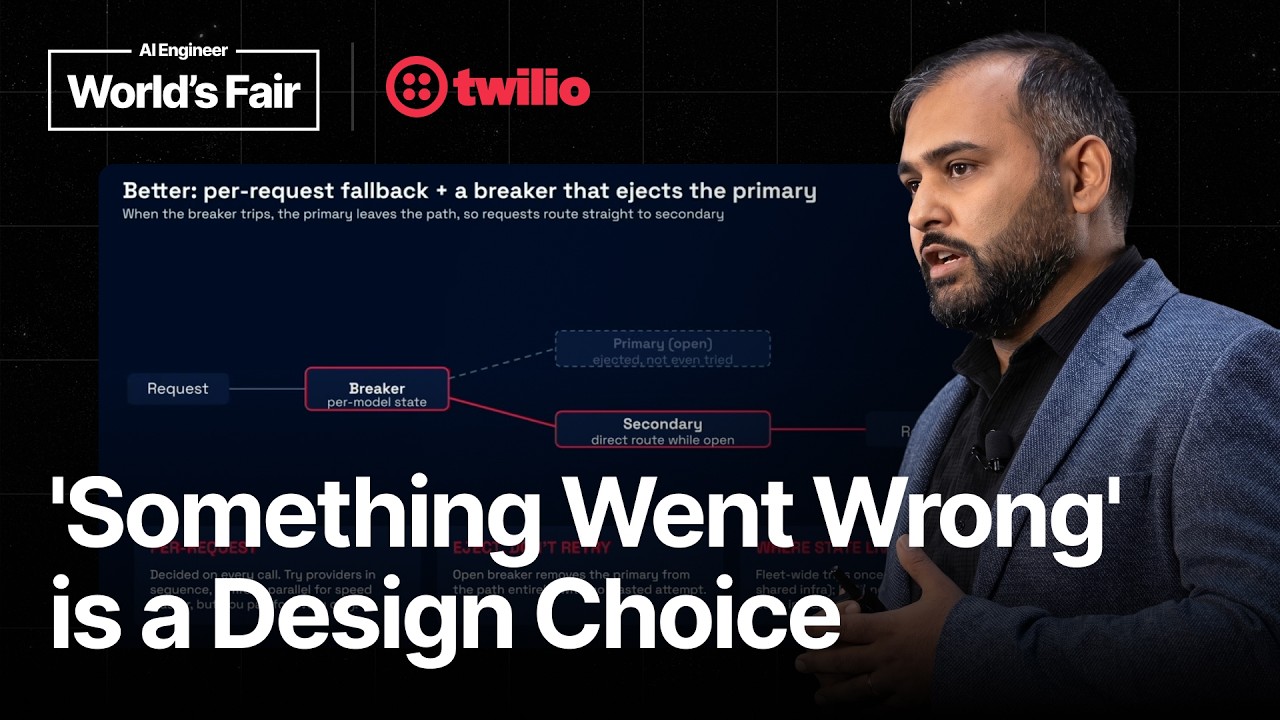
Instead of blind retries or circuit breakers, implement per-request fallbacks (trying Model A, then B if A fails) or parallel requests for low-latency needs. This prevents multiplying cost and tail latencies (2:33).
-
Latency Measurement Best Practices
7:08
Do not measure gateway-wide latency; instead, track P99 per model and per route. Setting timeouts on a per-model/per-route basis is critical to preventing silent outages (7:08).
-
Guardrails as Services
10:40
Treat guardrails (e.g., toxicity filters, PII checks) like any other service that can fail. Teams must decide in advance whether the system should 'fail open' (serve request despite failure) or 'fail close' (block request) (10:40).
-
Centralization vs. Governance
13:02
While many teams seek a central gateway, the underlying need is often centralized governance (e.g., cost tracking, rate limiting), which can be achieved by decentralizing traffic while centralizing policy enforcement (13:02).
Technical details
-
LLM Gateway Functionality
49s
The gateway acts as middleware providing routing, authentication, fallback logic, rate limits, and governance between applications and model providers (0:49).
-
Failure Handling Patterns
153s
Avoid traditional retries or circuit breakers for LLMs due to high cost and latency impact. Prefer per-request fallbacks or parallel requests if extreme low latency is required (2:33).
-
Performance Metrics
345s
Focus on tracking P99 per model/per route, especially for mixed workloads involving embedding, classification, and reasoning models. Reasoning models are highly non-deterministic, potentially taking 2 seconds to 60 seconds (8:17).
-
Guardrail Placement
689s
Guardrails can be implemented via pre-hooks (safest, adds serial latency), parallel hooks (best for structured output), or post-hooks (best for auditing/monitoring) (10:40).
-
System Resilience
725s
Implement load shedding and ensure API keys are segregated per route/use case to prevent noisy tenants from causing service degradation (14:11).
Channel & topics
Watch on YouTube · Back to latest
This independent, AI-assisted summary is provided for commentary and informational purposes. It may contain errors or omit important context. Please watch the original video for the creator's complete presentation. Video, thumbnail, and related copyrights belong to their respective owners.