Topic

Change Management

All digests tagged Change Management

Building GTM AI Agents: Lessons from Deploying to 6,000 Users — Sait Izmit, Snowflake thumbnail

· 20:39

Building GTM AI Agents: Lessons from Deploying to 6,000 Users — Sait Izmit, Snowflake

This talk details the process of building and scaling an internal Go-To-Market (GTM) AI assistant using Snowflake Co-work. The speaker emphasizes that successful deployment hinges less on technological capability and more on strategic execution: prioritizing quality over coverage, managing user trust, and planning for continuous architectural evolution. The system has processed over one million questions for 6,000 users, evolving from simple agent instructions to a complex architecture involving semantic views, skills, and MCP connections.

Key takeaways

  1. Quality Over Coverage 6:56

    Focusing on high accuracy (e.g., 95% correct) for a smaller set of critical questions is more effective than attempting to cover all possible data points with lower accuracy, as the first few interactions build user trust.

  2. Phased Rollout and Activation 9:06

    AI tools must follow a controlled launch process: Pilot (proving accuracy), Beta (e.g., 10% of users, tracking >70% retention rate), and General Availability (GA). The biggest failure point is often activation and change management, not the technology itself.

  3. Addressing the Collapsing Wow Factor 14:16

    After initial novelty wears off, the roadmap must evolve beyond simple Q&A. The progression should move from 'Talk to your data' (democratization) to 'Automate workflows' (integrations/MCPs), then to 'Team building skills,' and finally 'Hyper-personalization.'
Watch on YouTube Full article

Your Engineers Are Resisting Your AI Rollout. 3 Things Turn That Around. thumbnail

· 17:43

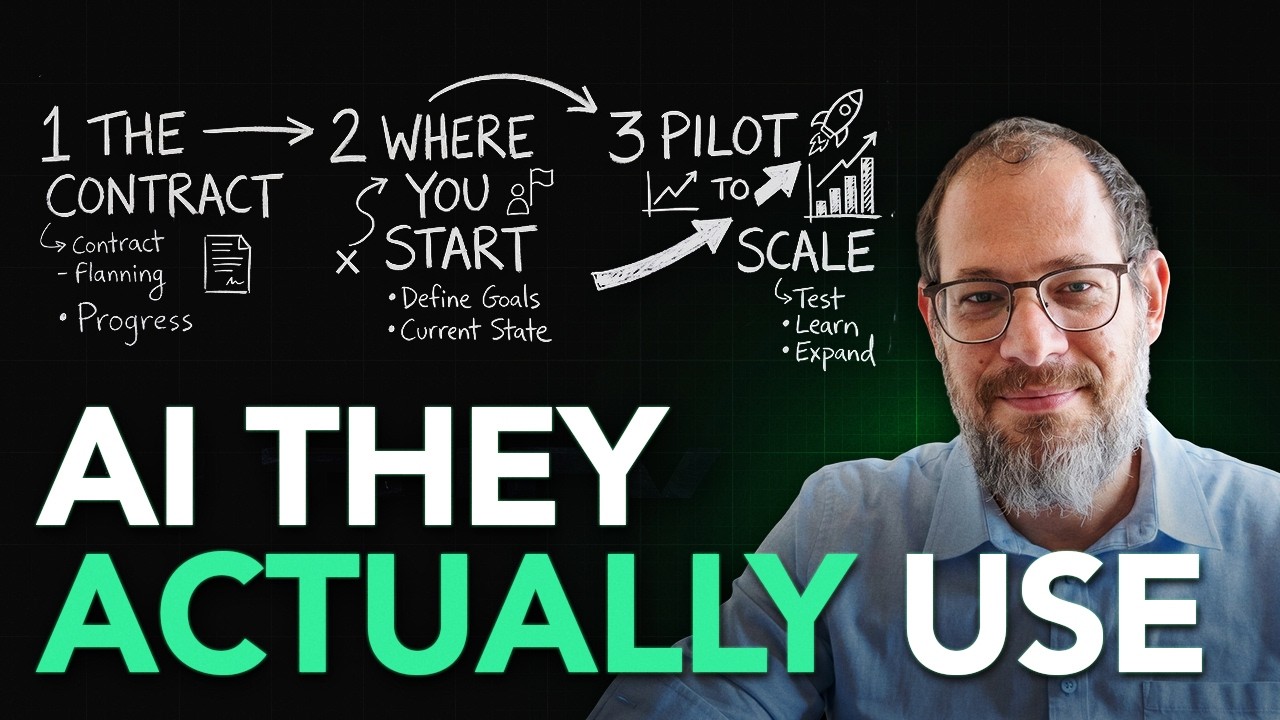
Your Engineers Are Resisting Your AI Rollout. 3 Things Turn That Around.

Successfully rolling out AI requires more than technical capability; it demands strategic leadership and transparent communication. The speaker outlines three core principles for leaders: making a public commitment regarding job security to address employee fears (the 'elephant in the room'); starting with a narrow, bottom-line focused pilot project; and managing the transition from pilot success to enterprise scale by defining where human expertise remains critical.

Key takeaways

  1. Principle 1: Make a Public Employment Commitment

    Leaders must address job risk directly, stating that the AI rollout is not designed to destroy jobs or take away roles. Framing AI as an 'expansion of horizons' rather than cost-cutting helps build trust and encourages participation.

  2. Principle 2: Pick a Specific, Bottom-Line Pilot 8:58

    Instead of attempting a generic AI transformation across the entire organization, start by selecting a specific use case that demonstrably drives the bottom line (e.g., cutting tooling costs or expanding revenue). This focus prevents scope creep and confusion.

  3. Principle 3: Define Human Value at Scale

    When scaling, the conversation must shift from technical details to people impact. Leaders must articulate how humans and AI agents will work together (e.g., defining safeguards against cyber attacks or maintaining a 'human edge') to ensure roles evolve rather than disappear.

Watch on YouTube Full article