AI News & Strategy Daily | Nate B Jones
Your Engineers Are Resisting Your AI Rollout. 3 Things Turn That Around.
Summary
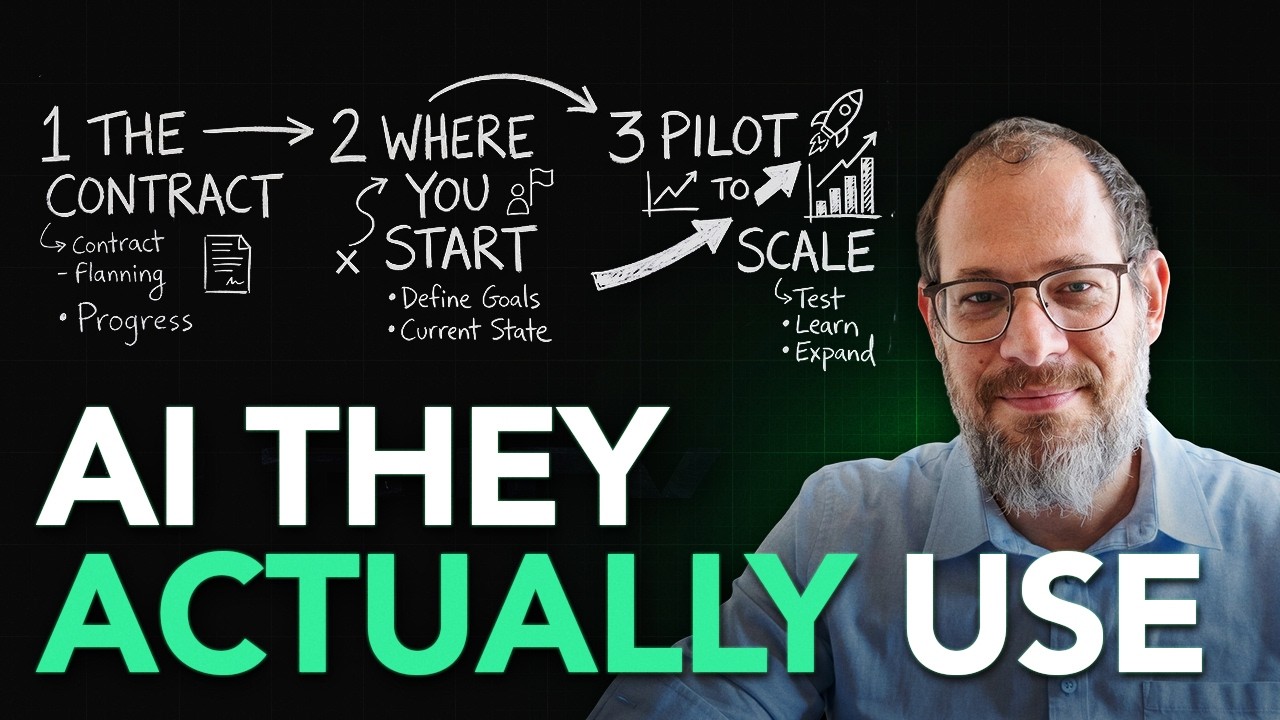
Successfully rolling out AI requires more than technical capability; it demands strategic leadership and transparent communication. The speaker outlines three core principles for leaders: making a public commitment regarding job security to address employee fears (the 'elephant in the room'); starting with a narrow, bottom-line focused pilot project; and managing the transition from pilot success to enterprise scale by defining where human expertise remains critical.
Key takeaways
-
Principle 1: Make a Public Employment Commitment
Leaders must address job risk directly, stating that the AI rollout is not designed to destroy jobs or take away roles. Framing AI as an 'expansion of horizons' rather than cost-cutting helps build trust and encourages participation.
-
Principle 2: Pick a Specific, Bottom-Line Pilot
8:58
Instead of attempting a generic AI transformation across the entire organization, start by selecting a specific use case that demonstrably drives the bottom line (e.g., cutting tooling costs or expanding revenue). This focus prevents scope creep and confusion.
-
Principle 3: Define Human Value at Scale
When scaling, the conversation must shift from technical details to people impact. Leaders must articulate how humans and AI agents will work together (e.g., defining safeguards against cyber attacks or maintaining a 'human edge') to ensure roles evolve rather than disappear.
Technical details
-
AI Agent Capabilities
AI agents are capable of performing increasingly complex jobs, accelerating iteration in coding, writing, mathematics, and deep analysis (e.g., analyzing a 20-tab spreadsheet).
-
System Design Shift
Engineers are evolving toward becoming system designers who write evaluation metrics ('evals') and deliver code in a loop, managing the interaction between human input and AI agent output.
-
LLMisms
Professional outputs require a human review to remove 'LLMisms' and ensure alignment with the larger business strategy, even when using advanced models.
Mentioned resources
Channel & topics
Watch on YouTube · Back to latest
This independent, AI-assisted summary is provided for commentary and informational purposes. It may contain errors or omit important context. Please watch the original video for the creator's complete presentation. Video, thumbnail, and related copyrights belong to their respective owners.