I don't prompt agents anymore...
Summary
The video clarifies that 'graph engineering' primarily refers to building **Control Graphs**, which are structured workflows or SOPs designed to make AI agents reliable and predictable. The speaker details three primary methods for implementing these graphs: using dedicated code frameworks (like `LangGraph` or Dynamic Workflow), leveraging the LLM itself as the orchestrator, or employing agent-to-agent communication patterns. Implementing robust graphs requires defining clear nodes/edges, managing state artifacts, and crucially, integrating deterministic tools like verifiers and scripts to ensure reliability.
Key takeaways
-
Focus on Control Graphs
The term 'graph' is often misused; the practical focus should be on **Control Graphs**—workflows that enforce SOPs for reliable agent execution. This is distinct from Knowledge Graphs or Graph of Loops (though the latter is a new, complex area).
-
Implement Reliability Layers
20:57
For any automated process, setting up a dedicated 'verifier' skill/agent node is critical to building confidence and ensuring the agent's output meets expected standards.
-
Choose Your Graph Implementation Method
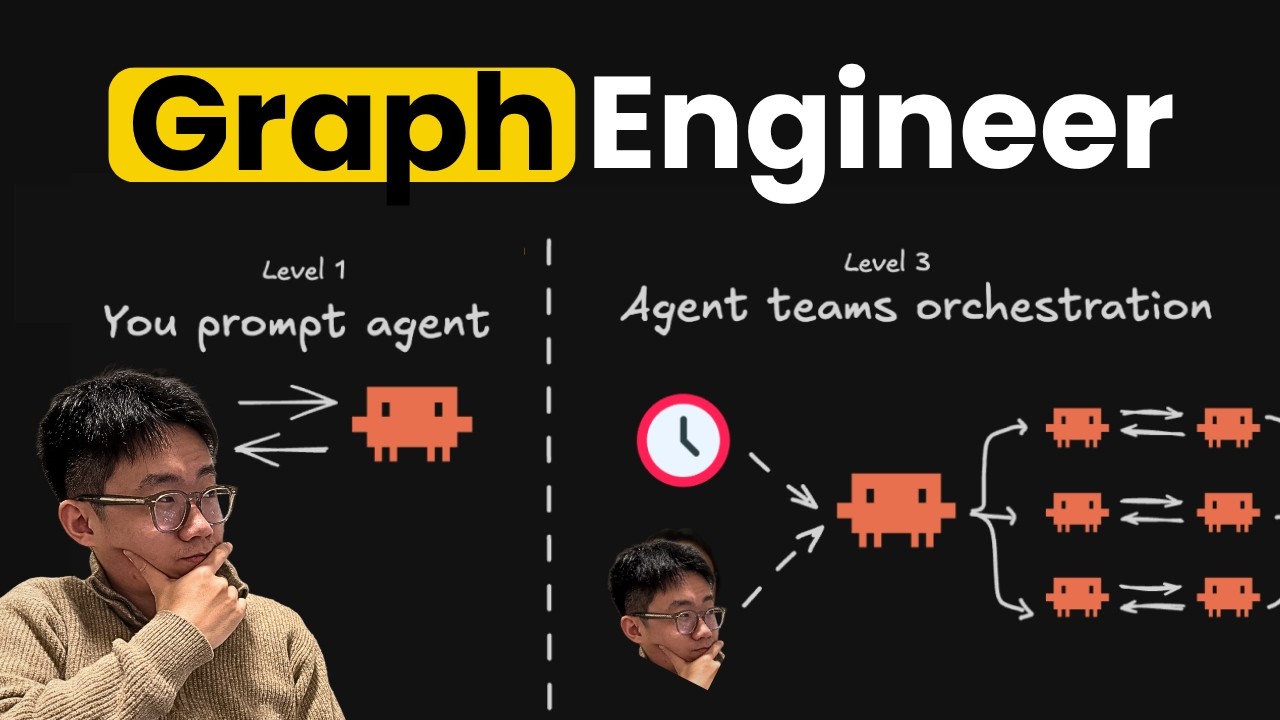
Graphs can be enforced via: 1) **Code-as-Graph** (using tools like Dynamic Workflow or `LangGraph`), 2) **Large Model as Graph** (defining SOPs in text/JSON for the LLM to follow), or 3) **Agent Teams** (an orchestrator agent managing a team of specialized agents).
-
Best Practices for Workflow Design
To maximize reliability, always define clear inputs and outputs for each node. Use dedicated scripts/code for complex data fetching or deterministic steps rather than relying solely on the LLM.
Technical details
-
Control Graph Definition
85s
A control graph represents a dynamic workflow (SOP) that ensures agents achieve reliable results, moving beyond simple human prompting. This is the core concept Peter was referring to.
-
Agent Workflow Patterns
1052s
Two major patterns are emerging: **Loops** (triggered by time, event, or goal for continuous optimization) and the **Orchestrator Pattern** (where a central agent manages context and spins up teams of specialized agents).
-
Code-as-Graph Implementation
1305s
Uses dedicated frameworks like Dynamic Workflow from Cloud Code or `LangGraph`. It defines nodes (actions), edges (next steps), and state (data carried over). Example: A 'ship change workflow' that progresses through Setup, Implement, and Verify phases using JavaScript primitives.
-
LLM as Graph Implementation
The process is defined by a structured SOP (e.g., in text or JSON) which the LLM follows iteratively. Example: Andrew Copsy's auto research project, where the agent continuously updates and evaluates a script (`train.py`) based on metrics until improvement is achieved.
-
State Management
Regardless of the graph type, maintaining state is crucial. This can be done by having an artifact store (like a markdown file) or using structured output schemas to pass context between nodes/agents.
Mentioned resources
- HubSpot Cloud Code Playbook
- AI Builder Club Workshop
Channel & topics
Watch on YouTube · Back to latest
This independent, AI-assisted summary is provided for commentary and informational purposes. It may contain errors or omit important context. Please watch the original video for the creator's complete presentation. Video, thumbnail, and related copyrights belong to their respective owners.