Topic

Anterior

All digests tagged Anterior

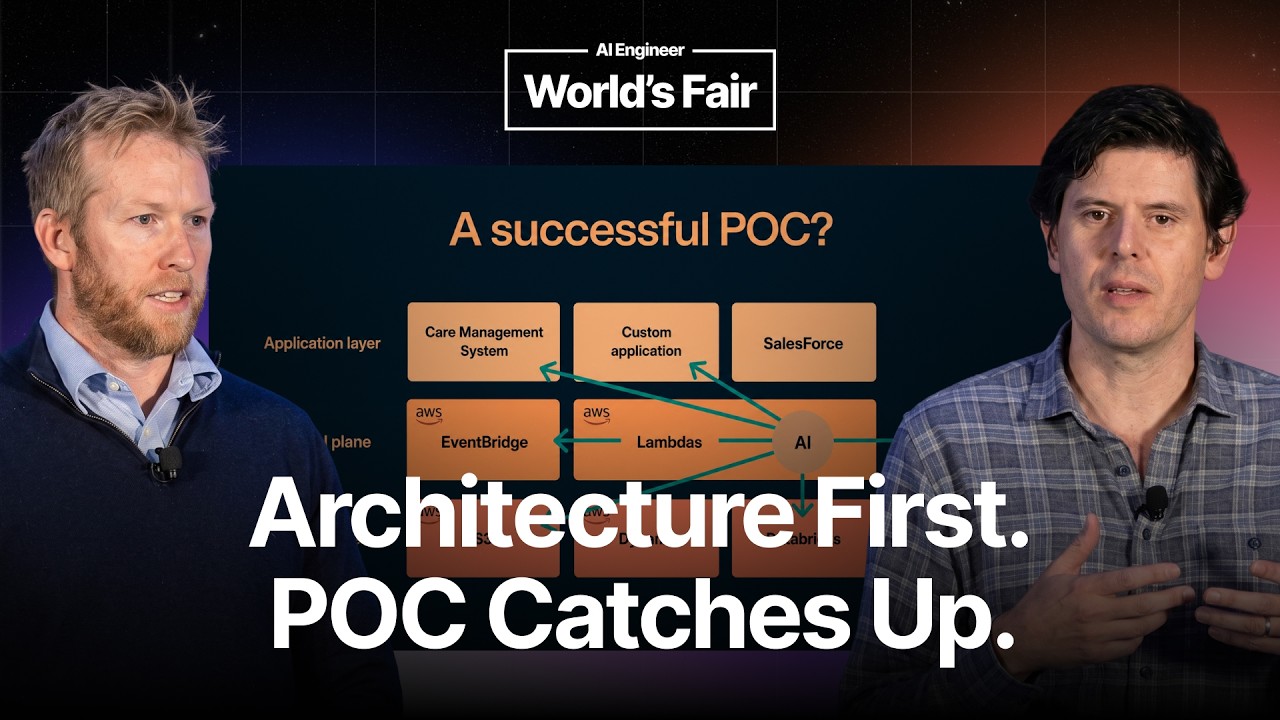
Why Your Enterprise Tech Stack Isn’t Ready for AI Agents — Christopher Lovejoy & Saul Howard thumbnail

· 19:15

Why Your Enterprise Tech Stack Isn’t Ready for AI Agents — Christopher Lovejoy & Saul Howard

The talk addresses why traditional enterprise tech stacks are insufficient for deploying AI agents in highly regulated industries like healthcare. The core argument is that focusing on achieving high accuracy during a Proof of Concept (POC) often leads to architectural debt when attempting productionization. To build scalable, compliant systems, engineers must prioritize non-functional requirements—specifically auditability, data security, and human oversight—from the outset. This requires adopting specialized primitives: immutable event logs, schema-driven object storage for sensitive data, and treating humans and models as equivalent agents.

Key takeaways

  1. Audit Trail vs. Developer Log 0:05

    In regulated environments (e.g., HIPAA, SOC 2), an audit trail must be a complete record of every action taken by the agent, every place it accessed data, and the authorization behind each step—not merely a developer log like those found in DataDog [5:19].

  2. Prioritize Constraints Over Accuracy 0:12

    Engineers should take regulatory constraints seriously first (e.g., auditability) and design the architecture around them, rather than bolting compliance requirements onto a high-performing POC [12:07].

  3. The Three Architectural Primitives 0:08

    Effective AI agent systems require three core primitives: an immutable append-only event log (for state tracking), schema-driven object storage (for data separation and Zero Trust), and human/model agent equivalency (for seamless escalation) [8:30].

  4. Evals as a Byproduct 0:10

    By implementing these three primitives, robust evaluation (evals) can emerge naturally—allowing for action replay, testing on production data without exposure, and comparing human vs. model performance—rather than being an afterthought [10:37].

Watch on YouTube Full article

Don’t be data poor — Anuj Iravane, Anterior thumbnail

· 16:46

Don’t be data poor — Anuj Iravane, Anterior

The talk addresses the critical problem of 'data poverty' in highly regulated domains like healthcare, where the most valuable data (Patient Health Information or PHI) is ephemeral and legally prohibited from being retained, anonymized, or derived for dataset creation. The core solution presented is synthetic data generation. This process involves reversing the standard inference workflow—starting by sampling a desired label and reasoning trace, and then generating the necessary unstructured medical record that would have produced it. The resulting pipeline uses an LLM-based, coarse-to-fine approach, ensuring high fidelity while maintaining domain expert control.

Key takeaways

  1. Reverse Inference for Data Generation 5:20

    Instead of running the forward task (Unstructured Data + Policy $\rightarrow$ Label), the method reverses this by sampling a label and a reasoning trace first, then generating the input data that supports it. This circumvents the diversity problem inherent in standard LLM generation.

  2. Domain Expert Ownership (Human-in-the-Loop) 11:30

    To ensure generated data is useful, domain experts (clinicians) must own the pipeline. This is achieved by enabling them to interject at any point in generation and modeling the entire workflow as a skills-based system running on an agent harness.

  3. Synthetic Data Fidelity 14:35

    The generated data can be highly accurate, with early results showing that in a blind review, clinicians were only able to distinguish synthetic from real records about 60% of the time.

Watch on YouTube Full article