Topic

Healthcare Technology

All digests tagged Healthcare Technology

Seattle DGX Spark Hackathon Winners Spotlight thumbnail

· 40:58

Seattle DGX Spark Hackathon Winners Spotlight

This summary covers the NVIDIA DGX Spark Hackathon winners, spotlighting two advanced local AI applications: Kerberos, a shared spatial-awareness system for search-and-rescue (SAR) teams, and VELA, a voice-first, consent-controlled healthcare action system. Both projects demonstrate the power of running complex, multi-agent AI workflows entirely on local hardware (NVIDIA GB10), ensuring data privacy and real-time action capability.

Key takeaways

  1. Local AI for Privacy and Reliability 22:40

    Both winning systems (Kerberos and VELA) are designed to run entirely on the NVIDIA GB10, ensuring that sensitive data (e.g., medical records, live camera feeds) remains local and is not transmitted to the cloud, addressing critical security concerns in healthcare and SAR.

  2. Agentic Workflows for Complex Tasks 25:40

    The projects utilize multi-agent architectures (e.g., VELA's system) where specialized agents (like Parakeet for speech recognition, Neatron for reasoning, and Magpie for speech output) collaborate to perform complex, multi-step tasks, moving beyond simple chatbots to actionable outcomes.

  3. Shared Situational Awareness in SAR 3:40

    Kerberos creates a shared live map for SAR, integrating data from multiple sources (drones, robots, body cameras) to track responders, map searched areas, and pinpoint casualties or hazards, even indoors where GPS fails.

Watch on YouTube Full article

When AI Stops Being a Project: Turning Technology into Real Value for Patients and Providers thumbnail

· 36:50

When AI Stops Being a Project: Turning Technology into Real Value for Patients and Providers

The conversation explores the shift of AI from a mere 'project' to an integral business function in healthcare. Key focus areas include moving beyond simple Q&A chatbots to complex, long-running agentic workflows that can handle tasks previously requiring many hours of human effort. Speakers emphasize that while the technology is rapidly advancing (e.g., GLM 5.2 and advanced LLMs), successful enterprise adoption requires significant architectural changes: establishing robust governance, managing token costs, mitigating vendor lock-in, and fundamentally reimagining existing clinical workflows rather than simply automating point solutions.

Key takeaways

  1. Shift to Agentic Workflows 14:25

    AI is moving past simple Q&A (quick, short, transactional) toward complex, long-running agentic tasks. OpenAI internal data suggests agents are now performing work across finance, recruiting, and legal that can take up to 8 hours of human effort [0:14:25].

  2. Governance and Architecture are Critical 23:15

    For large enterprises (like United Health Group), long-form agentic work requires establishing strong governance, guardrails, and security protocols. Simply calling an API a 'super agent' is insufficient; true agency requires reasoning and decision-making capabilities [0:23:15].

  3. Addressing Vendor Lock-in and Cost 4:46

    Enterprises must manage the risks of vendor lock-in when restructuring workflows around a single model or API. Concerns include escalating token costs and geopolitical instability, making architectural flexibility paramount [0:47:28].

  4. Reimagining vs. Automating Silos 3:31

    The most impactful approach is not to automate existing tasks (silos) but to fundamentally reimagine the entire end-to-end workflow—from patient intake to payment processing—given the new technological capabilities [0:35:12].

  5. AI as a Business Mandate 5:46

    Successful adoption requires AI to be elevated from an IT or innovation problem to a CEO-level, cross-functional business mandate. Leadership must obsess over defining the core metrics (the 'what is the metric?') and driving change at scale [0:57:12].

Watch on YouTube Full article

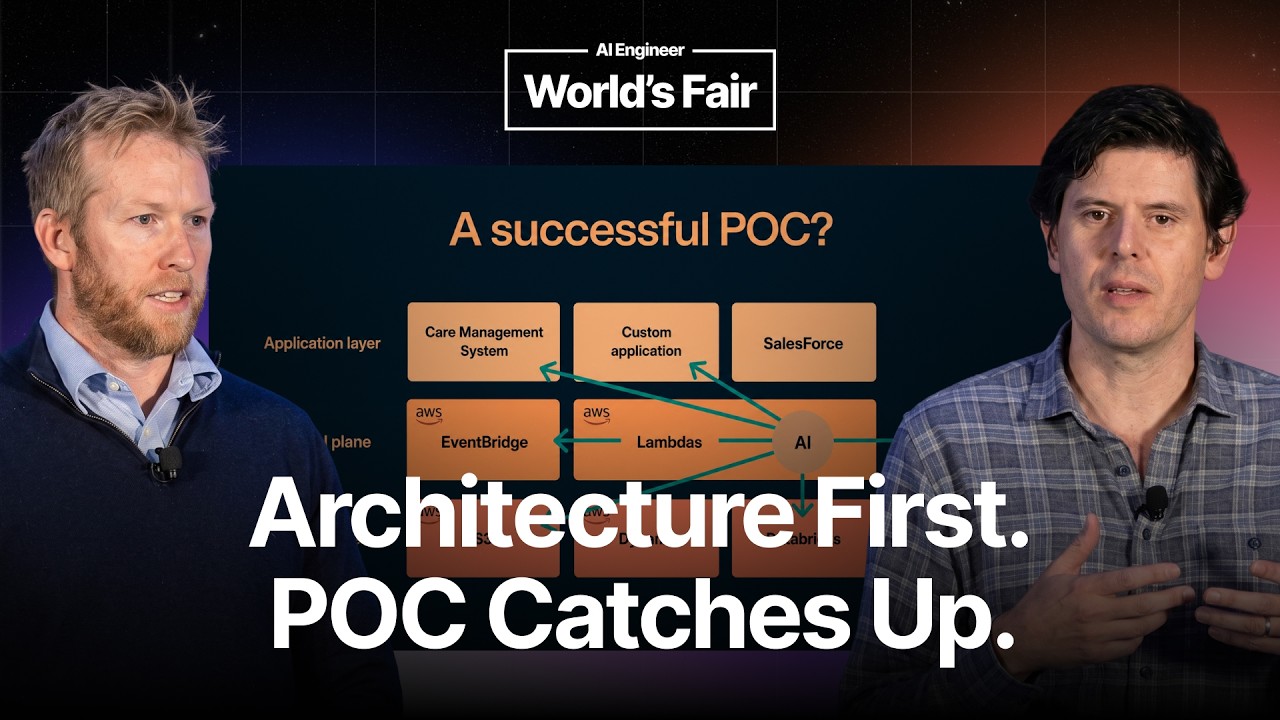
Why Your Enterprise Tech Stack Isn’t Ready for AI Agents — Christopher Lovejoy & Saul Howard thumbnail

· 19:15

Why Your Enterprise Tech Stack Isn’t Ready for AI Agents — Christopher Lovejoy & Saul Howard

The talk addresses why traditional enterprise tech stacks are insufficient for deploying AI agents in highly regulated industries like healthcare. The core argument is that focusing on achieving high accuracy during a Proof of Concept (POC) often leads to architectural debt when attempting productionization. To build scalable, compliant systems, engineers must prioritize non-functional requirements—specifically auditability, data security, and human oversight—from the outset. This requires adopting specialized primitives: immutable event logs, schema-driven object storage for sensitive data, and treating humans and models as equivalent agents.

Key takeaways

  1. Audit Trail vs. Developer Log 0:05

    In regulated environments (e.g., HIPAA, SOC 2), an audit trail must be a complete record of every action taken by the agent, every place it accessed data, and the authorization behind each step—not merely a developer log like those found in DataDog [5:19].

  2. Prioritize Constraints Over Accuracy 0:12

    Engineers should take regulatory constraints seriously first (e.g., auditability) and design the architecture around them, rather than bolting compliance requirements onto a high-performing POC [12:07].

  3. The Three Architectural Primitives 0:08

    Effective AI agent systems require three core primitives: an immutable append-only event log (for state tracking), schema-driven object storage (for data separation and Zero Trust), and human/model agent equivalency (for seamless escalation) [8:30].

  4. Evals as a Byproduct 0:10

    By implementing these three primitives, robust evaluation (evals) can emerge naturally—allowing for action replay, testing on production data without exposure, and comparing human vs. model performance—rather than being an afterthought [10:37].

Watch on YouTube Full article

Guardrails First: Engineering Member-Facing Health AI — Rashi Agrawal, Hinge Health thumbnail

· 21:49

Guardrails First: Engineering Member-Facing Health AI — Rashi Agrawal, Hinge Health

The talk outlines critical architectural guardrails necessary for deploying member-facing healthcare AI. The core argument is that most safety failures are not model flaws but architectural decisions made before any tokens are generated. Safety must be built into three non-negotiable foundations: protecting PHI at the pipeline boundary, ensuring deterministic code layers handle high-stakes decisions (like emergency routing), and implementing continuous monitoring using multiple signal sources.

Key takeaways

  1. Architectural Failures vs. Model Failures

    Most AI safety failures in healthcare are architectural decisions, not model failures. The system must be designed to prevent failure at the structural level before considering prompt engineering.

  2. Three Non-Negotiable Foundations 3:55

    1) Constraint is the architecture (not just policy). 2) Deterministic rules must belong above the model layer, as anything that can never be wrong cannot be left to probability. 3) Safety must be a continuous evaluation layer, not a one-time gate.

  3. PHI Protection at Ingestion 8:47

    Instead of treating PHI redaction as a runtime problem (on the dashboard), the architecture must strip PHI at the pipeline boundary during ingestion, ensuring it is never stored in the data lake.

  4. Deterministic Code Layer for High Stakes 13:35

    Irreversible decisions (e.g., emergency escalation to 911/988, intent routing) must be handled by a deterministic code layer that runs *before* the LLM processes the turn. The model should not get a vote on high-stakes calls.

  5. Decision Framework: Worst Case Wins

    When stakeholders disagree on a feature launch, severity must be set by the worst plausible outcome (the maximum potential harm), not the average case or current capacity. When unsure, default to the safer mistake.

Watch on YouTube Full article