First Steps Toward Automated AI Research — Richard Socher, CEO Recursive AI
Summary
Richard Socher proposes the concept of the 'Eureka machine,' a system designed to automate scientific discovery across all fields—from physics and biology to economics. Drawing parallels with evolution and Popper's philosophy of science, he argues that humanity is at an inflection point where Artificial Intelligence (AI) can achieve Recursive Self-Improvement (RSI). This process involves building systems that improve their own code and architecture over long time horizons, accelerating scientific progress far beyond current human capacity.
Key takeaways
-
The Eureka Machine Goal
15:07
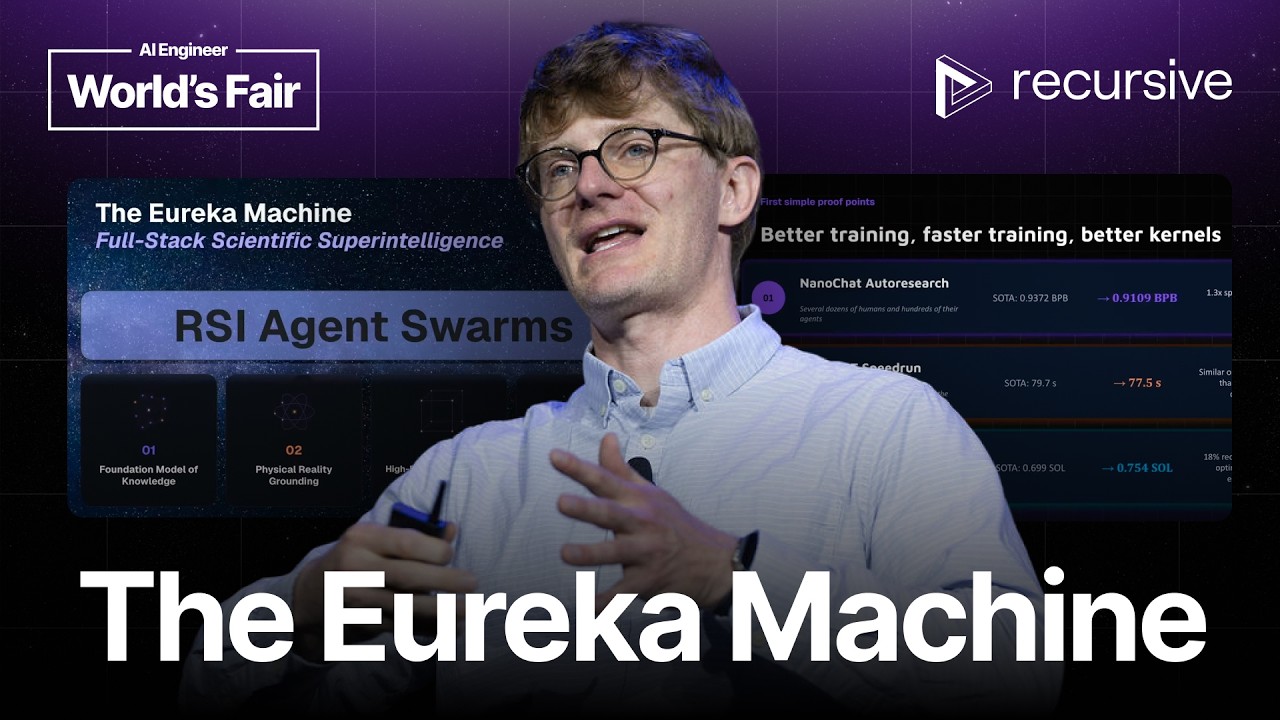
The ultimate goal is to build a machine that automates the entire process of scientific discovery. This requires integrating knowledge (scientific data), simulation, physical experimentation, and an agent swarm to manage all inputs.
-
Evolutionary Analogy for Progress
Scientific progress is viewed as an open-ended evolutionary process. Just as biology evolved over billions of years, technology and AI are expected to undergo rapid, exponential shifts (S-curves) leading to massive human flourishing.
-
The Necessity of RSI
AI progress is accelerating because modern AI can code. The next major step involves building a system with Recursive Self-Improvement (RSI)—an AI that has self-awareness of its shortcomings and autonomously updates its entire architecture, moving beyond manual processes.
Technical details
-
Automated Research Pillars
907s
The Eureka machine requires four pillars: 1) Comprehensive knowledge capture (all existing scientific data); 2) Simulation for unknown variables; 3) Physical industrial labs for real-world experiments; and 4) An agent swarm to coordinate these sources of knowledge, data, and rewards.
-
NanoChat Performance
A proof point demonstrated the system's ability to train a small chat model in under five minutes. It achieved an improvement from 0.93 to 0.91 bits per byte by discovering novel ideas, such as hash bi-grams and tri-gram embeddings.
-
NanoGPT Speed Run
The system significantly improved the speed of a model benchmark, achieving a time reduction of over two seconds at the 70-second mark, demonstrating rapid optimization capability.
-
CUDA Kernel Optimization
The system discovered better CUDA kernels than those listed on Nvidia's benchmark website across various categories. This demonstrated that automated research can find optimal solutions even in highly specialized hardware optimization tasks.
Mentioned resources
- Recursive AI
- you.com
Channel & topics
Watch on YouTube · Back to latest
This independent, AI-assisted summary is provided for commentary and informational purposes. It may contain errors or omit important context. Please watch the original video for the creator's complete presentation. Video, thumbnail, and related copyrights belong to their respective owners.