Topic

AI for Science

All digests tagged AI for Science

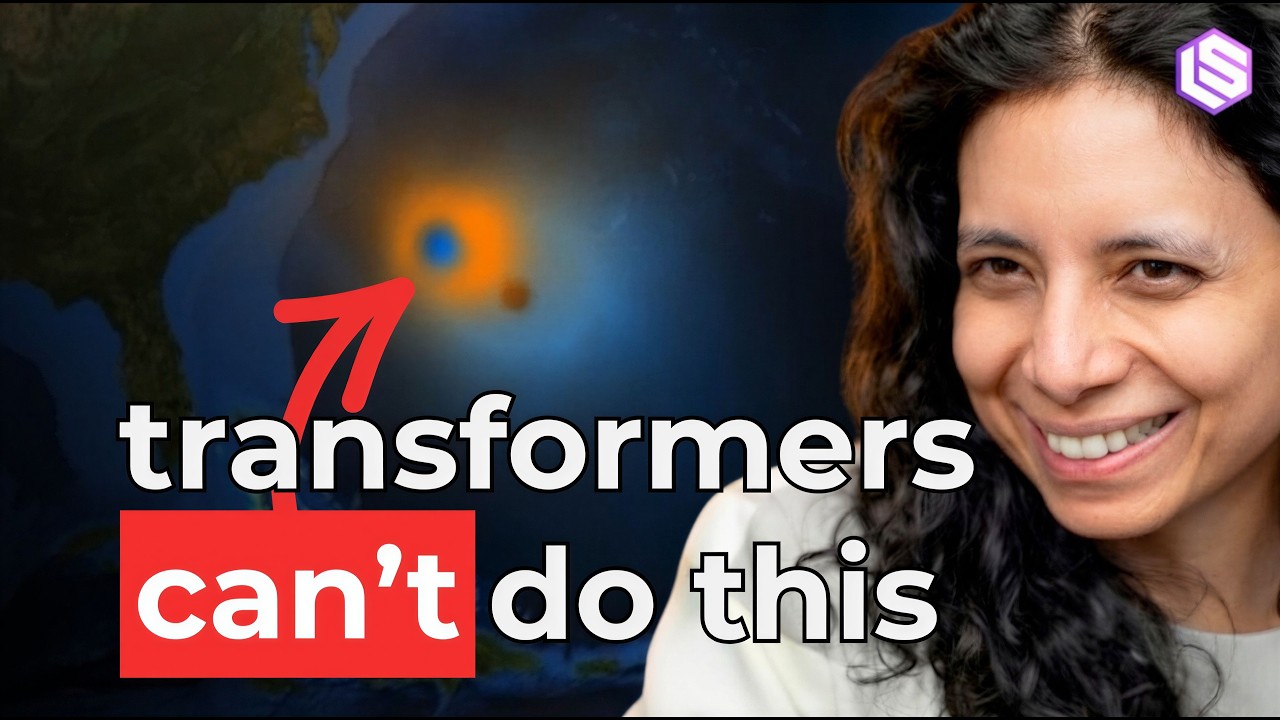
🔬 The Physical World Is More Forgiving Than You Think — Anima Anandkumar, Caltech thumbnail

· 1:23:32

🔬 The Physical World Is More Forgiving Than You Think — Anima Anandkumar, Caltech

Anima Anandkumar discusses the paradigm shift of applying AI to physical science—moving beyond language models to model complex systems like weather and fusion reactors. The core technology is the Neural Operator (NO), which allows for accurate, high-speed simulation of continuous functions across multiple scales. Key advancements include using NOs with spherical geometry (e.g., FourCastNet 3) for long-term climate modeling and applying formal verification frameworks like TorchLean to ensure AI systems are robust in critical control loops.

Key takeaways

  1. AI for Science vs. Language Models 5:29

    The focus of advanced AI should shift from language processing to simulating the physical world (weather, materials, fusion). The challenge is that physical data is limited and requires incorporating fundamental laws into the model structure.

  2. Neural Operators for Weather Modeling 20:03

    Using Neural Operators allowed researchers to create models (like FourCastNet) that are not only accurate but also tens of thousands of times faster than traditional physics-based supercomputer simulations, democratizing complex modeling.

  3. Foundation Models for Physics 25:30

    By incorporating the spherical geometry of Earth and using NOs, models can perform long-term climate simulations (months/years) that fail when assuming a rectangular domain.

  4. Formal Verification with TorchLean 10:44

    TorchLean is an overall framework enabling the formal verification of neural networks themselves. This allows engineers to guarantee properties like certified robustness or bounds on outputs, which is critical for safety-critical control loops (e.g., nuclear reactors).

  5. Fusion Reactor Digital Twins 20:40

    NOs are used to create 'digital twins' of plasma evolution in fusion reactors (like the Tokamak), enabling simulations a million times faster than traditional methods and aiding in designing control systems to prevent disruptive events.
Watch on YouTube Full article

Causal Models Need Causal Data - Xaira’s X-Cell model (Bo Wang & Ci Chu) thumbnail

· 1:29:47

Causal Models Need Causal Data - Xaira’s X-Cell model (Bo Wang & Ci Chu)

Xaira Therapeutics introduced X-Cell, a novel 4.9-billion-parameter diffusion language model designed as a virtual cell foundation model of biology. The model is trained on X-Atlas/Pisces—a massive dataset spanning 25.6 million single cells across 16 biological contexts and generated via the Perturb-seq platform. The core breakthrough lies in shifting from descriptive (observational) data to causal (interventional) data, allowing the model to predict how a cell will respond to genetic perturbations it has never encountered. This capability is crucial for advancing drug discovery by moving beyond trial-and-error methods.

Key takeaways

  1. Causality vs. Correlation in Biology 20:07

    Observational atlases (descriptive data) can describe biology, but they are fundamentally underpowered to learn causality. To predict the outcome of an intervention (e.g., knocking down a gene), causal data—generated through high-throughput perturbation screens—is required.

  2. X-Cell Architecture and Training 1:03:27

    X-Cell utilizes a diffusion language model approach, which treats gene expression prediction as an iterative 'editing' process rather than an autoregressive one. This architecture allows it to generate high-dimensional transcriptomic data by refining noisy representations until they minimize loss against the ground truth.

  3. Data Generation Scale and Engineering 1:16:47

    The model is powered by Perturb-seq, a technique combining high-throughput CRISPR perturbation with single-cell RNA sequencing. This process generates massive 2D datasets (perturbation on one axis, gene expression on the other) across millions of cells while minimizing batch effects.

  4. Generalization and Translational Potential 1:25:07

    X-Cell demonstrated impressive generalization by accurately predicting perturbation responses in active T-cells, even when the model was only trained on resting T-cell data. This suggests the potential to predict novel biology in unseen contexts.

Watch on YouTube Full article

🔬 RL with Verifiable Rewards, but the Verifier is a Lab — Lila Sciences thumbnail

· 1:41:04

🔬 RL with Verifiable Rewards, but the Verifier is a Lab — Lila Sciences

Lila Sciences proposes that the next frontier of data generation—the 'next internet-scale dataset'—will come from running the scientific method as a closed-loop Reinforcement Learning (RL) process. The wet lab acts as the verifier and data source for training general AI models. This approach aims to create an 'infinite token generator' by synthesizing knowledge across biology, chemistry, and materials science into a single reasoning model, which is then offered via a scalable 'zero-FTE startup' platform.

Key takeaways

  1. The Lab as Data Center 20:30

    The future scientific facility must function like a data center, prioritizing dense packing and energy efficiency. The infrastructure uses planar motor systems and a physical transport layer (analogized to a PCI bus) to connect instruments for seamless, automated operation.

  2. Scientific Superintelligence via RL 40:50

    The core thesis is that science can be an 'infinite token generator.' By using the scientific method and nature as verifiers in a closed-loop system, models generate verifiable reasoning tokens (e.g., 10 trillion tokens across multiple domains) that improve general intelligence, proving that 'breadth gives us depth.'

  3. The Zero-FTE Startup Model 1:18:20

    Lila Sciences commercializes its platform by allowing external partners to run entire scientific programs (e.g., CAR-T development or novel material synthesis) over a short period using the model and automated lab infrastructure, without needing to build their own physical facility.

Watch on YouTube Full article