🔬 The Physical World Is More Forgiving Than You Think — Anima Anandkumar, Caltech
Summary
Anima Anandkumar discusses the paradigm shift of applying AI to physical science—moving beyond language models to model complex systems like weather and fusion reactors. The core technology is the Neural Operator (NO), which allows for accurate, high-speed simulation of continuous functions across multiple scales. Key advancements include using NOs with spherical geometry (e.g., FourCastNet 3) for long-term climate modeling and applying formal verification frameworks like TorchLean to ensure AI systems are robust in critical control loops.
Key takeaways
-
AI for Science vs. Language Models
5:29
The focus of advanced AI should shift from language processing to simulating the physical world (weather, materials, fusion). The challenge is that physical data is limited and requires incorporating fundamental laws into the model structure.
-
Neural Operators for Weather Modeling
20:03
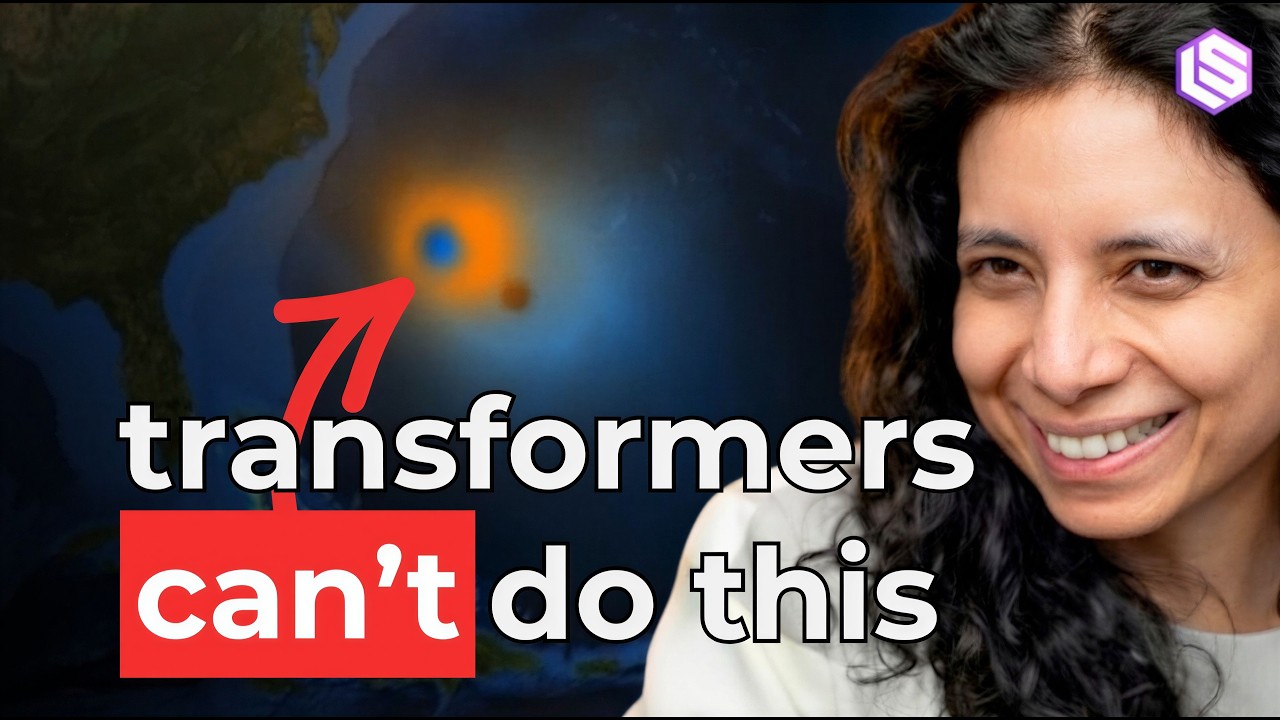
Using Neural Operators allowed researchers to create models (like FourCastNet) that are not only accurate but also tens of thousands of times faster than traditional physics-based supercomputer simulations, democratizing complex modeling.
-
Foundation Models for Physics
25:30
By incorporating the spherical geometry of Earth and using NOs, models can perform long-term climate simulations (months/years) that fail when assuming a rectangular domain.
-
Formal Verification with TorchLean
10:44
TorchLean is an overall framework enabling the formal verification of neural networks themselves. This allows engineers to guarantee properties like certified robustness or bounds on outputs, which is critical for safety-critical control loops (e.g., nuclear reactors).
-
Fusion Reactor Digital Twins
20:40
NOs are used to create 'digital twins' of plasma evolution in fusion reactors (like the Tokamak), enabling simulations a million times faster than traditional methods and aiding in designing control systems to prevent disruptive events.
Technical details
-
Neural Operators (NOs)
1941s
NOs are a generalization of standard neural networks, modeling inputs and outputs as continuous functions. Unlike fixed-resolution CNNs, NOs can handle multiscale data, allowing inference at any resolution by leveraging function space representations.
-
Fourier Neural Operators (FNO)
2108s
FNO utilizes the Fourier domain to capture non-local phenomena efficiently. It strikes a balance between expressivity and computational complexity, offering quasi-linear complexity compared to quadratic complexity in standard transformers.
-
Physics-Informed Modeling
2750s
NOs overcome the limitations of Physics-Informed Neural Networks (PINNs) by combining data-driven learning with physical constraints. Instead of relying solely on solving Partial Differential Equations (PDEs) from scratch, NOs utilize available real-world data and guide the solution using physics laws.
-
TorchLean Framework
644s
This framework allows writing neural networks in a formal language (Lean) for verification. It enables proving properties like certified robustness or bounding the effect of finite precision and perturbations, ensuring reliability in control systems.
Mentioned resources
Channel & topics
Watch on YouTube · Back to latest
This independent, AI-assisted summary is provided for commentary and informational purposes. It may contain errors or omit important context. Please watch the original video for the creator's complete presentation. Video, thumbnail, and related copyrights belong to their respective owners.