Topic

Stanford AI Programs Info

All digests tagged Stanford AI Programs Info

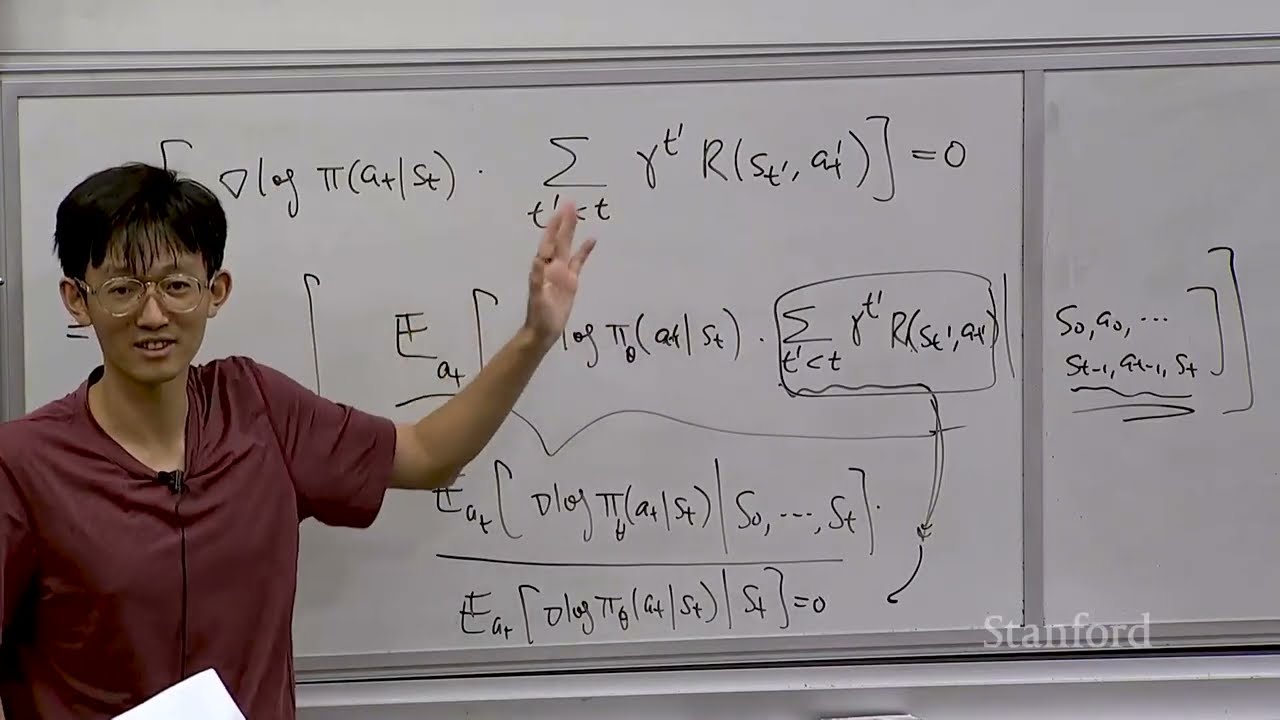
Stanford CS229 Machine Learning | Spring 2026 | Lecture 20: GMM (EM), PCA thumbnail

· 1:18:56

Stanford CS229 Machine Learning | Spring 2026 | Lecture 20: GMM (EM), PCA

This lecture provides an advanced deep dive into training Large Language Models (LLMs) using Reinforcement Learning (RL). It reviews Policy Gradient methods, detailing the mathematical derivations and limitations. The core focus shifts to Proximal Policy Optimization (PPO), a critical algorithm for stabilizing RL updates by utilizing importance sampling ratios and clipping mechanisms. Finally, the lecture applies these concepts to LLM generation, explaining how Chain-of-Thought (CoT) prompting can be formalized as an MDP problem solved via PPO/SISO.

Key takeaways

  1. Policy Gradient Theory 20:40

    The policy gradient estimator is necessary because the dependency on parameters ($ heta$) is complex. The fundamental property that $ abla_{ heta} ext{E}_{ ext{P}_{ heta}}[ abla_{ heta} ext{log } ext{P}_{ heta}(a|s)]$ equals zero shows that without a reward function, there are no preferences to optimize for.

  2. Proximal Policy Optimization (PPO) 26:40

    PPO is designed to stabilize RL training by using importance sampling and clipping the objective function. This prevents the new policy ($ heta$) from deviating too far from the old policy ($ heta_{old}$), which helps maintain stable learning.

  3. LLM Generation as an MDP 1:01:40

    The LLM generation process is modeled as a Markov Decision Process (MDP). The state ($s_t$) includes the history, and the action ($a_t$) is the next generated token. The reward function is typically applied only at the end of the trajectory based on whether the final answer matches the ground truth.

  4. Chain-of-Thought (CoT) Training 1:05:00

    To train models for complex reasoning, RL can be used to reward the entire trajectory based on the final answer's correctness. This approach bypasses the need for explicit labeling of the internal 'thinking tokens,' focusing only on verifiable outcomes.
Watch on YouTube Full article

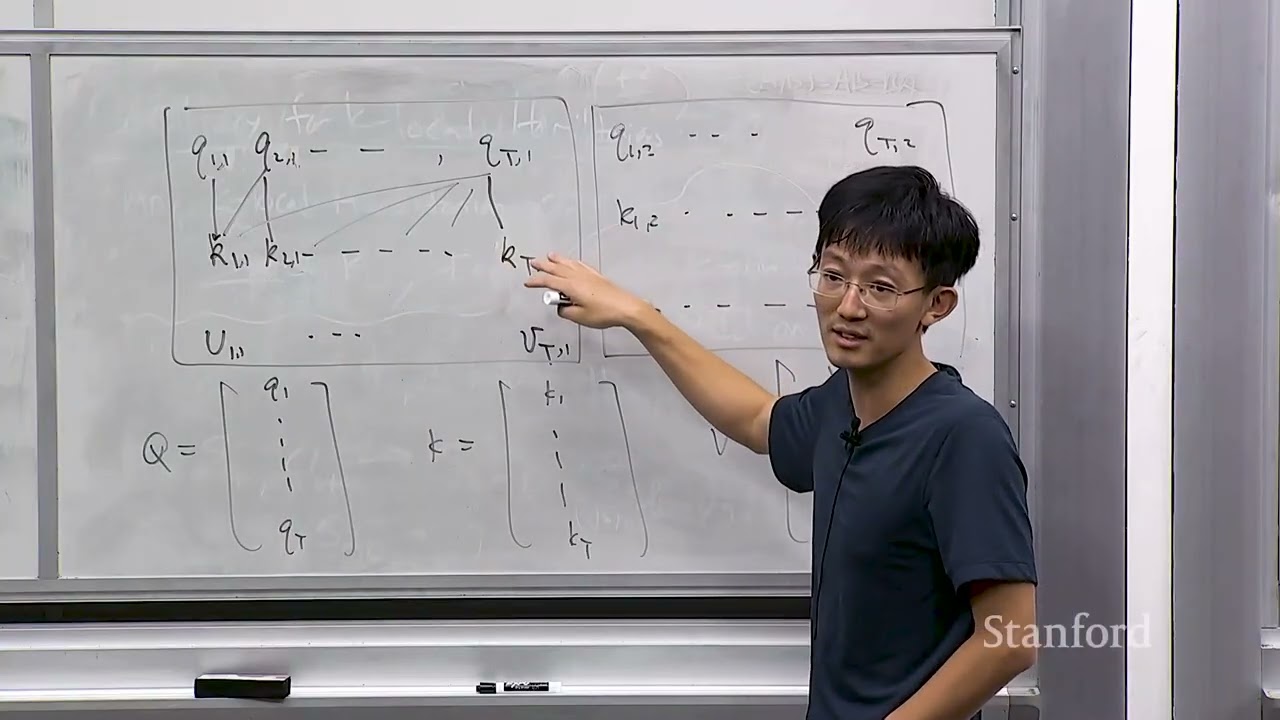
Stanford CS229 Machine Learning | Spring 2026 | Lecture 16: Basic Concept in RL, Policy Gradient thumbnail

· 1:13:19

Stanford CS229 Machine Learning | Spring 2026 | Lecture 16: Basic Concept in RL, Policy Gradient

This lecture provides an advanced deep dive into optimizing Transformer architectures for efficiency and adapting Large Language Models (LLMs) for various downstream tasks. Key focus areas include reducing the quadratic complexity of attention through techniques like Grouped Query Attention (GQA) and Sliding Window Attention; scaling models using Mixture of Experts (MoE) to decouple memory from compute; and exploring prompt-based methods such as In-Context Learning, Few-Shot, and Zero-Shot learning for task adaptation without updating model parameters.

Key takeaways

  1. Efficiency in Attention Mechanisms 20:04

    The standard self-attention mechanism has $O(T^2)$ complexity (where T is sequence length). To mitigate this, techniques like Grouped Query Attention (GQA) reduce the number of keys and values used across heads by mapping multiple query groups to a smaller set of shared keys/values. Similarly, Sliding Window Attention limits attention to only recent history, reducing complexity to $O(T imes W)$ where W is the window size.

  2. Scaling with Mixture of Experts (MoE) 42:28

    MoE allows models to have a large total parameter count (e.g., 30B) while keeping the active computation small (e.g., 3B). This is achieved by using a routing module that directs an input vector to only a subset of specialized expert sub-networks, significantly improving compute efficiency.

  3. LLM Adaptation via Prompting 56:48

    For downstream tasks (e.g., sentiment analysis), models can be adapted using In-Context Learning (ICL). This involves concatenating task examples and the test input into the prompt sequence without updating model parameters, which is fundamentally different from traditional fine-tuning.

  4. Supervised Fine-Tuning (SFT) 1:04:00

    SFT involves collecting data in an instruction/answer pair format and training the model by minimizing the negative log likelihood of predicting the answer ($Y$) given the instruction ($X$). This is a supervised process that updates the model's weights.

Watch on YouTube Full article

Stanford CS229 Machine Learning | Spring 2026 | Lecture 1: Introduction thumbnail

· 36:59

Stanford CS229 Machine Learning | Spring 2026 | Lecture 1: Introduction

This lecture provides a high-level introduction to Machine Learning fundamentals (Supervised, Unsupervised, and Reinforcement Learning) within the context of modern AI. The course emphasizes understanding the mathematical foundations and core techniques behind algorithms rather than focusing on programming implementation. Key topics include model training using large datasets, advanced concepts like embeddings, and the architectural differences between traditional ML tasks and general-purpose Large Language Models (LLMs). A critical focus for system builders is placed on the necessity of optimizing ML systems for hardware compatibility and speed.

Key takeaways

  1. ML Paradigm Shift 6:11

    The field has moved from specific, task-oriented models to general-purpose agents (LLMs). While traditional methods still apply, the focus is on tuning fundamental model capabilities rather than building complex data pipelines for every single use case.

  2. The Importance of ML Systems 33:00

    A planned lecture will cover 'ML system,' which addresses the critical need to make software and hardware compatible. Optimizing algorithms for speed (e.g., making them run 2x faster) is crucial due to the high cost associated with AI computation.

  3. Reinforcement Learning (RL) in LLMs 24:50

    RL can be used to train models dealing with stochastic sampling, such as text generation. Techniques like Policy Gradient and using human feedback (e.g., RLHF/RAG) are necessary because the generation process is not differentiable.

Watch on YouTube Full article