Topic

LLM Deployment

All digests tagged LLM Deployment

40 Trillion Tokens a Day (Yes, More Than OpenAI) | Lin Qiao, CEO of Fireworks thumbnail

· 1:19:05

40 Trillion Tokens a Day (Yes, More Than OpenAI) | Lin Qiao, CEO of Fireworks

The discussion centers on the industry shift from general-purpose AI models (like those from OpenAI/Anthropic) toward specialized intelligence. Lin Qiao of Fireworks argues that true innovation lies in leveraging proprietary, locked-in enterprise data—the 'alpha'—to build customized models. She asserts that this specialization is necessary because generalized models cannot capture a company's unique knowledge or judgment. Technically, the conversation details advanced training methods (SFT, DPO, KTO, RL) and emphasizes platform control, noting that Fireworks achieves bitwise equivalence between training and inference results to ensure maximum quality while optimizing for cost and speed.

Key takeaways

  1. The Rise of Specialized Intelligence 1:08:55

    Lin Qiao argues that the future belongs to specialized intelligence—customized models built on private company data—rather than general-purpose AGI. She believes every company is unique, making it difficult for a single general model to capture proprietary knowledge (41:35).

  2. Fireworks' Scale and Focus 22:16

    Fireworks claims to process over 40 trillion tokens daily, stating that 95% of this traffic comes from customized model inference deployment, not off-the-shelf APIs. This volume surpasses both OpenAI API and Gemini API usage (13:36).

  3. Open vs. Closed Models for Security 1:18:20

    Lin Qiao suggests that open models are better suited to strike a balance in the security debate, encouraging broader community participation to increase defensive complexity against potential cyber threats (47:00).

Watch on YouTube Full article

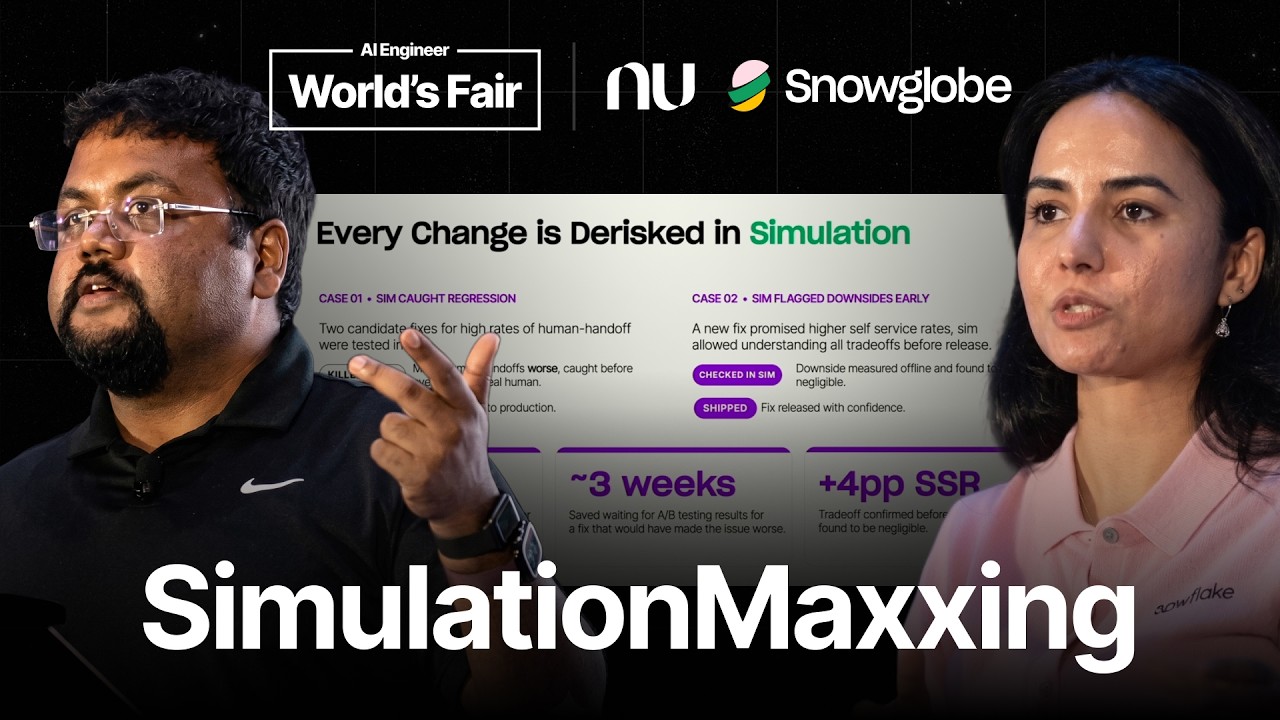
SimulationMaxxing: How Nubank ships agents 20× faster with simulations — Shreya Rajpal, Snowglobe thumbnail

· 16:29

SimulationMaxxing: How Nubank ships agents 20× faster with simulations — Shreya Rajpal, Snowglobe

Nubank achieved a massive acceleration in deploying AI agents—reporting up to 20x faster shipping—by shifting agent evaluation from relying solely on slow, expensive production data or manual curation to using grounded simulations. The core methodology involves running synthetic, multi-turn conversations against the agent within a specialized framework (Snowglobe), allowing teams to rapidly test models and variants in a continuous 'ship, observe, simulate, repeat' loop.

Key takeaways

  1. Simulations Shortcircuit the Eval Bottleneck 10:44

    Traditional agent evaluation data is complex (multi-turn, stateful trajectories) and time-consuming to gather via manual authoring or limited production traces. Simulations allow teams to generate thousands of multi-turn conversations quickly, reducing release cycles from weeks to hours.

  2. The Simulation Loop: Ship, Observe, Simulate

    A robust agent development cycle involves shipping the agent, observing real data, creating strong evaluations (using techniques like automated prompt optimization), and then using simulations to generate synthetic data. This simulated data is piped into the evaluation pipeline for continuous improvement.

  3. Closing the Sim-to-Real Gap

    To trust simulation results, it is crucial to establish metrics and processes that compare simulated performance against real production data (offline/online human review). The correlation between sim quality via evals and real data was found to be high.

Watch on YouTube Full article